
.svg)
.svg)
%201.svg)
%201.svg)
.svg)

.svg)
.svg)
Deepak Malghan

Deepak is an Associate Professor at the Center for Public Policy, Indian Institute for Management, Bangalore. Deepak is primarily recognised for his contributions to reformulating ecological economics from a scale perspective. Malghan’s research is highly interdisciplinary and routinely uses tools from economics, chemical engineering, ecology, normative reasoning, and historical analysis.
.svg)

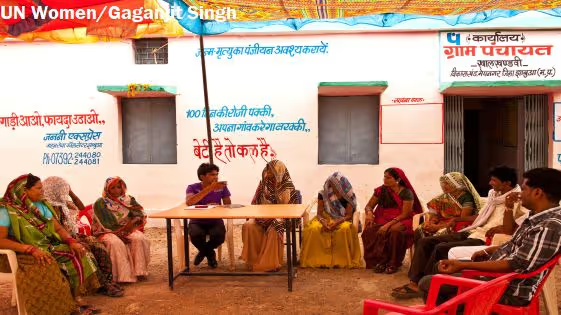
प्रशासनिक प्रसार के जनसांख्यिकीय और विकास परिणाम
भारत में अक्सर मौजूदा जिलों को विभाजित करके नए प्रशासनिक जिलों का निर्माण होता रहा है, जहां पिछले चार दशकों में जिलों की संख्या दोगुनी से अधिक हो गई है। इस लेख में, वर्ष 1991 से 2011 तक के आंकड़ों के मद्देनजर इस विभाजन के आर्थिक परिणामों पर हुए प्रभाव का आकलन किया गया है। यह लेख दर्शाता है कि विभाजन-प्रभावित जिले पहले की तुलना में अधिक समरूप हो गए हैं; यह विभाजन नव-निर्मित जिलों के लिए विशेष रूप से फायदेमंद है, जो विभाजन के पुनर्वितरण लाभों को प्राप्त करते हैं।


Demographic and development outcomes of administrative proliferation
This creation of new administrative districts by splitting existing districts is a frequent occurrence in India, where the number of districts has more than doubled in the last four decades. Looking at data from 1991 to 2011, this article considers the effect of this fragmentation on economic outcomes. It finds that impacted districts tend to be more homogenous than before; the split is especially advantageous for newly created districts, which reap the redistributive benefits of bifurcation.
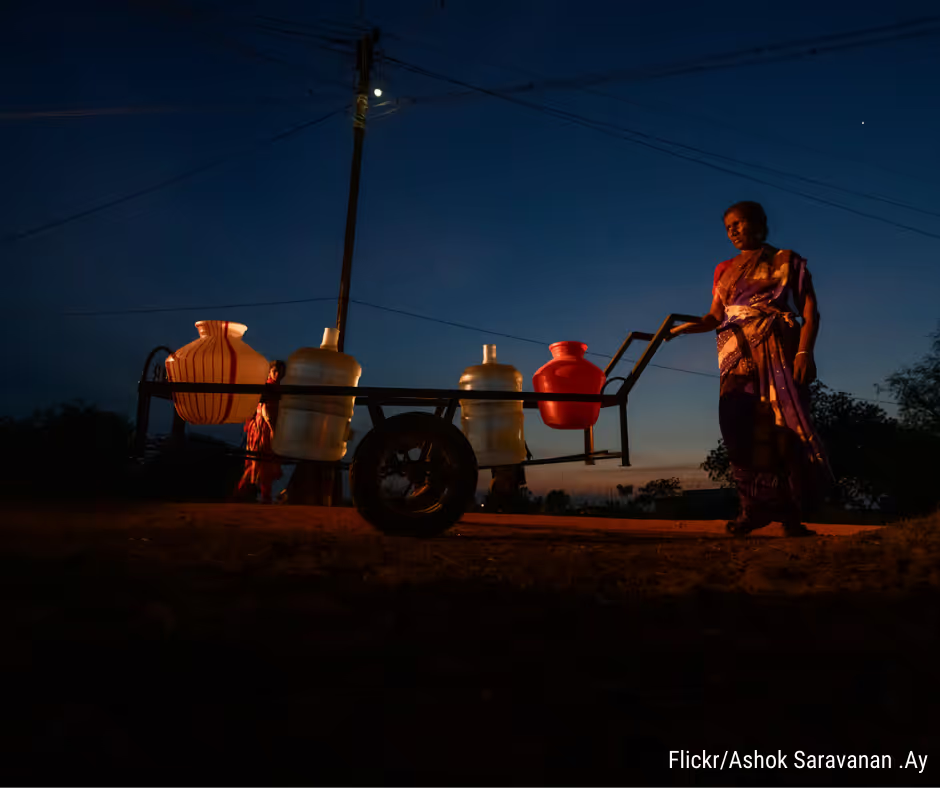
Diversity and public goods: Why the geographical unit of analysis matters
Research has shown that regions with higher caste diversity have lower share of villages with essential public goods. This article challenges this finding and shows that empirical models estimated at higher levels of geographical aggregation mask a considerable amount of variation. Any meaningful statistical relationship between diversity and public goods needs to be sensitive to geographical scale as the nature of local politics plays an important role.

संपन्न शहरी परिवारों में जल संरक्षण को प्रेरित करना
पानी की मांग को कम करना - विशेष रूप से संपन्न, शहरी घरों में - सार्वभौमिक पहुंच सुनिश्चित करने और इसे एक किफायती मूल्य पर बनाए रखने के लिए बढ़ती आपूर्ति के बोझ को कम कर सकता है। बेंगलुरू में किये गए एक क्षेत्र-प्रयोग के आधार पर यह लेख दर्शाता है कि 'आदत-परिवर्तन' के हस्तक्षेप से किसी भी आर्थिक प्रोत्साहन या प्रतिबंधों के बिना घरेलू पानी की खपत में 15-25% की कमी लाई जा सकती है और ये परिणाम हमारे अध्ययन की दो साल की अवलोकन अवधि के लिए बने रहे हैं।

Inducing water conservation in affluent urban households
Reducing the demand for water – particularly in affluent, urban households – can lower the burden of increasing supply to ensure universal access, and sustaining it at an affordable price. Based on a field experiment in Bengaluru, this article shows that ‘habit-change’ interventions can lead to a 15-25% reduction in household water consumption without economic incentives or restrictions and these results persisted for the two-year observation period of the study.
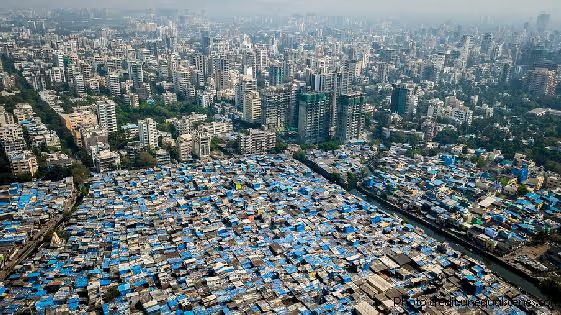
Residential segregation in urban India and persistence of caste
B.R. Ambedkar had exhorted lower-caste people to move towards cities to defy localism and benefit from the virtues of cosmopolitanism that urbanisation might provide. Using 2011 enumeration block-level Census data for five major cities in India – Bengaluru, Chennai, Delhi, Kolkata, and Mumbai – this article finds that not only are Indian cities highly segregated, but population size seems to have no association with the extent of segregation. In fact, the largest cities are some of the most segregated.