
.svg)
.svg)
%201.svg)
%201.svg)
.svg)

.svg)
.svg)
Deepak Kumar

Deepak Kumar heads the Research and Statistics Unit at the ASER Centre, New Delhi.
He holds a Ph.D. in Economics with a specialisation in education from Jawaharlal Nehru University. He is an applied micro-economist, focusing on policy questions related to education and health. Dr Kumar was previously associated with the REAL Centre, Faculty of Education at the University of Cambridge.
.svg)

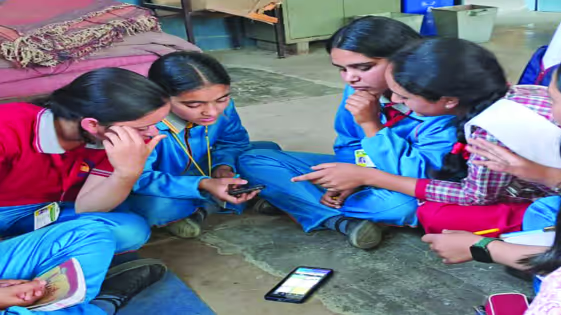
ग्रामीण भारत में युवाओं की डिजिटल तैयारी
भारत में तेज़ी से तकनीकी परिवर्तन हो रहा है, ऐसे में डिजिटल साक्षरता युवाओं की भविष्य की शैक्षिक, आर्थिक और सामाजिक अवसरों की तैयारियों का एक प्रमुख चालक बन गई है। कुमार और भुतडा ने इस लेख में, वार्षिक शिक्षा स्थिति रिपोर्ट (असर- एएसईआर) 2023 और 2024 में प्रस्तुत जानकारी के आधार पर ग्रामीण युवाओं के बीच डिजिटल तैयारी की जाँच की है। हालांकि स्मार्टफोन का अब व्यापक रूप में इस्तेमाल हो रहा है, तब भी डिजिटल कौशल और तेज़ी से प्रौद्योगिकी-संचालित दुनिया के अनुकूल होने की तैयारी में महत्वपूर्ण अंतर बना हुआ है।


Youth’s digital readiness in rural India
As India undergoes rapid technological transformation, digital literacy has become a key driver of youth’s preparedness for future educational, economic, and social opportunities. In this note, Kumar and Bhutada examine digital readiness among rural youth, based on insights offered by the Annual Status of Education Report (ASER) 2023 and 2024. While there is widespread smartphone access, significant gaps remain in digital skills and readiness to adapt to an increasingly technology-driven world.
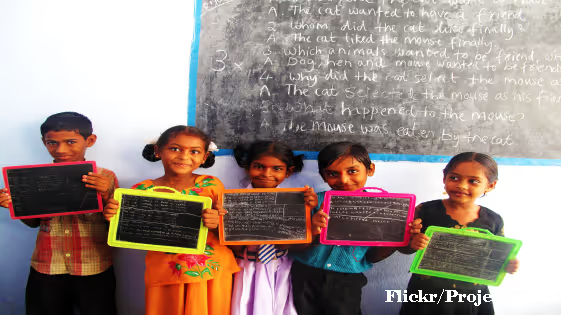
माता-पिता एवं शिक्षक के बीच सहयोग के माध्यम से आधारभूत शिक्षा को बढ़ावा देना
प्राथमिक विद्यालयों में नामांकन में प्रगति होने के बावजूद, ग्रामीण भारत में 50% से अधिक विद्यार्थी मूल साक्षरता हासिल करने में असफल रहते हैं, जबकि 5वीं कक्षा के अंत तक 44% विद्यार्थियों में अंकगणित कौशल का अभाव होता है। ग्रामीण उत्तर प्रदेश में किए गए एक यादृच्छिक प्रयोग के आधार पर, इस लेख में पाया गया है कि माता-पिता और शिक्षकों के बीच सहयोगात्मक तथा भागीदारीपूर्ण दृष्टिकोण के माध्यम से सामुदायिक भागीदारी से स्कूलों में जवाबदेही बढ़ती है, और बच्चों की बुनियादी शिक्षा में उल्लेखनीय सुधार होता है।
Enhancing foundational learning through parent-teacher collaboration
Despite advancements in primary school enrolment, over 50% of pupils in rural India fail to achieve core literacy, while 44% lack numeracy skills at the end of grade 5. Based on a randomised experiment in rural Uttar Pradesh this article finds that community participation, facilitated through a collaborative and participatory approach between parents and teachers, enhances accountability in schools, and significantly improves children’s foundational learning.