
.svg)
.svg)
%201.svg)
%201.svg)
.svg)

.svg)
.svg)
Deepti Goel
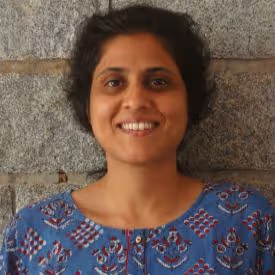
Deepti Goel is a faculty member at the School of Arts and Sciences, Azim Premji University, Bengaluru, India. She is also a research fellow at IZA-Institute of Labor Economics, and at Global Labor Organization (GLO). Her main areas of research are applied empirical econometrics and labor economics. Some of her recent and ongoing research projects include estimating labour supply, cohort analysis in labour markets, health effects of pollution, measuring teacher quality and perceptions of minority groups. She received her Ph.D. in economics in 2009 from Boston University.
.svg)


Identifying an effective teacher in public schools in Delhi
While there is near universal school enrolment among 6-14 year olds in India, learning levels are abysmally low. In this context, this project looks at senior secondary government schools in Delhi to understand what factors determine a student’s performance in exams. A primary focus is to understand the role of teachers and to identify the traits that make an effective teacher.



The decline of rural earning inequality in India
While earnings inequality remained virtually unchanged in urban India between 2004-05 and 2011-12, it declined sharply in rural India over this period. This column finds that although the change in the distribution of education among paid workers had an inequality-increasing effect, there was a net decline in rural inequality because returns to increased levels of education improved more for low-earning workers than high-earning ones.

Did the metro help reduce air pollution in Delhi?
The Delhi metro has been operational for over a decade now. Has it helped reduce the high levels of air pollution? This column presents initial findings from research that suggests that the metro has encouraged people to switch from private to public mode of travel, resulting in positive effects on air quality in the city.
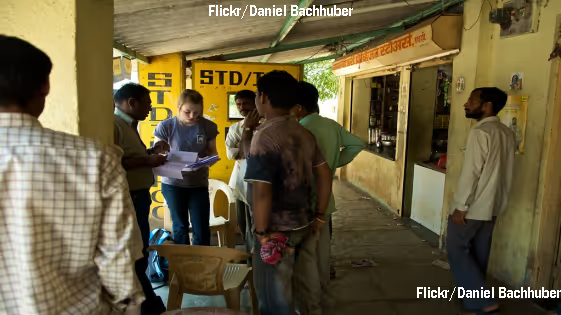
Improving survey quality using paradata: Lessons from the India Working Survey
To improve the credibility of survey data, several monitoring tools are used by researchers – such as ‘paradata’, which have gained prominence with the growth of computer-aided interviewing. In this post, Goel et al. discuss how paradata were used in the ‘India Working Survey’ conducted in the states of Karnataka and Rajasthan in 2020, to streamline enumerator practices and enhance data quality.