
.svg)
.svg)
%201.svg)
%201.svg)
.svg)

.svg)
.svg)
Diane Coffey

Diane is a demographer who studies health, nutrition, sanitation, and social inequality in India. She is an assistant professor of Sociology & Population Research at the University of Texas at Austin, a visiting researcher at the Indian Statistical Institute, Delhi, and she co-directs a research non-profit called r.i.c.e., a research institute for compassionate economics, which aims to inform policies relating to child health in India.
.svg)


Short-term migration and child welfare
While much has been said about the poor working and living conditions of short-term migrants, relatively little is known of the impact of short-term migration on child welfare. This column finds that although short-term migration does not lead to child labour, children of migrants have poorer educational outcomes.


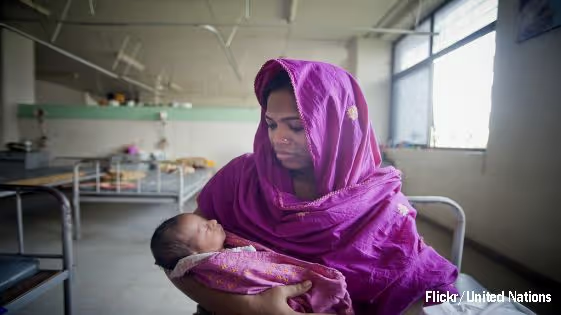
बजट 2021-22: स्वास्थ्य को प्राथमिकता, एक बार फिर से
वर्ष 2021-22 के केंद्रीय बजट का आकलन स्वास्थ्य क्षेत्र के नजरिए से करते हुए, कॉफी और स्पीयर्स यह तर्क देते हैं कि भारत के स्वास्थ्य परिणामों को बेहतर बनाने के लिए पुरानी समस्याओं को पुराने तरीको से हल करने की आवश्यकता है और ‘नए’ बजट में ऐसे किसी हल को ढूंढ पाना कठिन है। विशेष रूप से, वे अगले बजट में मातृ और नवजात शिशु सबंधी स्वास्थ्य कार्यक्रमों के लिए आवंटन बढ़ाने का पक्ष लेते हैं।
Budget 2021-22: Healthcare takes centre stage, again
Assessing the 2021-22 Union Budget from a health-sector perspective, Coffey and Spears contend that improving India’s health outcomes will require old solutions to old problems – and this sort of thing is hard to find in a ‘new’ budget. In particular, they advocate for increased allocation for maternal and newborn health programmes in the next budget.

What can we learn about Swachh Bharat Mission from NFHS-5 factsheets?
Swachh Bharat Mission was introduced by Government of India in 2014 to eliminate open defecation. Based on data from the National Family and Health Survey (NFHS)-5 factsheets, this article shows that the sanitation situation has broadly remained the same between NFHS-4 in 2014 and NFHS-5 in 2019. Half of the rural population in the states of Uttar Pradesh, Madhya Pradesh, Bihar, and Rajasthan, continue to defecate in the open.

Using phone surveys to measure mental health
The public health and humanitarian crises caused by Covid-19 have led to greater recognition of the issue of poor mental health. Although mental health can affect work and quality of life much like physical health, it remains under-researched. In this article, Coffey et al. show that mobile phone surveys can be a valuable medium for incorporating mental health measurement into population-level health surveys.
भारत में बच्चों की लंबाई: नए आंकड़े, परिचित चुनौतियां
भारत के बच्चे दुनिया के सबसे नाटे बच्चों में आते हैं। देश में बच्चों की लंबाई संबंधी जटिलता और विविधता की जांच के लिए इस आलेख में राष्ट्रीय पारिवारिक स्वास्थ्य सर्वेक्षण-4 (एनएफएचएस-4) के आंकड़ों का उपयोग किया गया है। इसमें पाया गया है कि भारत में बच्चों के हाइट-फॉर-एज (उम्र की तुलना में लंबाई) के मामले में 2005-06 और 2015-16 के बीच सुधार हुआ है। हालांकि यह महत्वपूर्ण बात है परन्तु भारत में कुल मिलाकर कम लंबाई और भारत की आर्थिक प्रगति को देखते हुए यह वृद्धि बहुत कम है।
Child height in India: New data, familiar challenges
Children in India are among the shortest in the world. This article uses the National Family Health Survey (NFHS-4) data to examine the complexity and diversity of child height in the country. It finds that India's overall average child height-for-age improved between 2005-06 and 2015-16. Although important, this increase is small relative to India’s overall height deficit and its economic progress.
Despite improvements in child health, why do so many newborns still die?
The ‘Million Death Study’ shows that the death rate of under-five children in India dropped from about 90 per 1,000 to about 47 during 2000-2015. However, improvements in death rates in the first month of life have been slow, and deaths from low birthweight remained largely unchanged. In this article, Diane Coffey elaborates on these findings and recommends stronger efforts to understand and improve the health of pregnant women.
Why doesn’t anybody know if Swachh Bharat Mission is succeeding?
In 2014, the Prime Minister announced a goal of eliminating open defecation by 2019. In this article, Coffey and Spears, contend that now almost two-thirds of the way through the Swachh Bharat Mission, nobody knows whether it is succeeding because there is no credible, independent survey that can offer a useful estimate of the fraction of rural persons defecating in the open.
Maternity entitlements for healthier babies
The National Food Security Act, 2013 provides for a maternity benefit of not less than Rs. 6,000 for every pregnant and lactating mother in India. In this article, Coffey and Hathi explain why maternity entitlements are a good investment, and discuss how they should be designed to have the biggest impact on the health and productivity of the next generation.
Is maternal health in India worse than we thought?
Since India does not have a national system to monitor health during pregnancy, the fraction of women of child-bearing age who are underweight - 35.5% - is used as a proxy for the fraction of pre-pregnant women who are underweight. This column presents new research that finds that the actual proportion of pre-pregnant women who are underweight is 7 percentage points higher than this figure.

Culture, religion and open defecation in rural north India
Open defecation in rural India is a human development emergency that is causing infant deaths, child stunting, and widespread infectious diseases. This column presents surprising qualitative and quantitative research about why so many people in rural India defecate in the open, even when latrines are available.

Angus Deaton's ideas for India
In a tribute to Angus Deaton, the 2015 Nobel laureate in Economics, Diane Coffey and Dean Spears – former graduate students of Prof. Deaton at Princeton University – review some of his work on the well-being of the poor in India, and discuss the paradoxes and puzzles that still remain.
Switching to sanitation in South Asia: A study of health technology adoption (a seed study)
Open defecation in rural India presents a puzzle: India has far higher open defecation rates than other developing regions where people are poorer, literacy rates are lower, and water is more scarce.
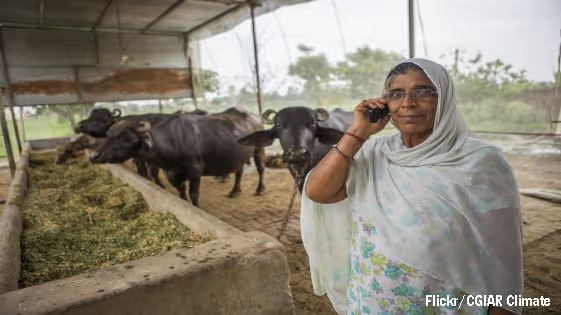
भारत में सामाजिक और आर्थिक अनुसंधान के लिए फोन सर्वेक्षण पद्धति
कोविड-19 के प्रसार को रोकने हेतु लगाई गई पाबंदियों और सामाजिक दूरी के दिशानिर्देशों के मद्देनजर फेस-टू-फेस सर्वेक्षणों के माध्यम से डेटा संग्रह करने में बड़ी बाधाओं का सामना करना पड़ा है। इस पोस्ट में कॉफ़ी एवं अन्य ने उनके द्वारा सामाजिक नज़रिया, भेदभाव, और सार्वजनिक राय पर वर्ष 2016 के बाद भारत के सात राज्यों एवं शहरों में किए गए मोबाइल फोन सर्वेक्षण करने के अपने अनुभव को साझा किया है।
Phone survey methodology for social and economic research in India
Data collection using face-to-face surveys has faced a roadblock in the wake of restricted mobility and social distancing guidelines to contain the spread of Covid-19. In this post, Coffey et al. describe their experience of conducting a mobile phone survey about social attitudes, discrimination, and public opinion, which has been carried out in seven states and cities in India since 2016.