
.svg)
.svg)
%201.svg)
%201.svg)
.svg)

.svg)
.svg)
E. Somanathan
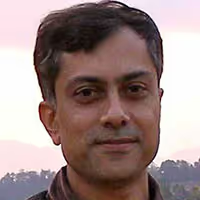
E. Somanathan received his Ph.D. in economics from Harvard in 1995 and taught at Emory University and the University of Michigan at Ann Arbor before joining the Indian Statistical Institute, Delhi where he is a Professor in the Planning Unit. His current research is in environmental and development economics. Ongoing research projects include the impact of global warming and aerosols on Indian agriculture and the distribution of income, and game-theoretic modeling of climate policies. Recent publications include Effects of Information on Environmental Quality in Developing Countries, (2010) Review of Environmental Economics and Policy, 4(2): 275-292, and “Decentralization for cost-effective conservation” (2009) with R. Prabhakar and B.S. Mehta, Proceedings of the National Academy of Sciences, 106(11): 4143-4147. He is a Co-ordinating Lead Author for Working Group III of the Fifth Assessment Report of the Intergovernmental Panel on Climate Change.
.svg)

Covid-19: Escaping the economic dangers
As long as the spread of Covid-19 is not controlled in India, there is a threat of new complete or partial lockdowns in response. In this post, E. Somanathan contends that any further lockdown risks incurring a loss of over 10% of GDP without stemming the spread of Covid-19. The ideal strategy is to find and isolate the small fraction of infected people through incentivised testing, while allowing business as usual to resume.



Exploratory research on the impact of the Forest Rights Act, 2006, on deforestation, tribal welfare, and poverty, with implications for implementation strategies.
When the United Progressive Alliance came to power in the Indian general elections of May 2004, it published a Common Minimum Programme in which it promised to end the eviction of tribal and other forest-dwelling people from forest lands.
Economics and the environment
Published in February 2021 by the UK government, the ‘Dasgupta Review’ calls for changes in how we think, act and measure economic success to protect and enhance our prosperity and the natural world. Against the backdrop of the Review, in the fourth edition of I4I Conversations, E. Somanathan speaks with Partha Dasgupta, tracing the origins of his interest in environmental economics – a consistent theme of his academic work that spans several fields of economics – and how his thinking on the issue has evolved over the years. They foray into economic theorising of the ecology’s imprint on collective behaviours; fusing micro and macro perspectives on the embeddedness of the economy in nature; the complexities of accounting for natural wealth in economic terms and enhancing this wealth via small institutional changes; how average yields of primary producers such as algae are much higher than of virtually any other investment; how the millions of small errors we are making are adding up t
Economics and the environment
Published in February 2021 by the UK government, the ‘Dasgupta Review’ calls for changes in how we think, act and measure economic success to protect and enhance our prosperity and the natural world. Against the backdrop of the Review, in the fourth edition of I4I Conversations, E. Somanathan speaks with Partha Dasgupta, tracing the origins of his interest in environmental economics – a consistent theme of his academic work that spans several fields of economics – and how his thinking on the issue has evolved over the years. They foray into economic theorising of the ecology’s imprint on collective behaviours; fusing micro and macro perspectives on the embeddedness of the economy in nature; the complexities of accounting for natural wealth in economic terms and enhancing this wealth via small institutional changes; how average yields of primary producers such as algae are much higher than of virtually any other investment; how the millions of small errors we are making are adding up

The simple economics of clean air
One of the main reasons why north-western India chokes on smog every November is the burning of residue from the rice crop by farmers. In this article, Somanathan and Gupta contend that public auctions to sell machines that weed out crop residue at a subsidised rate could help stop stubble burning. It will cost the agriculture ministry a fraction of its annual budget.

Happy Seeder: A solution to agricultural fires in north India
It is believed that much of the pollution in Delhi in November every year originates in the neighbouring states of Punjab and Haryana where farmers burn their fields to dispose of crop residue. This column discusses a simple, practical and cost-effective solution to deal with the problem.
Coal and the climate change debate
In the run-up to the Paris Climate Summit, there has been a growing call among advanced nations to phase out fossil fuels. In this article, Arvind Subramanian, Chief Economic Adviser, Government of India, argues that shunning coal is not viable for India. Instead, the world should come together to find effective techniques to ‘clean and green’ coal.
Pricey diesel
India was recently ranked 174th out of 178 countries, on air pollution. A key contributing factor is diesel vehicles. This column shows that diesel subsidies benefit the rich more than the poor, and emphasises the need to change current regulation to enforce fuel improvement measures. Although such policies seem expensive, the positive effects on sickness, health expenditures and productivity would outweigh the costs.

A tribute to Marty Weitzman
Prof. Martin Weitzman who was among the most influential economists in the world passed away on 27 August 2019. His work on the uncertainty about how bad the impacts of a changed climate could be has made a huge difference to how economists think about climate change. In this post, Prof. E. Somanthan of the Indian Statistical Institute, Delhi Centre pays a tribute to him.