
.svg)
.svg)
%201.svg)
%201.svg)
.svg)

.svg)
.svg)
Edward Glaeser
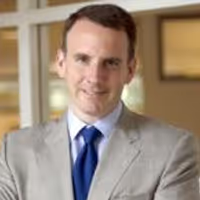
Edward Glaeser is the Fred and Eleanor Glimp Professor of Economics in the Faculty of Arts and Sciences at Harvard University, where he has taught since 1992. He is Director of the A. Alfred Taubman Center for State and Local Government and Director of the Rappaport Institute of Greater Boston. He teaches urban and social economics and microeconomic theory. He has published dozens of papers on cities, economic growth, and law and economics. In particular, his work has focussed on the determinants of city growth and the role of cities as centres of idea transmission. He also edits The Quarterly Journal of Economics. He received his Ph.D. from the University of Chicago in 1992.
.svg)


Fundamental errors in the voting booth margins
Psychologists have long documented that we over-attribute people's actions to innate characteristics rather than to circumstances. This column shows that when we commit this ‘fundamental attribution error’ as voters; we over-ascribe politicians’ success to personal characteristics that merit re-election. Although this mistake can improve politicians’ incentives in ordinary times, the theory also explains lack of institutional reform and poor institutional choices, such as decreased demand for a free press and preferences for dictatorship.


