
.svg)
.svg)
%201.svg)
%201.svg)
.svg)

.svg)
.svg)
Ejaz Ghani
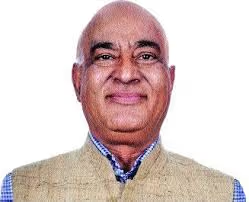
Ejaz Ghani is currently Senior Fellow at the Pune International Centre. He was previously Lead Economist at the World Bank and has worked on Africa, East Asia, South Asia, Corporate Strategy, and Independent Evaluation Unit. He writes economic opinion columns for Business Standard, Hindu, Financial Express, Mint, VoxEU, and Project Syndicate, and is an agenda contributor for the World Economic Forum.
He has edited several books including India's Pathways to Success: Winning in the next decade Rupa Publications India 2023 (with Ganesh Natarajan); Reshaping Tomorrow--Is South Asia Ready for the Big Leap? Oxford University Press 2011; The Poor Half Billion in South Asia, Oxford University Press 2010 The Service Revolution in South Asia, Oxford University Press 2010; Accelerating Growth and Job Creation in South Asia (with S. Ahmed) 2009, Promoting Economic Cooperation in South Asia (with S. Ahmed and S. Kelegama), 2009; and Growth and Regional Integration (with S. Ahmed) Macmillan 2007.
Prior to joining The World Bank, he taught economics at St. Anne's College (Oxford University) and Shri Ram College of Commerce (Delhi University). He obtained an M.Phil. & D.Phil. in Economics from Oxford University. He did his schooling in Bihar; Bachelors at St. Stephen's College; and Masters at Jawaharlal Nehru University, India. He is an Inlaks scholar.
.svg)


Rise of informality in India's tradable manufacturing sector
The vast informal sector in India affects everything from poverty to growth. This column presents new facts on how Indian job growth in manufacturing is concentrated in informal tradable industries, especially one-person establishments. These features are most closely linked to the urbanisation of informal Indian manufacturing, but subcontracting and rising female participation also appear to play noteworthy roles.


Can services be a growth escalator in low-income countries?
Just like the East Asian Tigers, the Lions of Africa are now growing much faster than the developed economies. However, this column shows that the growth escalators in Africa are different than in East Asia. The East Asian Tigers benefitted from a rapidly expanding manufacturing sector. The African Lions are benefitting from increases in productivity in the service sector, while the agricultural sector remains unproductive.
Who creates jobs?
With millions of young people entering the labour market each year, the big question is whether there will be enough jobs for them. But who actually creates these jobs? This column looks at data from India suggesting that young and small firms play a vital role. Policymakers just need to support them.
The Golden Quadrilateral: Highway to success
The Golden Quadrilateral, which connects four major cities in India, is the fifth-longest highway in the world. This column presents research that finds that by improving connectivity, the highway has helped with the efficient distribution of industries across locations. It has facilitated the shift of land and building intensive industries from the core to peripheries of cities, and has made medium-sized cities more attractive locations for manufacturing activity.
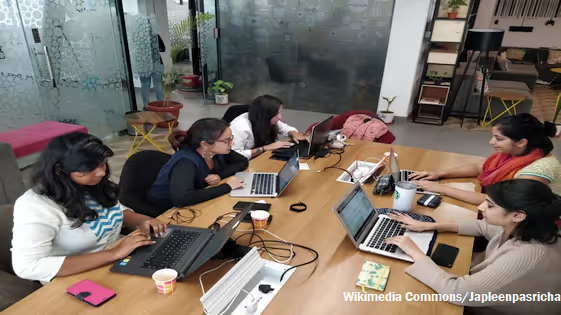
भारत में उद्यमिता और रोज़गार में लैंगिक असमानताओं का आकलन
आर्थिक विकास सम्पूर्ण कार्यबल के सफल उपयोग पर निर्भर करता है। एजाज़ ग़नी का तर्क है कि लैंगिक समानता न केवल मानवाधिकारों का एक प्रमुख स्तम्भ है, बल्कि उच्च और अधिक समावेशी आर्थिक विकास को बनाए रखने का एक शक्तिशाली साधन हो सकता है। उनके अनुसार भारत की आर्थिक प्रगति के बावजूद, आर्थिक भागीदारी के मामले में भारत में लैंगिक संतुलन दुनिया में सबसे कम है और वे इस शोध आलेख में इन असमानताओं को उजागर करने वाले विनिर्माण और सेवा क्षेत्र के कुछ आँकड़े साझा करते हैं।
Assessing gender disparities in entrepreneurship and employment in India
Economic growth depends on successful utilisation of the entire workforce. Ejaz Ghani argues that gender equality is not only a key pillar of human rights, but could be a powerful tool for sustaining higher and more inclusive economic growth. He notes that despite the economic advances that India has made, its gender balance in economic participation remains among the lowest in the world, and shares some statistics from the manufacturing and services sector which highlight these disparities.
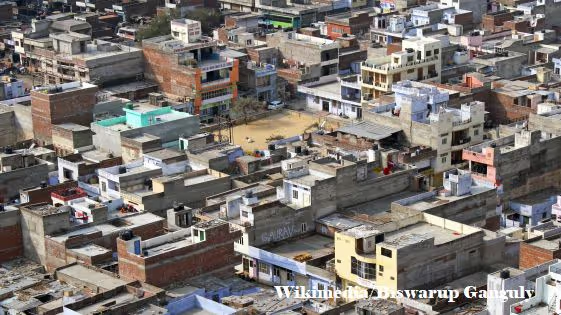
Reshaping social protection in India
As India has undergone a transformation in recent decades in terms of trends such as poverty reduction, food security and urbanisation, there is a need to also revamp the traditional social protection architecture. In this post, Ejaz Ghani proposes a four-pillar approach involving a focus on informally employed urban poor, incorporating gender differences in risks, streamlining existing schemes, and engaging the private sector
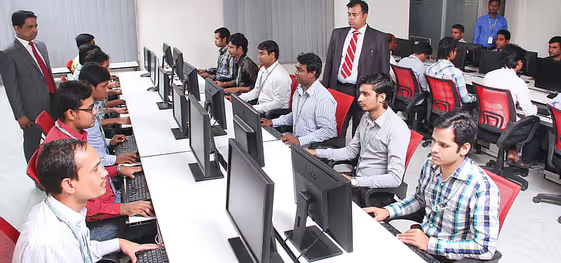
क्या रोज़गार के सृजन से भारत में गरीबी कम हो सकती है?
भारतीय अर्थव्यवस्था में जब लगातार वृद्धि हो रही है, इस बात पर आम सहमति बनी है कि गरीबी को कम करने के लिए अधिक से अधिक नौकरियों का सृजन किया जाना महत्वपूर्ण है। एजाज़ ग़नी उन रुझानों को साझा करते हैं जो दर्शाते हैं कि शहरों और छोटी तथा हाल ही में बनी कम्पनियों द्वारा रोज़गार का सृजन किया जा रहा है, फिर भी अपर्याप्त बुनियादी ढाँचे और विकृत कारकों वाले बाज़ारों के चलते भारत में उद्यमशीलता की वृद्धि धीमी हो गई है। वे यह दर्शाते हैं कि रोज़गार सृजन और गरीबी को कम करने का मार्ग बड़ी कम्पनियों के पीछे चलने में नहीं, बल्कि शिक्षा और बुनियादी ढाँचे में स्थानीय निवेश को बढ़ाने में है।
Could job creation be a driver of poverty reduction in India?
While the Indian economy continues to grow, there is a consensus that creating more jobs is vital to reduce poverty. Ejaz Ghani shares trends which suggest that job creation is being driven by cities and small and young firms, but entrepreneurial growth in India has slowed down due to inadequate infrastructure and distorted factor markets. He suggests that the path to job creation and poverty reduction is scaling up local investments in education and infrastructure, and not chasing large firms.

The implications of India’s spatial development
Mahatma Gandhi once said, “poverty is the worst form of violence”. In this piece, Ejaz Ghani highlights India’s poverty burden, its regional disparities and convergence thereof. He highlights how the growth process, as well as government transfers, currently benefit leading over lagging regions. He discusses how growth doesn't necessarily reduce poverty, and encourages policymakers to not wait to adopt direct interventions. He concludes with crucial policy suggestions around decentralization, labour mobility, and investments in agriculture to enable lagging regions.

Boosting shared prosperity in South Asia
Two-thirds of the poor in India and other South Asian countries live in the lagging regions. This column examines whether there are poverty traps that make it difficult to achieve shared prosperity, and if the current fiscal decentralisation arrangements in South Asia are working to the benefit of the poor regions. It highlights the need for shifting the locus of policy from the national to sub-national level, and from leading to lagging regions.
South Asia's bottom half billion
South Asia has more people in extreme poverty than Sub-Saharan Africa. This column asks why such conditions continue in the second fastest growing region in the world. It argues that growth is extremely important and necessary but not sufficient for reducing poverty – policymakers need to combine it with social policies that will provide better education, healthcare, and bring about social change
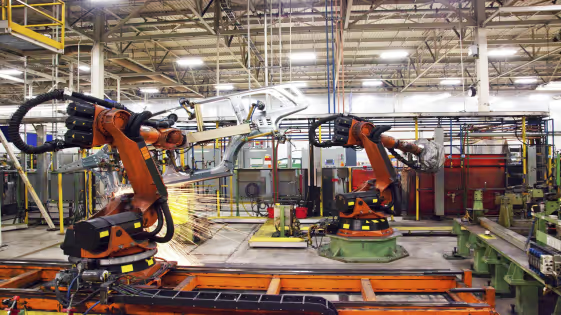
How can India become a manufacturing powerhouse?
India’s manufacturing sector has been stagnant over the past 20 years, in terms of contribution to national output as well as employment generation. In this article, Ejaz Ghani locates the explanation in the diverging paths of industrialisation and urbanisation, market distortions pertaining to land and finance, excessive focus on large enterprises rather than smaller, informal ones, and the misconception that services growth is crowding-out manufacturing.

Financing India’s green structural transformation
While India has launched an ambitious green structural transformation programme – with some initial successes to its credit – it is still nascent and there is a need to mobilise more resources. In this post, Ejaz Ghani outlines how global risk pooling, fiscal reforms, public-private partnerships and innovative financial instruments can help finance green growth – thereby enabling India to achieve both poverty reduction and climate risk mitigation.

Balancing economic development and climate goals
Although India is on track to meet its target under the Paris Climate Agreement, the fast pace of urbanisation could worsen the problem of climate change. In this post, Ejaz Ghani outlines the policy instruments available to promote green growth in the cities and enhance energy efficiency, and contends that there can be huge payoffs from linking urbanisation with climate change

India's energy efficiency
India is the fourth largest energy consumer in the world but is not well endowed with energy resources, making efficiency in energy use very important. This column analyses the spatial dynamics of electricity usage in India’s manufacturing sector. Such an understanding can help in defining a more focused and targeted energy policy.

Growing through cities in India
Do cities grow through specialisation or diversity? This column measures specialisation and diversity for the manufacturing and services sectors in India. It finds that Indian districts with a broader set of industries exhibit greater employment growth. This is particularly true for low population densities, rural areas and unorganised sector, reflecting knowledge flow and the inclusive nature of employment growth due to diversity.
What makes cities more competitive in India?
Policymakers in both developed and developing countries want to make cities more competitive, attract new entrepreneurs, boost economic growth, and promote job creation. This column shows that the two most consistent factors that bring entrepreneurs in manufacturing and services to a district in India are its education and quality of local physical infrastructure.
India's spatial disparities: Have big cities become too congested?
A key driver of the Indian economy is its rapidly growing service sector. This column compares the spatial growth pattern of the sector in India and other countries. It is found that while in US and Europe, the service sector is becoming increasing concentrated in medium-sized locations, high-density locations in India such as Mumbai and Chennai continue to attract more service sector jobs, causing congestion.
Is India's manufacturing sector moving out of cities?
While urbanisation is moving ahead at a rapid pace in India, industrialisation has slowed down. What explains this disconnect between urbanisation and infrastructure? This column presents results of a study that suggests that the formal manufacturing sector is moving from urban to rural locations, and the informal sector is moving from rural to urban locations.
Land and financial misallocation in India
Optimising the allocation of factors of production – land, capital and labour - improves productivity. In India, where evidence suggests land is severely misallocated to inefficient manufacturing firms, access to financing is disproportionately tied to access to land. This column examines the link between the misallocation of land and access to capital through financial markets. A very strong positive correlation emerges between the two, consistent with the fact that land and buildings can provide strong collateral support for accessing finance from the credit market.