
.svg)
.svg)
%201.svg)
%201.svg)
.svg)

.svg)
.svg)
Esther Gehrke

Esther Gehrke is Assistant Professor of Economics at Wageningen University and Research. She is an applied microeconomist with interests in development, education, agriculture, and demography. Her current research projects largely focus on human capital investment decisions – of parents who are confronted with uncertainty about whether their children might have to drop-out of school early in rural areas of India, of adolescents in Cambodia who lack guidance about possible career paths, and of students in Mexico who are confronted with worsening immigration prospects to the US.
.svg)

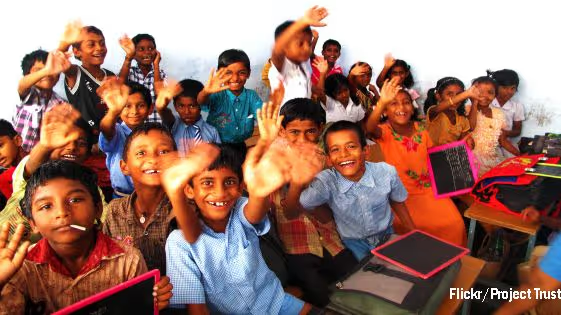
आरम्भ वही करे जो समाप्त हो सके! जोखिम और स्कूली शिक्षा में निवेश
आर्थिक झटकों के परिणामों को कम करने के लिए माता-पिता अधिक काम करने के लिए प्रेरित होते हैं और बच्चों का अधिक समय घर के कामों में उनकी मदद करने या परिवार के खेतों में बीत सकता है, जिससे उनकी स्कूली शिक्षा बाधित हो सकती है। ग्रामीण भारत के आंकड़ों का विश्लेषण करते हुए, इस लेख में दर्शाया गया है कि अधिक अस्थिर कृषि उत्पादन और खपत के रूप में जोखिम में 100% की वृद्धि होने से बच्चे के स्कूल जाने की संभावना में 4-5% तक की कमी हो जाती है।


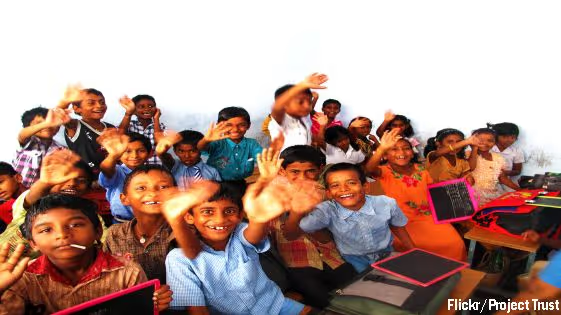
Start what you finish! Risk and schooling investments
Economic shocks prompt parents to work more in order to reduce the fallout, and children may spend more time helping in the household or on the family farm, thereby interrupting their schooling. Analysing data from rural India, this article shows that a 100% increase in risk – in the form of more volatile agricultural production and consumption – reduces the probability that a child attends school by 4-5%.