
.svg)
.svg)
%201.svg)
%201.svg)
.svg)

.svg)
.svg)
Eyal Frank

Eyal Frank is an Assistant Professor at the Harris School of Public Policy. As an environmental economist, he works at the intersection of ecology and economics. In his work, Frank draws natural experiments from ecology and policy, and uses econometric techniques to estimate different pieces of the puzzle regarding the social cost of biodiversity losses. Prior to the University of Chicago, Frank was a postdoctoral research associate at the School of Public and International Affairs at Princeton University. He received his Ph.D. in Sustainable Development from Columbia University, and his M.A. in Economics and B.Sc. in Environmental Sciences and Economics from the Hebrew University of Jerusalem.
.svg)

मानव और पारिस्थितिकी तंत्र स्वास्थ्य किस प्रकार से आपस में जुड़े हुए हैं: भारत में गिद्धों की संख्या में गिरावट से साक्ष्य
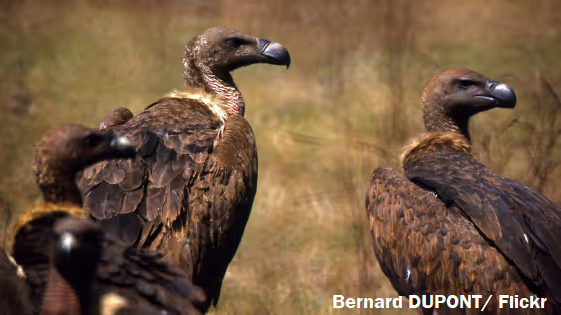
भारत के किसान परंपरागत रूप से अपने मृत मवेशियों के शवों के निपटान हेतु गिद्धों पर भरोसा करते आये हैं। किन्तु आकस्मिक विषाक्तता के चलते भारत में गिद्धों की संख्या कम हो जाने के कारण मृत मवेशियों के शवों की सफाई रूक-सी गई है और स्वच्छता का माहौल बिगड़ गया है। फ्रैंक और सुदर्शन इस लेख में, गिद्धों की संख्या में गिरावट के कारण सार्वजनिक स्वास्थ्य पर हो रहे नुकसान के परिणामों का अनुमान लगाते हुए दर्शाते हैं कि गिद्धों की संख्या के सबसे निचले स्तर पर आ जाने की अवधि के दौरान मनुष्य की मृत्यु-दर में वृद्धि हुई है, और वे यह भी दर्शाते हैं कि पारिस्थितिकी तंत्र में गिद्धों की भूमिका को आसानी से पुनर्स्थापित नहीं किया जा सकता है।


How human and ecosystem health are intertwined: Evidence from vulture population collapse in India
Livestock farmers in India have historically relied on vultures to dispose of dead animals. However, the collapse of vulture populations in India due to accidental poisoning has prevented the scavenging of carcasses, worsening sanitation. In this post, Frank and Sudarshan estimate the consequences of the loss of vultures on public health and estimate that human mortality increased during the period when vultures reached their new collapsed population level, and note that vultures’ role in the ecosystem cannot be easily replicated.