
.svg)
.svg)
%201.svg)
%201.svg)
.svg)

.svg)
.svg)
Forhad Shilpi

Forhad Shilpi is a Senior Economist in the Development Research Group (Sustainable Development and Infrastructure). Her current research focusses on the impacts of infrastructure on rural-urban transformation, the role of domestic market institutions in the transmission of international price signals, and intergenerational mobility in developing countries. Her research has been published or is forthcoming in leading development and economics journals such as American Economic Journal: Applied Economics, Economic Journal, Journal of Development Economics, Journal of Human Resources, Economica, Canadian Journal of Economics, Journal of Economic Geography, Oxford Bulletin of Economics and Statistics, Economics Letters, and World Development. She holds a Ph.D. in Economics from Johns Hopkins University.
.svg)

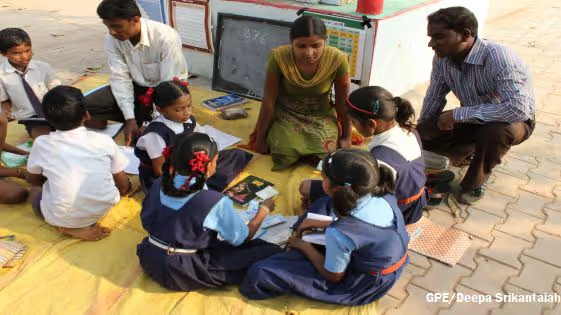
Understanding intergenerational educational mobility with conflicting evidence
There is a growing literature on intergenerational educational mobility that explores how parental education influences the educational attainment of children. This article compares three empirical models widely used to study intergenerational educational mobility. Using data from India, China and Indonesia, it finds that conclusions regarding educational mobility vary substantially across different models. . It argues that rank-based measures are not suitable for understanding the effects of economic policy, and suggests that policy advice should focus on the measures based on years of schooling.


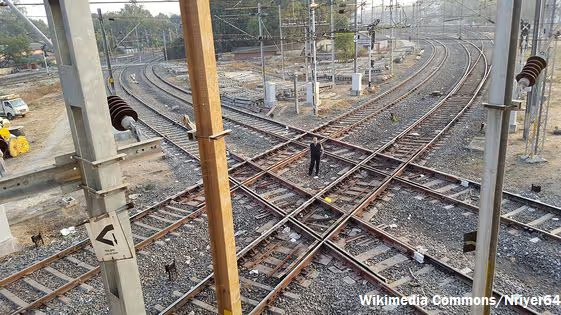
क्या परिवहन में ढाँचागत विकास से ग्रामीण भूमि असमानता बढ़ती है?
परिवहन से जुड़े आधारभूत संरचना में निवेश से व्यापार लागत कम होती है और गांव शहरी बाज़ारों के साथ जुड़ जाते हैं। यह लेख दर्शाता है कि इस स्थानिक एकीकरण के कारण ग्रामीण भारत में भूमि असमानता बढ़ने का अनपेक्षित परिणाम भी निकल सकता है। यह लेख, औपनिवेशिक रेलमार्ग स्थानों और स्वर्णिम चतुर्भुज राजमार्ग नेटवर्क से गांव की दूरी के आधार पर बाज़ार तक पहुँच के प्रभावों को पृथक करके देखता है। अध्ययन से पता चलता है कि एकीकरण से भूमिहीन परिवारों की संख्या में और उत्पादक कृषि प्रौद्योगिकी को अपनाने में वृद्धि होती है, जिससे बड़े खेत और भी बड़े हो जाएंगे और भूमि असमानता बढ़ जाएगी।
Does development of transport infrastructure increase rural land inequality?
Investments in transport infrastructure reduce trade costs and lead to integration of villages with urban markets. This article suggests that this spatial integration could have the unintended consequence of increasing land inequality in rural India. It isolates the effects of market access using colonial railroad locations and the distance of a village from the Golden Quadrilateral highway network. The study finds that integration also increases the share of landless households and the adoption of productive farming technology, which would lead to large farms getting bigger and increase land inequality