
.svg)
.svg)
%201.svg)
%201.svg)
.svg)

.svg)
.svg)
Gaurav Datt

Gaurav Datt is Associate Professor in the Department of Economics and the Deputy Director of the Centre for Development Economics and Sustainability at Monash University. He has worked in research and operational positions at the International Food Policy Research Institute (IFPRI) and the World Bank. Analysis of poverty, income distribution and social policy has been the primary focus of Gaurav's work. He has published widely in professional journals and authored several poverty assessment reports for the World Bank. His work encompasses a range of countries including India, China, Egypt, Laos, Mozambique, Nepal, Papua New Guinea, the Philippines, Sri Lanka and Timor-Leste.
.svg)


Financing of fiscal response to Covid-19: A red herring?
Governments around the world are frenetically announcing an expanding slew of rapid response measures to address the fallouts of Covid-19 pandemic. The fiscal price tag on these measures is massive and growing rapidly. In this post, Datt and Bajaj argue for an alternative way of financing the fiscal response in India: the Reserve Bank of India could directly buy government bonds to the tune of the fiscal response, offering money to the government account, and then write it off.



GST: A ‘good and simple’ tax?
The Goods and Services Tax (GST) came into effect in India on 1 July 2017. Even as it is too early to judge the performance of GST relative to the system of indirect taxation it has replaced, Gaurav Datt contends that there are a few aspects with respect to which it is possible to offer some evaluative comments

कोयला आधारित बिजली इकाइयों से प्रदूषण और बच्चों एवं महिलाओं की एनीमिक स्थिति
स्वास्थ्य पर वायु प्रदूषण के प्रभाव को व्यापक रूप से शोध-साहित्य में जगह मिली है। जहां अन्य अध्ययनों में मुख्य रूप से सामान्य रुग्णता और मृत्यु दर जैसे परिणामों पर ध्यान केंद्रित किया गया है, यह लेख भारत में छोटे बच्चों और प्रौढ़ उम्र की महिलाओं की एनीमिक स्थिति पर कोयला आधारित बिजली इकाइयों द्वारा पड़ने वाले प्रदूषण के प्रभाव का मूल्यांकन प्रस्तुत करता है। इन अतिरिक्त लागतों के जुड़ जाने से नवीकरणीय ऊर्जा की ओर प्रगतिशील बदलाव और कोयले पर निर्भरता कम करने का मामला मजबूत होता है।

Pollution from coal-based power units and anaemic status of children and women
An extensive literature has considered the impact of air pollution on health. While studies have mainly focussed on outcomes such as general morbidity and mortality, this article evaluates the impact of pollution caused by coal-based power units on the anaemic status of young children and prime-age women in India. Factoring in these additional costs strengthens the case for a progressive shift to renewable energy and reduced reliance on coal.
वस्तु-रूपी हस्तांतरण : डेडवेट हानि या लाभ?
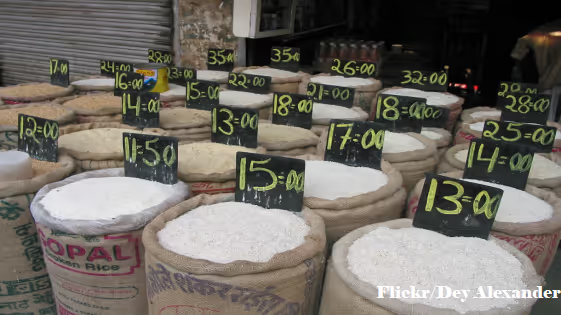
क्या सामाजिक सहायता के लिए वस्तु-रूप में दिया जाने वाला हस्तांतरण उपभोक्ता की पसंद को सीमित करके ‘डेडवेट लॉस’ की ओर ले जाता है? इस लेख में महाराष्ट्र में हुए एक प्रयोग से प्राप्त निष्कर्षों को प्रस्तुत किया गया है जिसमें कम आय वाले उत्तरदाताओं को चावल की मुफ्त मात्रा और नकदी की अलग-अलग मात्रा के बीच विकल्प की पेशकश की गई, ताकि चावल के लिए उनकी भुगतान करने की इच्छा का पता लगाया जा सके। इसमें पाया गया कि परिवार में अधिक मोल-भाव करने की क्षमता वाली महिलाएं चावल की अपेक्षा नकदी को ज़्यादा तरजीह देती हैं।
In-kind transfers: Deadweight losses or gains?
Do in-kind transfers for social assistance lead to ‘deadweight losses’ by restricting consumer choice? This article presents findings from an experiment in Maharashtra, which involved offering low-income respondents the choice between a free quantity of rice and varying amounts of cash to elicit their willingness to pay for rice. It finds that women with higher bargaining power within the household are more likely to choose cash over rice.
Has India eliminated extreme poverty?
In the second post of a six-part series on Gaurav Datt unpacks the claim that India was on the verge of eliminating extreme poverty, and questions two key assumptions on which it rests. Rather, he shows that the survey capture ratio has been declining, while top income shares have been rising over the last decade. He finally presents some alternative estimates, which call into question the elimination of extreme poverty.

Covid-19: Impact on migrant workers in Bihar
The nationwide lockdown – imposed in March 2020 to contain the spread of Covid-19 – left large sections of migrant workers in a precarious position, with livelihoods lost, and no means of public transport to get back home. This note presents findings from a survey of over 1,600 households in 12 villages across seven districts of the state of Bihar – a major source of migrant workers – to assess the impact of the pandemic on their lives.

Poverty reduction in India: Revisiting past debates with 60 years of data
There has been much debate about the poverty impacts of economic growth and structural transformation in developing countries. This column revisits these issues using a newly constructed dataset of poverty measures for India spanning 60 years. There has been a downward trend in poverty measures since 1970, with an acceleration post-1991, despite rising inequality. Post-1991 data suggest stronger inter-sectoral linkages. Urban consumption growth came with gains to both the rural and urban poor. The primary/secondary/tertiary composition of growth has ceased to matter, as all three sectors contributed to poverty reduction.