
.svg)
.svg)
%201.svg)
%201.svg)
.svg)

.svg)
.svg)
Guilhem Cassan
Guilhem Cassan holds a Ph.D. from the Paris School of Economics. His research, which was awarded the price of the French Economic Association, focuses on the impact of identity-based policies in India. After having completed a post doctoral visit at the London School of Economics, he is now Associate Professor in Economics at the University of Namur.
.svg)

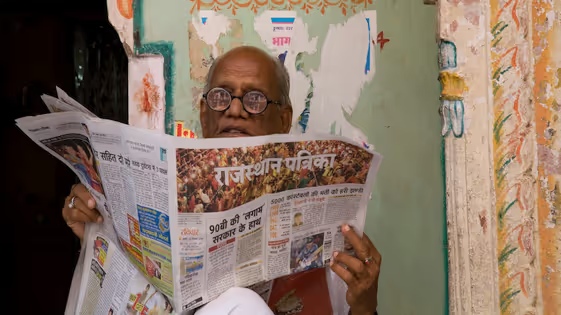
भारत में समाचार पत्र बाज़ार के राजनीतिक निर्धारक
समाचार पत्र भारतीय मतदाताओं के लिए राजनीतिक जानकारी का एक महत्त्वपूर्ण स्रोत हैं। लेख में इस बात पर प्रकाश डाला गया है कि राजनीतिक कारक समाचार पत्र बाज़ार को किस तरह से प्रभावित करते हैं। 2000 के दशक के मध्य में की गई परिसीमन की घोषणा को एक बाहरी झटके के रूप में मानते हुए, यह पाया गया कि उन जिलों में समाचार पत्रों के प्रसार में वृद्धि हुई थी, जिनका चुनावी महत्त्व घोषणा के बाद बढ़ गया था। देखा गया कि, अल्पावधि में यह परिवर्तन आपूर्ति में बदलाव से प्रेरित था, क्योंकि मतदाता अभी भी राजनीतिक झटके से अनजान थे।


Political determinants of newspaper markets in India
Newspapers are an important source of political information for Indian voters. This article looks at how political factors influence the newspaper market. Using the announcement of delimitation in the mid-2000s as an exogenous shock, it finds that there was an increase in newspaper circulation in districts whose electoral importance increased after the announcement. It notes that, in the short run, this change was driven by a shift in supply, as voters were still unaware of the political shock.

क्या मतदान का अधिकार राजनीतिक व्यवहार को प्रभावित करता है? भारत से ऐतिहासिक साक्ष्य
लोकतंत्र को लंबे समय से बेहतर आर्थिक विकास परिणामों के लिए जाना जाता है। हालांकि यह स्पष्ट नहीं है कि नागरिकों को मतदान का अधिकार देना, राजनीतिक भागीदारी या प्रतियोगिता को प्रभावी बनाए रखने को सुनिश्चित करने के लिए पर्याप्त है या नहीं। एक नए प्रयोग के तहत 1921-1957 के दौरान जिला-स्तरीय डेटासेट को आधार बनाते हुए यह लेख इस बात की जाँच करता है कि भारत में किस प्रकार दो वर्ग-आधारित विस्तार द्वारा राजनीतिक व्यवहार को आकार दिया गया है।

Does the right to vote affect political behaviour? Historical evidence from India
Democracies are known to have better economic development outcomes over the longer run. However, it is not clear whether giving citizens the right to vote is sufficient for ensuring an effective degree of political participation or competition. Creating a novel, district-level dataset from 1921-1957, this article examines how political behaviour is shaped by two class-based extensions of voting rights in India.