
.svg)
.svg)
%201.svg)
%201.svg)
.svg)

.svg)
.svg)
Hamid Beladi
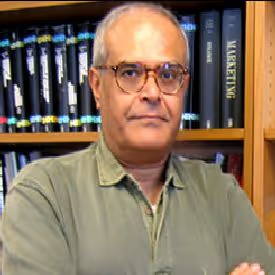
Hamid Beladi is the Janey S. Briscoe Endowed Chair in Business and professor of economics at The University of Texas at San Antonio (UTSA). Prior to joining the UTSA faculty in 2005, he was at North Dakota State University. He is the co-founder of the International Review of Economics and Finance, and served as editor from 1992-2018. He is the editor-in-chief of the North American Journal of Economics and Finance (since 2010), series editor of Frontiers of Economics and Globalization (since 2006), and associate editor of Review of International Economics (since 1992). He also serves as a member of the editorial boards of several other journals. He is a co-founder of the International Economics and Finance Society (IEFS).
Professor Beladi has published extensively in a wide spectrum of scholarly journals including Journal of International Economics, Review of International Economics, Journal of Banking and Finance, Review of Economics & Statistics, Journal of Economic Theory, Journal of Development Economics, Journal of Economic Behavior & Organization, Journal of Mathematical Economics, Review of Development Economics, Research Policy, Economica, and European Economic Review. His research Interests include economics of migration of skilled and unskilled labor, international trade in technology, global outsourcing and bi-sourcing, exchange rate pass-through, and fraudulent financial practices. Further link: https://business.utsa.edu/faculty/hamid-beladi-ph-d/
.svg)

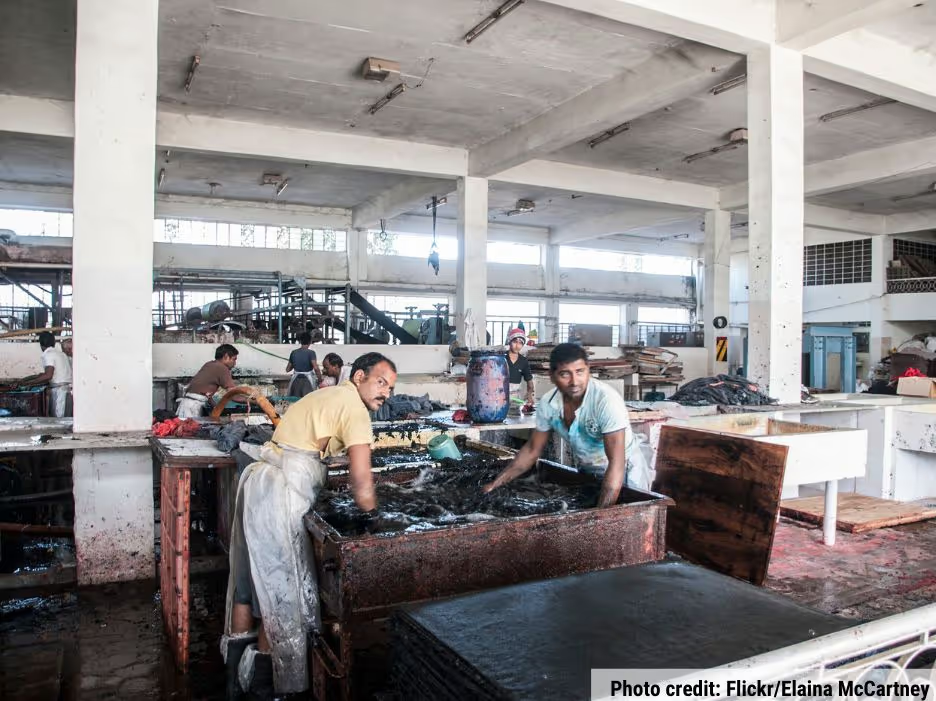
Perceived obstacles among Indian firms: What happens to innovation efforts?
For countries like India where large numbers of small- and medium-sized firms cannot access formal credit and face widespread bureaucratic corruption, long-run survival and consequent distributional implications are important. Based on firm-level micro-data, this article shows that obstacles, as perceived by firms in the form of corruption and access to finance, jointly reduce their probability to innovate.


