
.svg)
.svg)
%201.svg)
%201.svg)
.svg)

.svg)
.svg)
Harold Alderman

Harold Alderman is a Senior Research Fellow at IFPRI (International Food Policy Research Institute). He holds a Masters in Nutrition from Cornell University and a Ph.D. in Economics from Harvard University. His research interests include the economics of nutrition and food policy. He spent 10 years at IFPRI prior to joining the World Bank in 1991 and rejoined IFPRI in 2012. While at the World Bank, he divided his time between the Development Research Group and the Africa region where he advised on social protection policy.
His current research focusses on the linkages between nutrition and early child development and the means by which nutrition and social protection programmes contribute to long-term economic growth.
.svg)

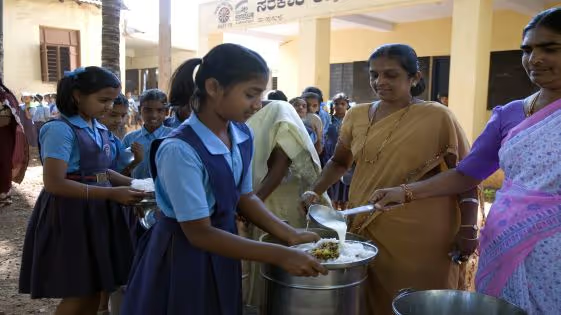
पोषण में सुधार हेतु स्कूली भोजन योजनाओं का महत्व
भारत में अल्पपोषित बच्चों की संख्या दुनिया में सबसे अधिक है और यहां मिड-डे मील (एमडीएम) के रूप में स्कूली भोजन की सबसे बड़ी योजना जारी है परंतु इस योजना के अंतर-पीढ़ीगत प्रभाव पर सीमित साक्ष्य उपलब्ध हैं। राष्ट्रीय परिवार स्वास्थ्य सर्वेक्षण और राष्ट्रीय नमूना सर्वेक्षण के आंकड़ों के आधार पर, यह लेख दिखाता है कि अगर स्कूली शिक्षा के दौरान एक माँ एमडीएम की लाभार्थी थी, तो उसके बच्चों की लम्बाई की कमी में 20-30% की गिरावट आती है।


The power of school feeding programmes to improve nutrition
India has the world’s highest number of undernourished children and the largest school-feeding programme – the Mid-Day Meal (MDM) scheme – but limited evidence is available on the intergenerational impact of the programme. Based on data from the National Family Health Survey and National Sample Survey, this article shows if a mother was a beneficiary of MDM during schooling, there is a 20-30% reduction in height deficits of her children.