.svg)
.svg)
%201.svg)
%201.svg)
.svg)

.svg)
.svg)
Jishnu Das

Jishnu Das is Professor at the McCourt School of Public Policy and the Walsh School of Foreign Service at Georgetown University. His work focusses on health and education in low- and middle-income countries, with an emphasis on social markets, or common, but complex, conflagrations of public and private education, and health providers operating in a small geographical space.
As part of this research, he has co-developed the largest and longest-running cohort study on learning outcomes in low-income countries and has led an agenda on the measurement of healthcare quality in low-income countries. The methods he has developed are now being used by The World Bank in its Service Delivery Indicators as well as by multiple research groups in in India, Indonesia, South Africa, Kenya, Senegal and Tanzania. His research has shown how government can use information, funding and training programmes, to improve service delivery for the poor. His evaluations with multiple co-authors have led to the widespread adoption of a training programme for informal providers (in West Bengal), health facility inspections (in Kenya), and networks for private sector providers (in India). He was also part of the team that developed India’s federal in-patient health insurance scheme, the RSBY (Rashtriya Swasthya Bima Yojana), which reached 150 million people in 2016.
He helped write the World Development Report on Gender and Development, and in 2015 he was the Flander’s Visiting Professor at McGill University. He has received the George Bereday Award from the Comparative and International Education Society, the Stockholm Challenge Award for the best ICT project in the public administration category in 2006, and the Research Academy Award from the World Bank in 2017 and 2013 for research on health and education. He is currently working on health inspections (Kenya), Tuberculosis (India), and education programmes (Pakistan).
.svg)

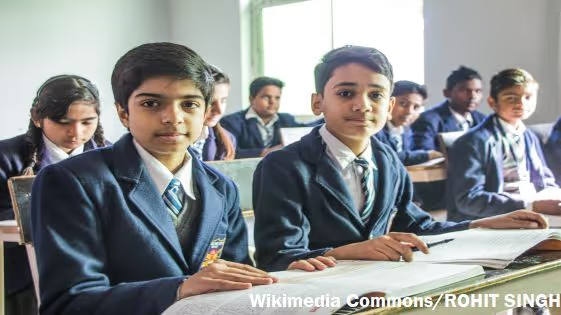
उच्च स्कोरिंग लेकिन गरीब: उच्च शिक्षा में प्रतिभा का गलत आवंटन
जैसे-जैसे कॉलेज शिक्षा में श्रम बाजार के लाभों में बढ़ोतरी हुई है, अब पहले से कहीं अधिक युवको को किसी न किसी प्रकार की उच्च शिक्षा प्राप्त हो रही है। फिर भी, गरीब सामाजिक आर्थिक स्थिति के बच्चों की कॉलेज में उपस्थिति कम रहती है। यह लेख उस असमानता की पड़ताल करता है। इस लेख में पाया गया है कि पारिवारिक पृष्ठभूमि कॉलेज में उपस्थिति के लिए अकादमिक तैयारी से अधिक महत्वपूर्ण है, क्योंकि अपनी कक्षा में शीर्ष स्थान पर रहने वाले गरीब छात्रों के कॉलेज में उपस्थित रहने की संभावना उतनी ही होती है जितनी उनकी कक्षा में सबसे नीचे स्थान पर रहने वाले अमीर छात्रों की होती है।


High scoring but poor: The misallocation of talent in higher education
As labour market returns to college education have increased, more young adults now receive some form of higher education than ever before. Yet, college attendance remains low for children from poor socioeconomic backgrounds. This article investigates that disparity. It finds that family background remains as, if not more, important than academic preparedness for college attendance–poor students at the top of their class are just as likely to attend college as rich students at the bottom of the class.

A letter to Oxfam: Reframing the questions around private-sector healthcare
A 2009 Oxfam paper puts forth the view that scaling-up private healthcare provision is very unlikely to deliver high-quality care to the poor. Commenting on the paper, Jishnu Das contends that while it is right to argue for investments that improve public healthcare and build State capacity, we will not get there by demonising the private sector.
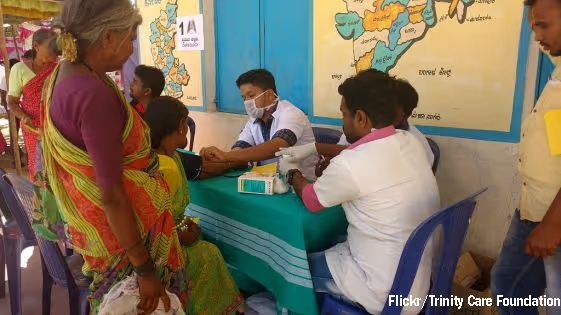
India's informal doctors: Assets, not crooks
Informal healthcare providers are the most common, and sometimes the only source of healthcare, in much of rural India. In this post, Jishnu Das of the World Bank argues that informal providers should be trained and their impact evaluated to see if it improves healthcare for poor people.