
.svg)
.svg)
%201.svg)
%201.svg)
.svg)

.svg)
.svg)
Jorge Tamayo

Jorge Tamayo is an assistant professor of business administration in the Strategy Unit at Harvard Business School. He teaches the Strategy course in the MBA required curriculum.
Professor Tamayo is an applied microeconomist primarily interested in industrial organization and development economics. His research focuses on theoretical modeling and structural estimation of firm decision-making and productivity. Professor Tamayo examines the market responses to settings in which firms use price discrimination (i.e. subscriptions, or membership fees) for goods and services. His research also focuses on the ways in which managers contribute to the productivity dynamics of their teams.
Professor Tamayo earned his Ph.D. in economics from the University of Southern California. He has a B.A. in economics and an M.S. in applied mathematics from Eafit University in Medellin, Colombia. Before pursuing his doctoral degree, he worked at the Central Bank of Colombia and as an adjunct professor in the department of economics at Eafit University.
.svg)

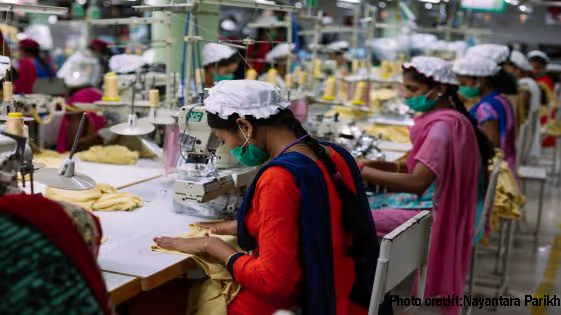
श्रम-प्रधान उद्योगों में श्रमिकों की अनुपस्थिति का सामना करना
श्रम-प्रधान उद्योगों में श्रमिकों की अनुपस्थिति फर्मों की उत्पादकता में हानि का कारण बनती है, जिसके चलते श्रमिकों के लिए उत्पादकता-आधारित प्रोत्साहन की संभावना कम होती है। कर्नाटक में किये गए एक अध्ययन के आधार पर, यह लेख इस बात की जाँच करता है कि अपनी लाइनों पर श्रमिकों की विशेष रूप से कम उपस्थिति का सामना करते समय फैक्ट्री लाइन-मैनेजर किस प्रकार से आपस में श्रमिकों का अदल-बदल करते हैं, और यह लेख लाइनों में अपने श्रमिकों की तैनाती में सुधार करने पर फर्मों को मिलने वाले वित्तीय लाभों का अनुमान भी लगाता है।


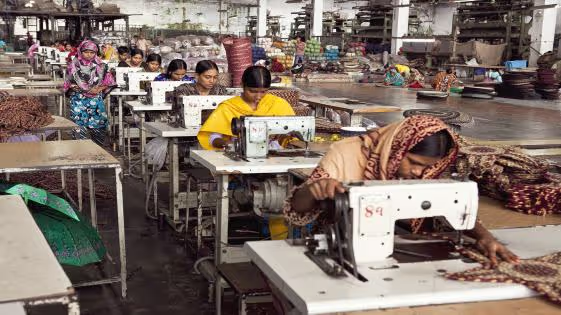
Dealing with worker absenteeism in labour-intensive industries
Worker absenteeism in labour-intensive industries causes productivity losses for firms, and reduced potential for productivity-based incentives for workers. Based on a study in Karnataka, this article investigates how factory line-managers trade workers amongst themselves when facing particularly low attendance on their lines, and estimates the financial gains that firms can make when they improve the distribution of workers across lines.
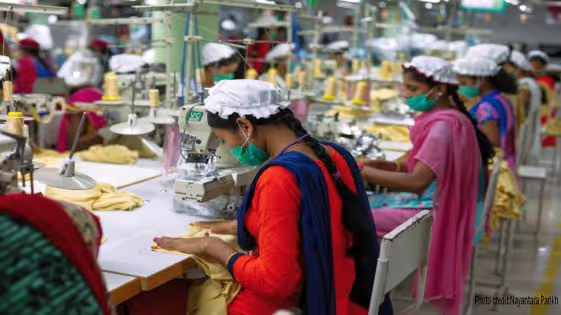
No line left behind: How firms match workers and managers
Various studies consistently affirm the importance of strong worker-manager dynamics in driving productivity. Based on analysis of worker-level productivity data, information on orders, and interviews with managers of a large garment manufacturing firm in India, this article suggests that when it comes to labour-allocation decisions, productivity sometimes takes a back seat to managing complex relationships with buyers, who can take their business to the factory down the road.

Managerial quality and productivity dynamics
It is well known that managerial quality impacts firm productivity and growth. Which managerial skills, traits, and practices contribute most to productivity? Are all such traits easily observable? Are such traits appropriately rewarded in pay? Based on two years of daily, line-level production data from a large Indian garment firm and rich survey data on line managers, this article seeks to address these questions.