
.svg)
.svg)
%201.svg)
%201.svg)
.svg)

.svg)
.svg)
Joseph Vecci

Joseph Vecci is a Ph.D. student in the Department of Economics, Monash University. His research interest include development, economics of education and experimental economics. Specifically, he is conducting experiments to understand social status and leadership in developed and developing countries (including India). Joe has also worked as a consultant for the Solomon Island government examining the impact of its rural development programme.
.svg)

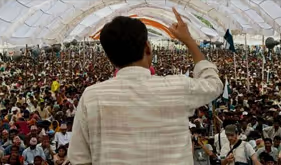
How leader identity impacts group coordination
In principle, leaders can facilitate group coordination towards a common goal but in diverse societies, their effectiveness may depend upon their social identity, and how citizens react to leader identity. Based on a lab-in-field experiment in India, this article investigates the role of leader religion in improving coordination, and the effectiveness of two policies that are often used to aid disadvantaged groups: intergroup contact, and affirmative action.



Impact of Elite Capture on the Provision of Public Services
The Bihar Rural Livelihoods Project commonly called JEEViKA, is a community-driven poverty reduction programme with the key aim of improving the social and economic empowerment of the rural poor.

Citizens' trust in local politicians and implications for good governance
The new state of Telangana was carved out of Andhra Pradesh in June 2014, after a prolonged movement by the people of Telangana region for a separate state. Based on field experiments among citizens in the two successor states, this column finds greater trust in politicians in Andhra relative to Telangana, which may facilitate effective functioning of the State and signal citizens’ expectations from the government.
Impact of Elite Capture on the Provision of Public Services
This project studies the effectiveness of major Government programmes in JEEViKA (Bihar Rural Livelihoods Project) villages versus others to see whether the presence of self-help groups leads to improved delivery of public services. By comparing the extent of elite capture in JEEViKA and non-JEEViKA blocks, the findings of the project contributes to the understanding of the effectiveness of community driven development (CDD) projects on elite capture and public service delivery.