
.svg)
.svg)
%201.svg)
%201.svg)
.svg)

.svg)
.svg)
Jyoti Prasad Mukhopadhyay

Jyoti Prasad Mukhopadhyay is currently Associate Professor of Economics at IFMR Graduate School of Business, Krea University. He holds a masters in economics from Delhi School of Economics, University of Delhi and a PhD in economics from Institute for Financial Management and Research (IFMR), University of Madras. He has worked with Centre for Micro Finance (CMF) at IFMR as a Research Associate for more than three years, and with The World Bank as a Short-term Consultant (STC) on an impact evaluation study in Chhattisgarh, India. He has participated and presented papers in various national and international conferences both in India and abroad. Some of his research articles have been published in peer reviewed journals. His research interests lie in the areas of development economics, applied econometrics, empirical corporate finance, and behavioural economics.
.svg)


Does mandatory CSR expenditure affect firm value? Evidence from Indian firms
Section 135 of the Companies Act, 2013 mandates all Indian firms above certain size or profit threshold to spend at least 2% of net profit earned in preceding three years on Corporate Social Responsibility (CSR) from 2014-15 onwards. The existing literature is divided on whether CSR spending helps improve firm performance. Analysing firm-level data from India for 2006-2016, this column finds that CSR spending has a significant positive impact on firm value.


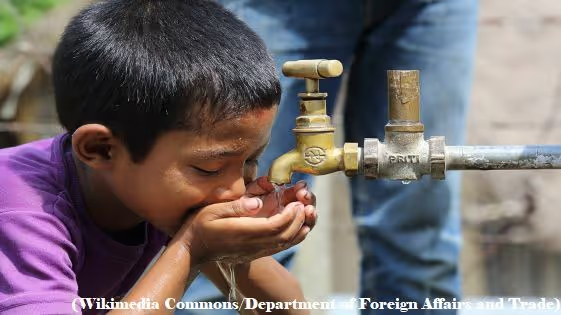
क्या सुरक्षित पेयजल से बच्चों के शैक्षिक परिणामों में सुधार हो सकता है?
यह अच्छी तरह से प्रमाणित हो चुका है कि शुद्ध पानी पीने से स्वास्थ्य संबंधी लाभ होते हैं, लेकिन क्या इससे बच्चों के शैक्षिक परिणामों में भी सुधार हो सकता है? साफ पानी का अधिकार एक मूल अधिकार है और एक सतत विकास लक्ष्य भी। विश्व स्वास्थ्य दिवस, जो हर साल 7 अप्रैल को मनाया जाता है, के सन्दर्भ में भारत मानव विकास सर्वेक्षण के आँकड़ों का विश्लेषण करते हुए, इस लेख में दस्त की घटनाओं में कमी, पानी लाने में कम समय बिताया जाना और अल्पकालिक रुग्णता पर कम खर्च तथा शिक्षा पर अधिक खर्च कर पाने जैसे विकल्पों की पहचान के प्रमाण प्रस्तुत किए गए हैं। एक विशेष बात यह है कि इसका प्रभाव लड़कियों पर अधिक स्पष्ट है।
Can safe drinking water improve children’s educational outcomes?
It is well-established that treated water has health benefits, but can it also enhance children’s educational outcomes? Analysing India Human Development Survey data, this article provides evidence in this context – identifying pathways such as decreased incidence of diarrhoea, lesser time spent on fetching water, and reduced expenditure on short-term morbidity allowing for higher spend on education. Further, the impact is more pronounced for girls.