
.svg)
.svg)
%201.svg)
%201.svg)
.svg)

.svg)
.svg)
Kanchan Mukherjee
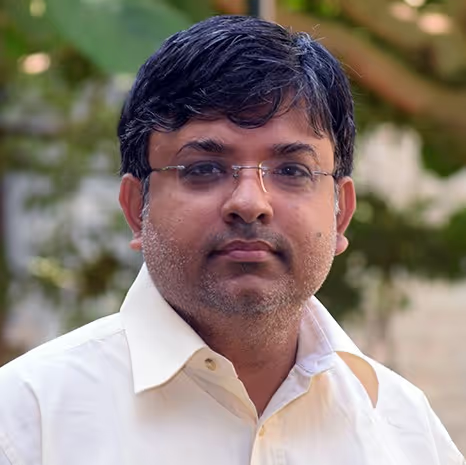
Kanchan Mukherjee is Professor of Organizational Behavior and Human Resource Management at IIM Bangalore. He has a Bachelors in Electrical Engineering from IIT Kanpur, an MBA from IIM Calcutta, and a Ph.D. in Decision Sciences from INSEAD, France. He held the Young Faculty Research Chair from 2012-2015 at IIM Bangalore.
His corporate experience, spanning almost a decade, is primarily in consulting and financial services, with focus on mergers and acquisitions, credit policy, and risk management. He has several publications in leading academic and practitioner journals. He specialises in analytical modelling as well as experimental research methods including surveys and design of controlled experiments. He received the prestigious Hillel Einhorn Award from the US-based Society for Judgment and Decision Making in 2011 for research excellence.
.svg)


संपन्न शहरी परिवारों में जल संरक्षण को प्रेरित करना
पानी की मांग को कम करना - विशेष रूप से संपन्न, शहरी घरों में - सार्वभौमिक पहुंच सुनिश्चित करने और इसे एक किफायती मूल्य पर बनाए रखने के लिए बढ़ती आपूर्ति के बोझ को कम कर सकता है। बेंगलुरू में किये गए एक क्षेत्र-प्रयोग के आधार पर यह लेख दर्शाता है कि 'आदत-परिवर्तन' के हस्तक्षेप से किसी भी आर्थिक प्रोत्साहन या प्रतिबंधों के बिना घरेलू पानी की खपत में 15-25% की कमी लाई जा सकती है और ये परिणाम हमारे अध्ययन की दो साल की अवलोकन अवधि के लिए बने रहे हैं।


Inducing water conservation in affluent urban households
Reducing the demand for water – particularly in affluent, urban households – can lower the burden of increasing supply to ensure universal access, and sustaining it at an affordable price. Based on a field experiment in Bengaluru, this article shows that ‘habit-change’ interventions can lead to a 15-25% reduction in household water consumption without economic incentives or restrictions and these results persisted for the two-year observation period of the study.