
.svg)
.svg)
%201.svg)
%201.svg)
.svg)

.svg)
.svg)
Kanika Mahajan

Kanika Mahajan is an Associate Professor at Ashoka University. She was formerly Assistant Professor in Economics at School of Liberal Studies in Ambedkar University, Delhi. She obtained her Ph.D. in Quantitative Economics from the Economics and Planning Unit of Indian Statistical Institute, Delhi, in 2015. Her primary research interests include empirical development economics in the field of gender, labour and environment. Her recently published articles look at the supply side determinants behind the falling female labour supply in India, the effect of female labour supply and climatic shocks on gender wage gap and the effect of NREGA on casual wages in rural India.
.svg)

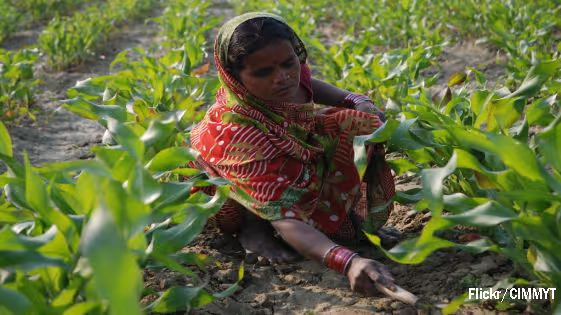
प्रोद्योगिकी में लैंगिक परिवर्तन: कृषि मशीनीकरण से साक्ष्य
भारतीय कृषि में बढ़ते मशीनीकरण के कारण ग्रामीण क्षेत्रों में विशेषकर महिलाओं के लिए कृषि रोजगार में कमी आई है। यह लेख दर्शाता है कि 1999-2011 के दौरान मशीनीकरण में 32 प्रतिशत की वृद्धि देखी गई, जो कृषि में महिलाओं के ग्रामीण रोजगार में हुई 30% की समग्र गिरावट में से 22% गिरावट का कारण हो सकती है। यह गिरावट भूमि की जुताई के बाद किये जाने वाले निराई के कार्य हेतु लगाए जाने वाले श्रम में एक महत्वपूर्ण गिरावट के कारण है।


Gendering technological change: Evidence from agricultural mechanisation
Rising mechanisation in Indian agriculture has been accompanied by reduction in farm employment in rural areas, particularly for women. This article shows that the observed 32 percentage point increase in mechanisation during 1999-2011 can account for 22% of the 30% overall decline in women’s rural employment in agriculture. This is driven by a significant fall in labour used for weeding, an operation that follows tilling of land.

Agricultural wages and MNREGA: Exploring the myth
The Mahatma Gandhi National Rural Employment Guarantee Act, India’s flagship programme that guarantees 100 days of minimum wage employment to rural households, has come under attack for pushing up the wages demanded by hired hands in agriculture. This column argues that most of these attacks fail to account for changing productivity in agriculture and the consequences of this for agricultural wages.
कोविड-19: क्या हम लंबी दौड़ के लिए तैयार हैं? - भाग 2
इस आलेख के पहले भाग में, लेखकों ने भारत में कोविड-19 के प्रति सरकार की प्रतिक्रिया का मार्गदर्शन करने हेतु व्यापक सिफारिशें कीं। इस भाग में, वे पांच ऐसे समूहों की पहचान करते हैं जिनके वर्तमान संकट से उत्पन्न आर्थिक एवं स्वास्थ्य संबंधी झटकों की चपेट में आने की आशंका ज्यादा है, और ऐसे क्षेत्र जहां राहत प्रयासों को केंद्रित करने की आवश्यकता है।
कोविड-19: क्या हम लंबी दौड़ के लिए तैयार हैं? - भाग 1
कोविड-19 के प्रसार की संभावित पुनरावृत्ति को रोकने के लिए यह लॉकडाउन, संभवतः भविष्य में किए जाने वाले कई लॉकडाउन में से पहला हो सकता है, इसलिए नीति निर्माताओं को इससे प्रतिकूल रूप से प्रभावित व्यक्तियों को राहत प्रदान करने के लिए तैयार रहना होगा। इसे ध्यान में रखते हुए, लेखक एक व्यापक दृष्टिकोण का प्रस्ताव करते हैं जिसमें अगले 24 महीनों में होने वाले किसी भी लॉकडाउन के दौरान राशन कार्ड धारक सभी परिवारों को प्रदान किए जाने वाले वस्तु रूपी अंतरणों और नकद सहायता के एक संयोजन के लिए तर्क दिया गया है।
Covid-19: Are we ready for the long haul? - Part II
In Part I of this piece, the authors made broad recommendations to guide the government’s response to Covid-19 in India. In this part, they identify five salient population groups that are particularly vulnerable to the economic and health shocks arising from the current crisis, and regions where relief effort needs to be concentrated.
Covid-19: Are we ready for the long haul? - Part I
As this may be the first of many future lockdowns to stamp out possible repeated outbreaks of Covid-19, policymakers must be prepared to provide relief to adversely affected individuals. With this in mind, the authors propose a comprehensive approach that argues for a combination of in-kind transfers and cash support to be provided to all households with ration cards during any lockdown that takes place over the next 24 months.

Can job ad language help explain the gender gap in the Indian labour market?
Women applying for jobs tend to earn a lot less than men of the same age and education qualifications. Understanding the factors contributing to this disparity is crucial for addressing gender inequality in the labour market. This article explores one such factor: the wording of job advertisements and how it is linked to applicant behaviour. It finds that women might be deterred from applying to high-salary jobs due to implicit gender associations, together with explicit preferences. This is the fourth post of a five-part series to mark International Women’s Day 2025.

आप्रवासन नीति सम्बन्धी अनिश्चितता श्रम बाज़ारों को प्रभावित करती है
राष्ट्रपति ट्रम्प के फिर से चुने जाने से एच-1बी वीज़ा सम्बन्धी नीतियों पर बहस फिर से शुरू हो गई है, यह एक अस्थाई उच्च कौशल कार्य वीज़ा है जिसमें 70% वीज़ा भारतीयों के पास हैं। इस लेख में, वर्ष 2016 में ट्रम्प की पहली बार हुई जीत के दौरान भारत से प्राप्त नौकरियों के आँकड़ों का विश्लेषण करते हुए पाया गया है कि अमेरिकी आप्रवासन नीतियों के बारे में अनिश्चितता बढ़ने के कारण तथा वीज़ा कोटा एवं प्रक्रियाओं में कोई बदलाव नहीं होने के कारण, कई फर्मों ने नौकरियाँ अमेरिका से भारत स्थानांतरित कर दीं।
How immigration policy uncertainty affects labour markets
President Trump’s re-election has reignited debate over H-1B visa policies, a temporary high-skill work visa programme wherein 70% of visas are held by Indians. Analysing jobs data from India from the period around Trump’s first victory in 2016, this article finds that increased uncertainty around US immigration policies – without any change in visa quotas and procedures – caused firms to relocate jobs from the US to India.
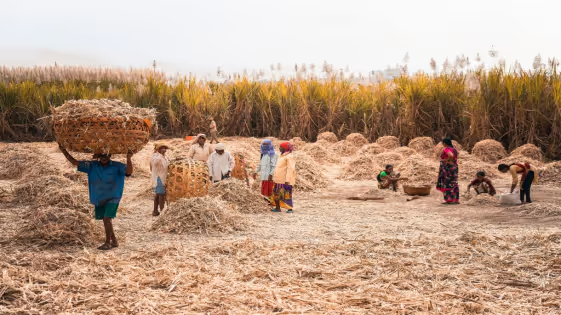
Do minimum wages reduce inequality in India?
Wage inequality in India has declined over the past two decades. This article examines the role of rising minimum wages in driving this trend. Exploiting state-level variations in legislative minimum wage changes, it finds that minimum wage increases account for 26% of the decline in wage inequality between 1999 and 2018. Moreover, these gains were achieved without adverse effects on employment.
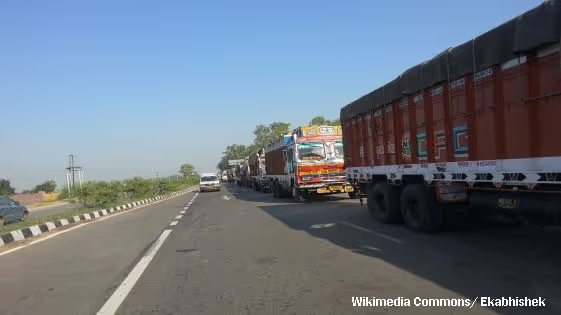
Lockdown-induced trade disruptions and adaptations by firms
In the face of trade disruptions, firms can reorient their trade to minimise risk. This article documents a fall in inter-state trade in India during the Covid-19 lockdown, that continues until December 2020. This is explained by ‘reshoring’, as plants more dependent on inter-state sales (and input-sourcing) shifted to intra-state sales (and input-sourcing). The extent of reshoring is determined by a new measure – Scope for Home Expansion – that captures excess home production which can be diverted within the state
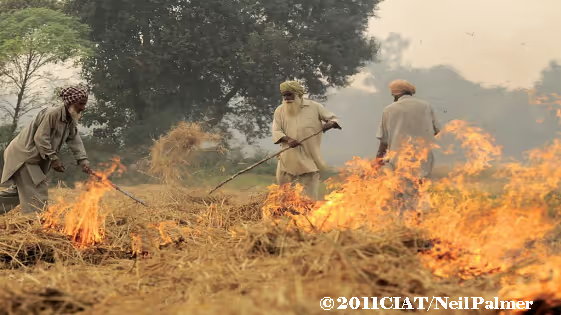
Clearing the air: Do India’s crop burning bans really work?
In December 2015, the National Green Tribunal instituted a ban on crop residue burning across five states. Utilising satellite data on crop fires and administrative data on fines levied, this article examines the efficacy of the ban. It finds that the ban did have a sizeable downward impact on fire counts – but with a lag of a year, and effects lasting for at most two years.