
.svg)
.svg)
%201.svg)
%201.svg)
.svg)

.svg)
.svg)
Karthik Muralidharan

Karthik Muralidharan is a professor of economics at the University of California, San Diego, where he also holds the Tata Chancellor's Endowed Chair in Economics.
Born and raised in India, he earned an A.B. in economics (summa cum laude) from Harvard, an M.Phil. in economics from Cambridge (UK), and a Ph.D. in economics from Harvard. He is a Research Associate of the National Bureau of Economic Research (NBER), an Affiliate at the Bureau for Research and Economic Analysis of Development (BREAD), a Member of the Jameel Poverty Action Lab (J-PAL) network, an Affiliate at the Center for Effective Global Action (CEGA), and a Research Affiliate with Innovations for Poverty Action (IPA).
Prof. Muralidharan's primary research interests include development, public, and labor economics. Specific topics of interest include education, health, and social protection; measuring quality of public service delivery; program evaluation; and improving the effectiveness of public spending (with a focus on developing countries). Courses taught include undergraduate and graduate classes in development economics, program evaluation, and the economics of education.
.svg)


पीडीएस में पसंद-आधारित विकल्प की आवश्यकता
भारत के प्रमुख खाद्य सुरक्षा कार्यक्रम पब्लिक डिस्ट्रीब्यूशन सिस्टम (पीडीएस) पर सार्वजनिक व्यय का एक बड़ा हिस्सा अपेक्षित लाभार्थियों तक नहीं पहुंचता है। इसलिए सब्सिडी वाले अनाज के बदले डायरेक्ट बेनिफिट ट्रांसफर (डीबीटी) का विचार एक प्रमुख नीति विकल्प के रूप में उभरा है। मुरलीधरन, नीहौस, और सुखतंकर एक सरल लेकिन शक्तिशाली दृष्टिकोण की सलाह देते हैं: इसके बजाय कि नीति निर्माता पीडीएस और डीबीटी के बीच निर्णय लें, हम लाभार्थियों को यह विकल्प दे सकते हैं।


Building an inclusive and high-performing school system
Clause 12 of the Right to Education Act aims to reduce social stratification in education by requiring private schools to reserve one-fourth of their seats for economically weaker students, with the government reimbursing their fee up to a maximum of per-child spending in public schools. This column argues that the RTE Clause 12 is an opportunity to build an inclusive and high-performing school system in India, and outlines an implementation protocol for the Clause.
Understanding the relative effectiveness of government and private schools in India
Data suggests a steady increase in the share of students attending private schools in rural India. This column analyses data from the largest and longest evaluation of a school choice programme in India, conducted over four years in the state of Andhra Pradesh, to assess whether private schools are indeed more effective than government schools.
An evidence-based proposal to achieve universal quality primary education in India
It is well established that learning levels in Indian primary schools are unacceptably low. This column proposes a strategy for achieving universal functional literacy and numeracy for all primary school children in India during the 12th Five-Year Plan that is fiscally sustainable, politically feasible, implementable at scale, and based on interventions proven to be effective by rigorous research on education in India.
Cycling to School: Increasing High School Enrolment for Girls in Bihar
This project studies the impact of an innovative Programme in the Indian state of Bihar that aimed to reduce the gender gap in secondary school enrolment by providing girls who continued to secondary school with a bicycle that would improve access to school. The findings shows that the Programme was much more cost effective at increasing girls' enrolment than comparable conditional cash transfer programmes.
Using evidence for better policy: The case of primary education in India
While India has achieved considerable success in increasing primary school enrolment and improving input-based measures of school quality over the past 10 years, learning outcomes continue to be abysmally low. This column synthesises over a decade of research on the challenge of converting increased spending into improved education outcomes and highlights key policy implications.
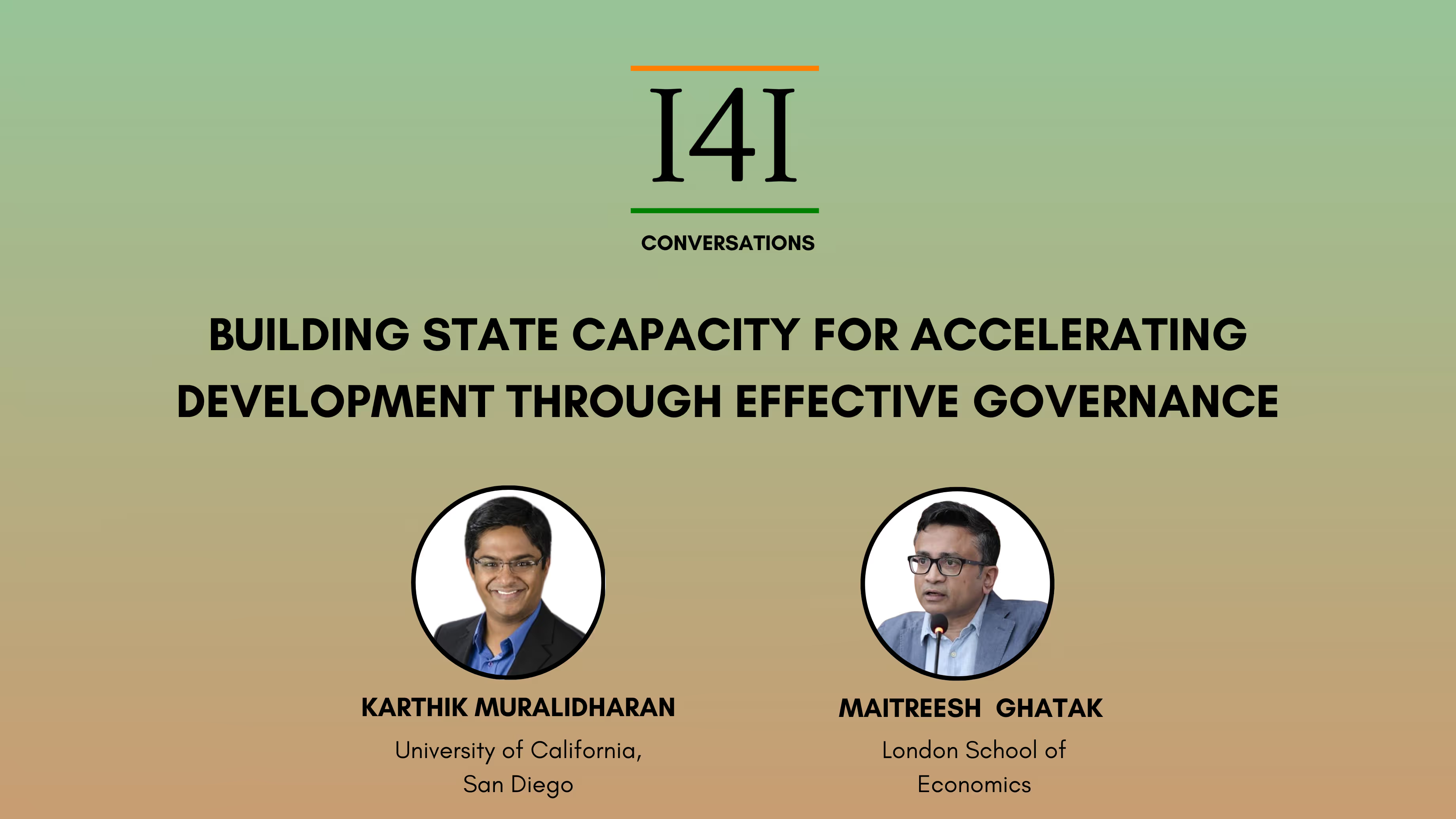
Building State capacity for accelerating development through effective governance
In a new edition of I4I conversations, Maitreesh Ghatak (London School of Economics) is joined by Karthik Muralidharan (University of California, San Diego) to discuss his new book, Accelerating India's Development: A State-Led Roadmap for Effective Governance.
Building State capacity for accelerating development through effective governance
In a new edition of I4I conversations, Maitreesh Ghatak (London School of Economics) is joined by Karthik Muralidharan (University of California, San Diego) to discuss his new book, Accelerating India's Development: A State-Led Roadmap for Effective Governance.

शासन में सुधार के लिए मोबाइल का उपयोग
मुख्य सार्वजनिक कार्यक्रमों का कितनी अच्छी तरह क्रियान्वयन हो रहा है इसे मापना शासन की एक बड़ी चुनौती बनी हुई है। देश में मोबाइल-फोन की तेजी से बढ़ रही पहुंच को देखते, मुरलीधरन, नीहौस, सुखतंकर, और वीवर का मानना है की सार्वजनिक सेवा वितरण में सुधार के लिए इस सशक्त साधन का लाभ उठाना चाहिए।
Using mobiles to improve governance
Measuring how well major public programmes are implemented remains a core governance challenge. With the increasing mobile-phone penetration in the country, Muralidharan, Niehaus, Sukhtankar, and Weaver make the case for leveraging this powerful tool to improve public service delivery.
मनरेगा से निकली हैं कई राहें
भारत की महात्मा गांधी राष्ट्रीय ग्रामीण रोजगार गारंटी योजना (मनरेगा) की भूमिहीन ग्रामीण परिवारों को लाभ पहुंचाने के लिए बनाए गए सुरक्षा तंत्र के रूप में प्रभावशीलता को लेकर बहुत सारे विवाद उत्पन्न हुए हैं। मुरलीधरन, नीहौस, और सुखतंकर ने बड़े पैमाने पर एक मूल्यांकन के परिणामों की चर्चा करके बताया है कि मनरेगा भूमिहीन ग्रामीण गरीबों के कल्याण में सुधार, और समग्र ग्रामीण उत्पादकता में वृद्धि के लिए आश्चर्यजनक रूप से प्रभावी उपकरण हो सकता है।
Strengthen MNREGS to support the rural economy
India’s Mahatma Gandhi National Rural Employment Guarantee Scheme (MNREGS) has generated a lot of controversy about its effectiveness as a safety net designed to benefit landless rural households. Muralidharan, Niehaus, and Sukhtankar discuss the results from a large-scale randomised evaluation that suggest MNREGS may be a surprisingly effective tool both for improving the welfare of the landless rural poor and increasing overall rural productivity.
Need for a choice-based approach in PDS
A large share of public spending on the Public Distribution System (PDS), India’s flagship food security programme, does not reach intended beneficiaries. Thus, the idea of Direct Benefits Transfer (DBT) in lieu of subsidised food has emerged as a leading policy alternative. Muralidharan, Niehaus, and Sukhtankar recommend a simple but powerful approach: rather than policymakers deciding between PDS and DBT, we could give beneficiaries that choice.

Improving School Governance at Scale: A Randomised Evaluation of the Madhya Pradesh School Quality Assessment Programme
Weak governance is a critical constraint in delivering quality education in developing countries. This project conducts a randomised evaluation of one of the most ambitious recent attempts by a develop

Charting a course for the Indian economy
Karthik Muralidharan (Associate Professor of Economics, University of California, San Diego) speaks with Arvind Subramanian (Chief Economic Adviser, Government of India) on a broad set of issues ranging from the uniqueness of the Indian development model, the political economy of reforms, reducing factor misallocation in the economy, enhancing State capacity, financing India´s infrastructure needs, to the implications of the Fourteenth Finance Commission, improving the design of social welfare programmes, and climate change.
Building state capacity for better programme implementation: Lessons from the Andhra Pradesh Smartcard Programme
Biometric payment systems are posited to reduce leakages in public welfare programmes but there is limited evidence on their effectiveness. This column presents evidence on the impact of the Andhra Pradesh Smartcard Programme on MNREGS and Social Security Pension beneficiaries, based on a large-scale randomised controlled trial. It finds substantial economic benefits, and concludes that using biometric payment infrastructure to deliver welfare payments can be a game changer for governance in India.
A conversation on Bihar
I4I Guest Editor Karthik Muralidharan (Associate Professor of Economics, University of California, San Diego) speaks with Anjani Kumar Singh (Chief Secretary, Government of Bihar) during the IGC Growth Week in London, on issues ranging from the successes and challenges of Bihar in the past five years, constraints on industrialisation, skilling, spatial distribution of development, to frequent transfer of bureaucrats and role of research inputs in policymaking.

How reforming India’s workfare programme raised private sector earnings
By randomising the rollout of improved, biometric payment infrastructure used to issue National Rural Employment Guarantee Scheme payments in Andhra Pradesh, this study found that this reform raised incomes and reduced poverty. This effect was realised mostly through increases in private labour market earnings, as higher earnings through NREGS put competitive pressure on large landowners who had kept wages low by limiting employment. These findings highlight how critical it is to get implementation of policies and social programmes right..

भ्रष्टाचार और बहिष्करण को संतुलित करना: आधार को पीडीएस में शामिल करना
सार्वजनिक रूप से प्रदान की जाने वाली वस्तुओं और सेवाओं के लाभार्थियों को इन लाभों को प्राप्त करने के लिए अपनी पहचान कैसे साबित करनी चाहिए? यह लेख, झारखंड राज्य में सार्वजनिक वितरण प्रणाली (पीडीएस) में बायोमेट्रिक प्रमाणीकरण के आधार पर अधिक कड़ी पहचान आवश्यकताओं के प्रभावों के अध्ययन को हमारे सामने रखता है। यह अध्ययन झारखंड राज्य में 1.5 करोड़ लाभार्थियों के बड़े पैमाने पर एक प्रयोग के तौर पर किया गया है। इसमे यह पाया गया है कि भ्रष्टाचार को कम करने के प्रयासों में, इस प्रक्रिया के कारण कुछ कम आय वाले परिवार अपने लाभ से वंचित हो गए हैं।

Balancing corruption and exclusion: Incorporating Aadhaar into PDS
How should recipients of publicly provided goods and services prove their identity in order to access these benefits? This article reports findings from a large-scale experiment across 15 million beneficiaries to evaluate the effects of more stringent identification requirements based on biometric authentication, on the delivery of subsidised food through Public Distribution System in the state of Jharkhand. It finds that attempts to reduce corruption has cost some low-income households their benefits in the process.

‘न्याय’ विचार-गोष्ठी: सही लक्ष्यीकरण करना
कैलिफोर्निया विश्वविद्यालय, सैन डीएगो में अर्थशास्त्र के टाटा चांसलर्स प्रोफेसर कार्तिक मुरलीधरन ने न्याय के तहत देश में सबसे गरीब 20 प्रतिशत प्रखंडों (ब्लॉक्स) को लक्षित करने की और उन क्षेत्रों में नकद अंतरण को सार्वभौमिक या अर्ध-सार्वभौमिक बनाने की अनुशंसा की है।
NYAY e-Symposium: Getting targeting right
Karthik Muralidharan (Tata Chancellor's Professor of Economics, University of California, San Diego) recommends targeting the 20% of poorest blocks in the country under NYAY, and making the cash transfers universal or quasi-universal in those areas.

Big and small ideas in development economics: Theory, evidence and practice
Karthik Muralidharan, Associate Professor of Economics, University of California, San Diego speaks with Kaushik Basu, Chief Economist and Senior Vice President, World Bank and former Chief Economic Adviser, Government of India, on the World Bank’s global development agenda; inequality and the design of anti-poverty policies; contribution of recent academic research to development policy; research evidence, political economy and policymaking; State capacity for implementation; and law and economics.