
.svg)
.svg)
%201.svg)
%201.svg)
.svg)

.svg)
.svg)
Kelsey Jack

B. Kelsey Jack is an Associate Professor at the Bren School of Environmental Science and Management, University of California, Santa Barbara. Kelsey does research at the intersection of environmental and development economics, with a focus on how individuals, households, and communities decide to use natural resources and provide public goods. Much of her research uses field experiments to test theory and new policy innovations. She has conducted research in numerous countries in Africa, Asia and Latin America, and has ongoing work in South Africa, Uganda, Zambia and Niger. She joined the Bren School after seven years as an Assistant Professor in the Economics Department at Tufts University and a postdoc position at MIT, with the Agricultural Technology Adoption Initiative (ATAI) at J-PAL. She holds a Bachelor's degree in Public and International Affairs from Princeton University and a PhD in Public Policy from Harvard University. Before graduate school, she spent two years in Lao PDR working for IUCN.
.svg)

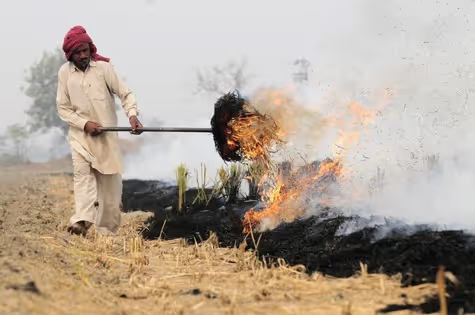
भारत में पराली जलना कम करने के लिए स्थानांतरण भुगतान डिज़ाइन करना
पराली जलाने से होने वाले वायु प्रदूषण का स्वास्थ्य पर गंभीर प्रभाव पड़ता है, ख़ासकर उत्तर भारत में। पर्यावरण के अनुकूल प्रथाओं को अपनाने के लिए सशर्त नकद हस्तांतरण कार्यक्रम की शुरुआत के बावजूद, किसानों में इस प्रक्रिया में तरलता और विश्वास की कमी है। यह लेख पंजाब में किए गए एक अध्ययन का वर्णन करता है और बताता है कि यद्यपि कार्यक्रम के अनुपालन में चुनौतियों का सामना हो सकता है, आंशिक अग्रिम भुगतान वाले अनुबन्ध पराली जलने को कम करने और पराली जैसे फसल अवशेषों के कुशल प्रबंधन में उपकरणों व तकनीक के उपयोग को बढ़ाने में मदद कर सकते हैं।


Designing transfer payments to reduce crop burning in India
Air pollution caused due to crop burning has severe health impacts, particularly in north India. Despite the introduction of a conditional cash transfer programme to adopt environmentally friendly practices, farmers lack liquidity and trust in the process. This article describes a study undertaken in Punjab, and reveals that although the programme may face challenges with compliance, contracts that include partial upfront payments can help reduce crop burning and increase the use of equipment to manage crop residue.