
.svg)
.svg)
%201.svg)
%201.svg)
.svg)

.svg)
.svg)
Lata Gangadharan

Lata Gangadharan is a Professor of Economics at Monash University in Australia. She is an experimental economist whose research interests are in understanding and designing appropriate institutions for the environment and for development. In recent years she has conducted experiments to understand: varying propensity for corruption, appropriate institutions for credit provision in developing countries, trust and trustworthiness between individuals in economic transactions, charitable giving and selection into labour market programmes in developing countries. Her work has been funded by the Australian Research Council and by grants from AusAID. Some of her recent work has been published in the American Economic Review, Science, Journal of Public Economics, Journal of Environmental Economics and Management and American Journal of Agricultural Economics. More information about her research is available at the following website: http://www.monash.edu.au/research/people/profiles/profile.html?sid=34317&pid=5335
.svg)


Choosing to be trained: Behavioural restrictions on participation decisions
Widespread unemployment has prompted policymakers to consider introduction of various training programmes that can help workers accumulate additional skills to obtain new jobs and/ or retain current ones. However, these programmes can only help if targeted individuals take up such opportunities. This column argues that participation in short-term skill-building courses is not just limited by economic factors but is also influenced by intrinsic characteristics such as attitudes towards risk and competition.



Impact of Elite Capture on the Provision of Public Services
The Bihar Rural Livelihoods Project commonly called JEEViKA, is a community-driven poverty reduction programme with the key aim of improving the social and economic empowerment of the rural poor.

Citizens' trust in local politicians and implications for good governance
The new state of Telangana was carved out of Andhra Pradesh in June 2014, after a prolonged movement by the people of Telangana region for a separate state. Based on field experiments among citizens in the two successor states, this column finds greater trust in politicians in Andhra relative to Telangana, which may facilitate effective functioning of the State and signal citizens’ expectations from the government.
Impact of Elite Capture on the Provision of Public Services
This project studies the effectiveness of major Government programmes in JEEViKA (Bihar Rural Livelihoods Project) villages versus others to see whether the presence of self-help groups leads to improved delivery of public services. By comparing the extent of elite capture in JEEViKA and non-JEEViKA blocks, the findings of the project contributes to the understanding of the effectiveness of community driven development (CDD) projects on elite capture and public service delivery.
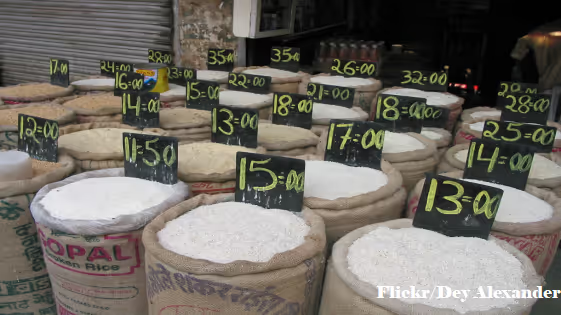
वस्तु-रूपी हस्तांतरण : डेडवेट हानि या लाभ?
क्या सामाजिक सहायता के लिए वस्तु-रूप में दिया जाने वाला हस्तांतरण उपभोक्ता की पसंद को सीमित करके ‘डेडवेट लॉस’ की ओर ले जाता है? इस लेख में महाराष्ट्र में हुए एक प्रयोग से प्राप्त निष्कर्षों को प्रस्तुत किया गया है जिसमें कम आय वाले उत्तरदाताओं को चावल की मुफ्त मात्रा और नकदी की अलग-अलग मात्रा के बीच विकल्प की पेशकश की गई, ताकि चावल के लिए उनकी भुगतान करने की इच्छा का पता लगाया जा सके। इसमें पाया गया कि परिवार में अधिक मोल-भाव करने की क्षमता वाली महिलाएं चावल की अपेक्षा नकदी को ज़्यादा तरजीह देती हैं।
In-kind transfers: Deadweight losses or gains?
Do in-kind transfers for social assistance lead to ‘deadweight losses’ by restricting consumer choice? This article presents findings from an experiment in Maharashtra, which involved offering low-income respondents the choice between a free quantity of rice and varying amounts of cash to elicit their willingness to pay for rice. It finds that women with higher bargaining power within the household are more likely to choose cash over rice.