
.svg)
.svg)
%201.svg)
%201.svg)
.svg)

.svg)
.svg)
Latika Chaudhary

Latika Chaudhary is an Associate Professor at the Graduate School of Business and Public Policy at Naval Postgraduate School. Previously, she has worked as an Assistant Professor at Scripps College. She received her Ph.D. from University of California, Los Angeles in 2006. She was a Hoover National Fellow in 2006-2007 and an Economic Fellow at Stanford University from 2007 to 2009 before joining Scripps College in 2009. Her research has focused on how colonial policy influenced educational outcomes in British India, the effects of state ownership on Indian railways and other public finance issues surrounding the provision of education and railways.
.svg)


Could railways have done more to aid economic development in India?
Indian Railways celebrated its 160th anniversary last month. This column argues that while railways played a large economic role in British India, it is likely they could have done more to aid economic growth and development in the country.


What constrained the expansion of education in British India?
Education and human capital development were neglected in colonial India. This column explores how colonial policies interacted with local conditions to influence the trajectory of Indian education. It finds that public spending on education was inadequate and susceptible to elite capture, and that the lack of focus on education was an important constraint on economic growth in the country during that period.
Does being local matter? Administrative decentralisation and human development
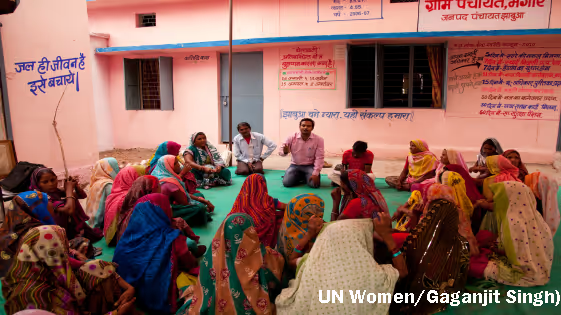
In this post, Chaudhary and Iyer discuss the administrative decentralisation reforms brought about by the Panchayati Raj Act, and measure the effect of decentralisation on the provision of public services and human development outcomes. States implemented these decentralisation reforms at different times, and to different extents. Their findings show that devolution of only functions to the local level, without a devolution of functionaries or funds, results in a decline in the quality of public service.

Microfinance and predatory lending: The same old story?
Once hailed as a near-miraculous way of lending money to the poor, microfinance is now often seen as exploitation – and governments are stepping in. This column looks at another point in India’s history where lawmakers have intervened in lending practices: following the Deccan Riots between farmers and moneylenders in 1876. It argues that in hindsight this was an overreaction – and perhaps there is a lesson for today.