
.svg)
.svg)
%201.svg)
%201.svg)
.svg)

.svg)
.svg)
Laura Zimmermann

Laura Zimmermann is an assistant professor in the Departmentof Economics and the Department of International Affairs at the University of Georgia. She received her PhD and M.A. in Economics from the University ofMichigan, and a BA in Philosophy, Politics, and Economics (PPE) from theUniversity of Oxford. Her fields of interest are Development Economics, LabourEconomics, and Political Economy. Her research interests include the impacts ofpoverty-alleviation programs in developing countries, the effects of weathershocks and natural disasters, and the causes and consequences ofintra-household discrimination. Her recent work explores the labor market andpolitical economy impacts of India’s National Rural Employment Guarantee Scheme.Other papers and current projects focus on living arrangements and issues ofintra-household allocation of resources in India andSub-Saharan Africa, agricultural productivity in India, and early childdevelopment in Indonesia.
.svg)


Production responses and tax evasion with limited State capacity: Evidence from major reform in India
Although VAT eliminates the double taxation of inputs of the retail sales system, which enhances growth, it may increase the number of firms in the informal sector. This makes it very important, from a policy perspective, to understand the impacts of VAT adoption. Currently, there are no studies on the adoption of VAT in developing countries. This project asks: what is the effect of switching from a retail sales tax to a VAT in India - a country with limited tax capacity and a large informal economy?


Production Responses and Tax Evasion with Limited State Capacity - Evidence from Major Reform in India
This project explores: what is the effect of switching from a retail sales tax to a VAT in a country with limited tax capacity and a large informal economy? The project explores this question through two ways: first, exploit individual firm level data. Second, utilise variation in tax rates across various goods and sectors within a state, variation across space and time, and variation in the exemption thresholds below which firms do not need to file a VAT return.

बेटियों को सशक्त बनाना : सशर्त नकद हस्तांतरण किस प्रकार से पारम्परिक मानदंडों को बदल सकते हैं
हर साल 24 जनवरी को राष्ट्रीय बालिका दिवस के रूप में मनाया जाता है। इस दिन की स्थापना 2008 में भारत सरकार के महिला एवं बाल विकास मंत्रालय ने लड़कियों को सशक्त बनाने और उनकी सुरक्षा के महत्व के बारे में जागरूकता बढ़ाने के लिए की थी। यह दिन उन सभी असमानताओं के बारे में लोगों में जागरूकता बढ़ाने के लिए मनाया जाता है जिनका सामना लड़कियों को करना पड़ता है। इसी अवसर पर पेश है आज का आलेख। पिछले 30 वर्षों में भारत सरकार ने बेटियों के जन्म के बाद, उनके लिए निवेश करने वाले माता-पिता को पुरस्कृत करने के लिए 20 से अधिक कार्यक्रम लागू किए हैं। फिर भी, पुत्र प्राप्ति की प्राथमिकता को कम करने तथा सांस्कृतिक मानदंडों में बदलाव लाने में इन कार्यक्रमों की प्रभावशीलता के बारे में बहुत कम जानकारी उपलब्ध है। इस शोध आलेख में, कई विशिष्ट डिज़ाइन वाली योजनाओं के प्रभाव का विश्लेषण करते हुए पाया गया है कि ऐसे कार्यक्रम सही मायने में नीति सम्बन्धी टूलकिट का हिस्सा हैं और उन पर और अधिक ध्यान देने की आवश्यकता है।
Empowering daughters: How conditional cash transfers can shift cultural norms
During the last 30 years, Indian governments have implemented over 20 programmes that reward parents who have daughters and invest in them after birth. Yet, very little is known about these programmes’ effectiveness in reducing son preference and shifting cultural norms. Analysing the impact of a scheme with many typical design features, the article finds that such programmes are rightfully part of the policy toolkit and deserve more attention.

Do value-added taxes benefit firms? Evidence from the adoption of state-specific value-added taxes
Value-added tax (VAT) systems have grown popular in the last 30 years, especially among developing countries looking for ways to raise tax revenue efficiently. Using 2000-2012 data on product, state-specific, and firm-specific tax rates, this article examines the staggered adoption of VAT across states between 2003 and 2008 on firms. It finds that the VAT reform increased firm sales by 45% within four years of the reform.
Are transparency and accountability enough? Open corruption and why it exists
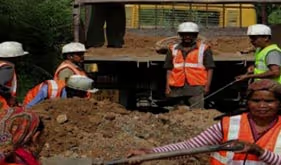
While India’s federal anti-corruption ombudsmen have just taken up their work, awareness of the complexity of corruption is growing. This article studies whether highly accountable Indian village council presidents favour their own households while making observable allocations of public works jobs. It finds that corruption can exist even when it is visible and punishable, plausibly because it serves as a reward for efforts put into programme implementation.

Maoist violence and MNREGA
The spate of Maoist attacks on security personnel in Chhattisgarh this week serves as a reminder that Moaist insurgency is the single biggest internal security threat faced by India. This column analyses the impact of MNREGA on Maoist violence and finds a spike in police-initiated attacks on Maoists following the implementation of the job guarantee scheme in 2006. This is possibly because MNREGA provides credibility to the government’s commitment to development, making the local population more willing to share information on Maoists.

MNREGA's impact on rural labour markets
In this article, Laura Zimmermann, Assistant Professor of Economics at the University of Georgia, provides an overview of the research on the impact of the initial phase of MNREGA on rural labour markets in India. The evidence suggests that the programme has served as an important short- and long-term safety net, and has had some employment generation effects during the agricultural off-season. However, the effect on rural casual wages is less clear.