
.svg)
.svg)
%201.svg)
%201.svg)
.svg)

.svg)
.svg)
Louis Preonas

Louis Preonas is Assistant Professor in the Department of Agricultural and Resource Economics, at the University of Maryland, College Park.
He is an energy and environmental economist, and much of his research focusses on interacting market distortions in US energy markets. His recent work studies market power in US coal transportation, and analyses the extent to which decreasing coal markups may lead to incomplete pass-through of a carbon tax. He is currently working to quantify the extent to which the decline of the US coal sector is causing carbon emissions to leak out of the country via coal exports.
His research also includes work at the intersection of environmental and development economics, focussing on the economic impacts of electricity access in the developing world. This work focusses on many points along the electricity supply chain in India, including generation, dispatch, transmission, and both rural and urban end-uses. In related research, a new working paper investigates the extent to which blackouts in developing countries are driven by a combination of utilities’ discretion and misallocation of generation.
Currently, he is developing a research agenda at the intersection of energy, water, and agriculture. A recent working paper combines (i) detailed electricity data for California farmers, (ii) detailed technical audits for 12,000 agricultural groundwater pumps, (iii) high-frequency measurements of groundwater depth, and (iv) satellite-derived measures of crop cover – in order to estimate how changes in the cost of pumping groundwater impact both agricultural groundwater use and cropping decisions.
.svg)

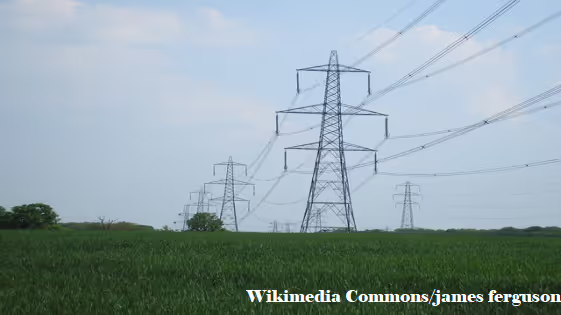
Does rural electrification cause economic development?
The last unelectrified Indian village is now connected to the grid. Given the large investments required for these infrastructure projects, value-for-money is an important consideration. Examining the impact of the Rajiv Gandhi Rural Electrification Programme, which expanded electricity access in 400,000 villages during 2005-2011, this article shows that the economic benefits of the intervention likely do not outweigh the costs below a certain population threshold.


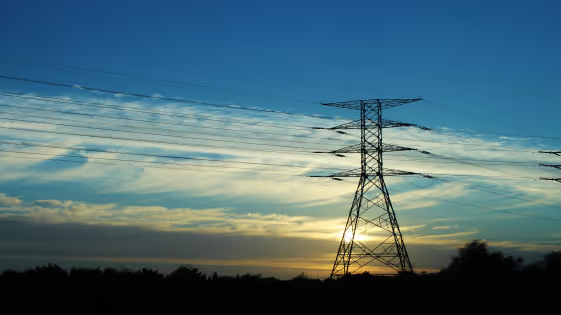
बिजली की कटौती को कम करने हेतु बिजली संयंत्रों की प्रोत्साहन राशि निश्चित करना
भारत में अपेक्षाकृत उच्च गुणवत्ता वाले बुनियादी ढांचे और बिजली संयंत्रों की पर्याप्त आपूर्ति के बावजूद, उपभोक्ताओं को लगातार बिजली की कटौती का सामना करना पड़ता है। यह लेख भारत में ब्लैकआउट के सन्दर्भ में एक नए स्पष्टीकरण को सामने लाता है: जब बिजली की खरीद लागत बढ़ जाती है, तो उपयोगिताएं बिजली संयंत्रों से कम बिजली खरीदना पसंद करती हैं, जिससे अंतिम उपयोगकर्ताओं तक पहुंचने वाली बिजली की मात्रा सीमित हो जाती है। थोक मूल्य लागत में कमी लाने वाले ‘थोक आपूर्ति सुधार’ ब्लैकआउट को प्रभावी तरीके से कम करने में सहायक हो सकते हैं।
Fixing incentives for power plants to reduce outages
Consumers in India face frequent power outages despite relatively high-quality infrastructure and ample supply of power plants. This article identifies a novel explanation for India’s blackouts: when the cost of purchasing electricity rises, utilities choose to buy less from power plants, thereby restricting the amount of power that reaches end-users. Reforms in wholesale supply that lower wholesale prices may help reduce blackouts in a cost-effective manner.