
.svg)
.svg)
%201.svg)
%201.svg)
.svg)

.svg)
.svg)
M. Shahe Emran

M. Shahe Emran is a development economist with Initiative for Policy Dialogue at Columbia University. He previously taught at George Washington University, and has worked at the World Bank and Bangladesh Institute of Development Studies. His research interests include theoretical and empirical analysis of tax policy in developing countries, the interaction of labour market with microfinance, effects of market integration on poor households, distributional effects of corruption, intergenerational mobility in developing countries, and pricing and passthrough in vertical supply chains. His research has been published (or forthcoming) in Review of Economics and Statistics, American Economic Journal: Applied Economics, Journal of Public Economics, Journal of Human Resources, Journal of Development Economics, Economica, Oxford Bulletin of Economics and Statistics, Canadian Journal of Economics, Economic Development and Cultural Change, and World Development
.svg)

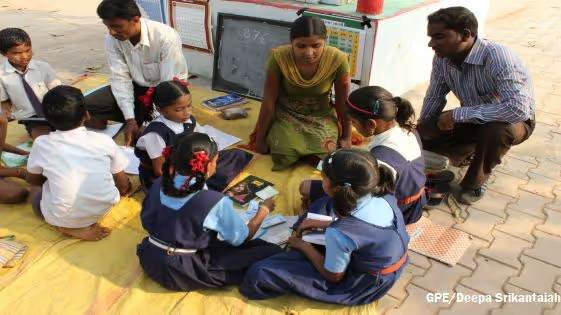
Understanding intergenerational educational mobility with conflicting evidence
There is a growing literature on intergenerational educational mobility that explores how parental education influences the educational attainment of children. This article compares three empirical models widely used to study intergenerational educational mobility. Using data from India, China and Indonesia, it finds that conclusions regarding educational mobility vary substantially across different models. . It argues that rank-based measures are not suitable for understanding the effects of economic policy, and suggests that policy advice should focus on the measures based on years of schooling.


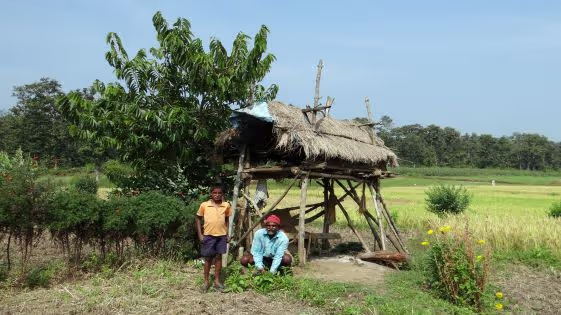
Does non-farm growth in rural areas reduce intergenerational educational mobility?
While the growth of the non-farm sector in a rural economy is known to reduce poverty, it may also exacerbate inequality. Comparing rural India and rural China the study finds that there is lower intergenerational education mobility in the former. Farmers’ sons in India attain higher schooling relative to non-farm sons when the father has low education, but the advantage flips when the father has over 10 years of education.
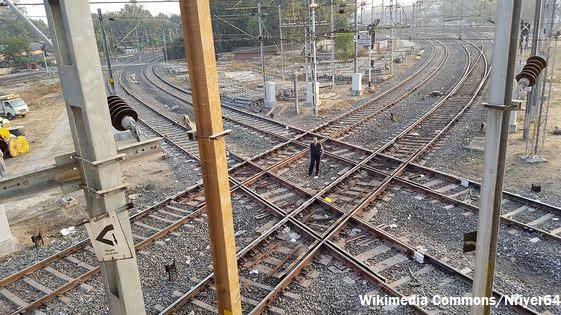
क्या परिवहन में ढाँचागत विकास से ग्रामीण भूमि असमानता बढ़ती है?
परिवहन से जुड़े आधारभूत संरचना में निवेश से व्यापार लागत कम होती है और गांव शहरी बाज़ारों के साथ जुड़ जाते हैं। यह लेख दर्शाता है कि इस स्थानिक एकीकरण के कारण ग्रामीण भारत में भूमि असमानता बढ़ने का अनपेक्षित परिणाम भी निकल सकता है। यह लेख, औपनिवेशिक रेलमार्ग स्थानों और स्वर्णिम चतुर्भुज राजमार्ग नेटवर्क से गांव की दूरी के आधार पर बाज़ार तक पहुँच के प्रभावों को पृथक करके देखता है। अध्ययन से पता चलता है कि एकीकरण से भूमिहीन परिवारों की संख्या में और उत्पादक कृषि प्रौद्योगिकी को अपनाने में वृद्धि होती है, जिससे बड़े खेत और भी बड़े हो जाएंगे और भूमि असमानता बढ़ जाएगी।
Does development of transport infrastructure increase rural land inequality?
Investments in transport infrastructure reduce trade costs and lead to integration of villages with urban markets. This article suggests that this spatial integration could have the unintended consequence of increasing land inequality in rural India. It isolates the effects of market access using colonial railroad locations and the distance of a village from the Golden Quadrilateral highway network. The study finds that integration also increases the share of landless households and the adoption of productive farming technology, which would lead to large farms getting bigger and increase land inequality