
.svg)
.svg)
%201.svg)
%201.svg)
.svg)

.svg)
.svg)
Madhu Khanna

Madhu Khanna is the ACES Distinguished Professor of Environmental Economics in the Department of Agricultural and Consumer Economics and Interim Director of the Institute for Sustainability, Energy, and Environment, at the University of Illinois at Urbana-Champaign. She received her Ph.D. from the University of California at Berkeley. Her research examines the economic incentives for and effectiveness of voluntary approaches to environmental sustainability and clean technology adoption, and the design of policy instruments for environmental protection. She is the Theme Leader for the Sustainability Theme in the Center for Advanced Bioenergy and Bioproducts Innovation at the University of Illinois, Urbana-Champaign. She is a Fellow of the Agricultural and Applied Economics Association, a University of Illinois Scholar, and a Leopold Leadership Fellow of the Woods Institute at Stanford University. She is also the President-Elect of the Agricultural and Applied Economics Association.
.svg)

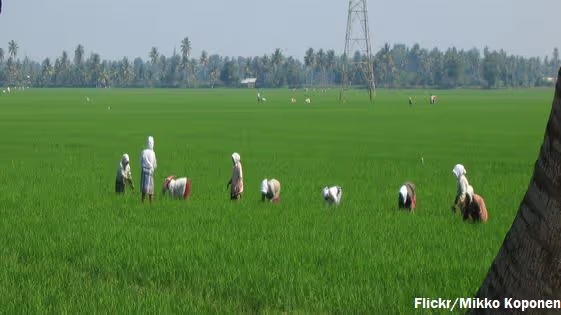
The impact of climate change on Indian crops
This article looks at deviations in the impact of short-term weather events and long-term climate change on yields of rice, maize and wheat, and finds that the negative impact of temperature is higher in the short run than in the long run, implying that farmers were able to adapt to long-term changes in climate. It also discusses the impact of precipitation on crop yields, and concludes by highlighting the need for customised farm management policies to adapt to climate change.


भारत की फसलों पर जलवायु परिवर्तन का प्रभाव
हर साल, 16 अक्तूबर को विश्व खाद्य दिवस के रूप में मनाया जाता है। इसी दिन वर्ष 1945 में संयुक्त राष्ट्र के खाद्य एवं कृषि संगठन की स्थापना हुई थी। इसे मनाने का उद्देश्य वैश्विक भुखमरी से निपटना और उसे पूरी दुनिया से खत्म करना है। खाद्य और इसलिए, भुखमरी का सीधा सम्बन्ध कृषि और कृषि उत्पादों से है। वर्तमान जनसंख्या वृद्धि और जलवायु परिवर्तन के परिप्रेक्ष्य में कृषि उत्पादकता पहले से कहीं अधिक महत्त्वपूर्ण हो गई है। इस लेख में, मौसम में बदलाव की अल्पकालिक घटनाओं तथा दीर्घकालिक जलवायु परिवर्तन के प्रभाव के कारण धान, मक्का और गेहूं की पैदावार में आने वाले अन्तर पर प्रकाश डाला गया है और पाया गया कि तापमान का नकारात्मक प्रभाव लम्बे समय की तुलना में अल्पावधि में अधिक होता है। इस लेख में फसल की पैदावार पर होने वाले वर्षा के प्रभाव की भी चर्चा की गई है और जलवायु परिवर्तन के अनुकूल स्वनिर्धारित कृषि प्रबंधन नीतियों की आवश्यकता पर प्रकाश डाला गया है।

How effective are unenforced mandates for corporate social responsibility?
By enacting the Companies Act in 2013, India became the first country in the world to mandate spending by large corporations on socially responsible initiatives. Using firm data from 2010 and 2016, this article shows that the Act increased expenditure levels on corporate social responsibility as well as their reporting. However, the hybrid mandatory-voluntary nature of the Act has led to some under compliance.