
.svg)
.svg)
%201.svg)
%201.svg)
.svg)

.svg)
.svg)
Manaswini Rao

Manaswini Rao is an Assistant Professor of Economics at the Alfred Lerner College of Business and Economics, University of Delaware. Her primary fields of interest are development economics, organisational economics, and the economics of institutions with a focus on legal and judicial institutions.
Her research can be classified into three major buckets - the role of frontline judiciary and broader dispute resolution institutions in the economic development process; collective action and coordination in improving agricultural productivity in the context of smallholder agricultural production; and structural transformation process of moving from agricultural production into urban and/or non-agricultural sectors from the lens of rural land inequality.
.svg)

The role of caste in agricultural technology diffusion
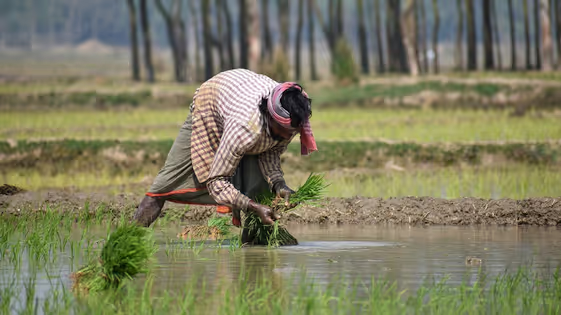
Local social structures, such as the jati-caste system in India, can play an important role in the extent of diffusion of new and beneficial agricultural technologies. This article builds on an existing study of paddy farmers in Odisha and finds that village-level caste homogeneity supports the diffusion of a flood-resistant seed variety, while fragmentation deters it. De Janvry et al. note differences in diffusion rates based on the frequency of flooding, and the caste identity of the initial recipient.



न्यायपालिका: अर्थव्यवस्था का एक प्रमुख स्तंभ
आर्थिक सर्वेक्षण 2018-19 में इस बात को मुख्य रूप से दर्शाया गया है कि भारत में ईज़ ऑफ डूइंग बिज़नेस (व्यापार करने में आसानी) के लिए सबसे बड़ी बाधा ठेका (अनुबंध) प्रवर्तन और विवाद समाधान है, और यह भी की निचली न्यायपालिकाओं की क्षमता बढ़ाना महत्वपूर्ण है। इस लेख में यह अनुमान लगाया गया है कि अदालत में एक रिक्ति पर एक न्यायाधीश को नियुक्त करने से एक साल बाद बैंक ऋण में 0.5% की वृद्धि होती है, जो अदालत के अधिकार क्षेत्र में स्थित फर्मों की ऋण उपलब्धता, उत्पादन और लाभप्रदता को प्रभावित करती है।

How district courts influence firm growth
The Economic Survey 2018-19 highlights that the single biggest constraint to ease of doing business in India is contract enforcement and dispute resolution, and increasing capacity in lower judiciary is crucial. This article estimates that adding one judge to a court with vacancy increases bank lending by 0.5% a year later, which affects credit availability, production, and profitability of firms located within the court’s jurisdiction.