
.svg)
.svg)
%201.svg)
%201.svg)
.svg)

.svg)
.svg)
Maulik Jagnani

Maulik Jagnani is an Assistant Professor at the Fletcher School and Department of Economics at Tufts University.
Previously, he was an Assistant Professor at University of Colorado, Denver. He completed his PhD in applied economics from Cornell University. His research focusses on microeconomic topics in environmental health and human capital in lower-income countries. He also investigates the impacts, both intended and unintended, of government policies on environmental health and human capital outcomes.
.svg)


Here comes the sun(set): It puts children to sleep and affects global educational outcomes
Emerging out of the British Empire in the mid-20th century, India reckoned a single time zone would serve as a unifying force, and adopted the Indian Standard Time across her territorial boundaries. However, India spans roughly 30° longitude, corresponding with a two-hour difference in average solar time from east to west. This article provides evidence that arbitrary clock conventions – by generating long-term differences in sleep – influence the geographic distribution of educational attainment levels.


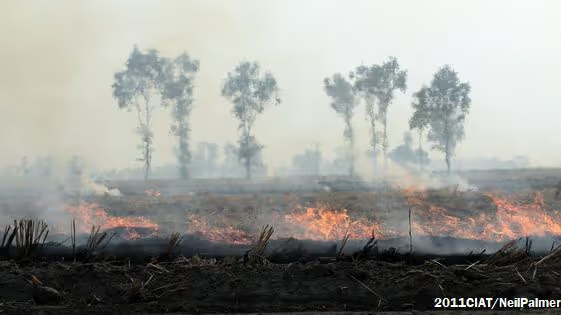
Do women leaders improve environmental outcomes? Evidence from crop fires in India
This study looks at how women leadership improves environmental outcomes. Using satellite data from India, it compares incidence of crop fires between constituencies where women narrowly won or lost elections against men and finds that female legislators decrease crop fire incidence and lower particulate emissions. A survey to understand mechanisms suggests that female leaders are more likely to consider crop fires a serious issue, weigh their impacts on child health, and implement crop residue management policies.

Temperature and human capital in India
A large proportion of the population in India has agrarian livelihoods that remain climate-exposed. The number of hot days per year in the country are expected to double by the end of this century. This column shows that higher-than-normal temperatures in a particular year lead to a contemporaneous reduction in agricultural incomes, and large negative impacts on children’s human capital outcomes in the subsequent year.