
.svg)
.svg)
%201.svg)
%201.svg)
.svg)

.svg)
.svg)
Meera Mahadevan

Meera Mahadevan is an Assistant Professor at the Economics Department, UC Irvine. Her research focuses on energy and environmental economics in developing countries. She examines topics such as the political economy of electricity provision and groundwater, the welfare consequences of corruption, and the role of technology adoption in meeting environmental goals and energy needs.
She obtained a PhD in Economics from the University of Michigan in 2019. She completed her BA (Honors) in Economics at St. Stephen’s College, University of Delhi, followed by an MSc. in Economics for Development at the University of Oxford. Before moving to UC Irvine, she was a postdoctoral fellow at the Bren School, UC Santa Barbara, and is also affiliated with the Abdul Latif Jameel Poverty Action Lab (J-PAL) and the Center for Effective Global Action (CEGA).
.svg)

Out of power? Political capture of the Indian electricity sector
Although power generation has been growing exponentially in India, the quality of electricity supply remains poor. This article argues that political corruption is among the root causes behind unreliable electricity supply. Using data from West Bengal, it shows that billed electricity consumption is lower and actual consumption is higher for constituencies of the winning party after an election, as politicians systematically allow the manipulation of electricity bills.


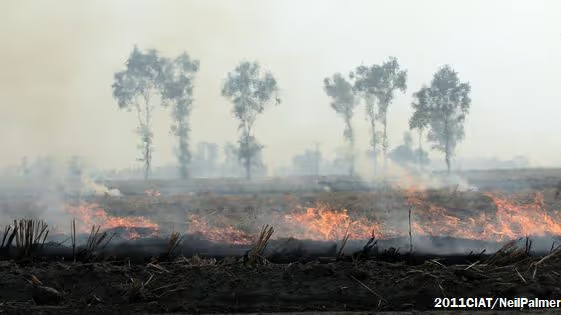
Do women leaders improve environmental outcomes? Evidence from crop fires in India
This study looks at how women leadership improves environmental outcomes. Using satellite data from India, it compares incidence of crop fires between constituencies where women narrowly won or lost elections against men and finds that female legislators decrease crop fire incidence and lower particulate emissions. A survey to understand mechanisms suggests that female leaders are more likely to consider crop fires a serious issue, weigh their impacts on child health, and implement crop residue management policies.
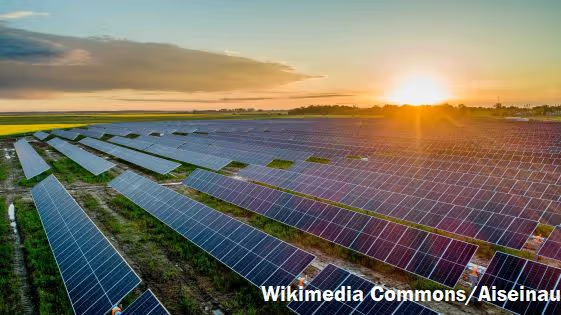
सौर ऊर्जा को अपनाने के लिए सूचना-संबंधी बाधाओं को कम करना: भारत से प्रायोगिक साक्ष्य
अभी भी बड़ी संख्या में लोगों को विश्वसनीय और उच्च गुणवत्ता वाली बिजली आपूर्ति नहीं हो रही है। इस अंतर को ऑफ-ग्रिड सौर प्रौद्योगिकियां कम कर सकती हैं,तथापि इन्हें कम अपनाया गया है। इस लेख में तीन भारतीय राज्यों में सौर गृह-प्रणालियों को अपनाये जाने संबंधी सूचना प्रावधान की भूमिका पर प्रकाश डाला गया है, और यह पाया गया कि भले ही इन प्रौद्योगिकियों में वास्तविक रूप में टेक-अप आय और क्रेडिट बाधाओं के कारण कम रहा हो, संभावित ग्राहक जिन्हें इनकी बेहतर जानकारी दी गई थी,उन्होंने सौर उत्पादों में अधिक रुचि व्यक्त की है।
Reducing information barriers to solar adoption: Experimental evidence from India
A large number of people lack access to reliable and high-quality electricity supply. Off-grid solar technologies can fill this gap, but adoption remains low. This article looks at the role of information provision on the adoption of solar home-systems in three Indian states, and finds that potential customers who were better informed expressed a greater interest in solar products, even though actual take-up remained low due to income and credit constraints.