
.svg)
.svg)
%201.svg)
%201.svg)
.svg)

.svg)
.svg)
Milan Vaishnav
Milan Vaishnav is senior fellow and director of the South Asia program at the Carnegie Endowment for International Peace in Washington, D.C.
.svg)

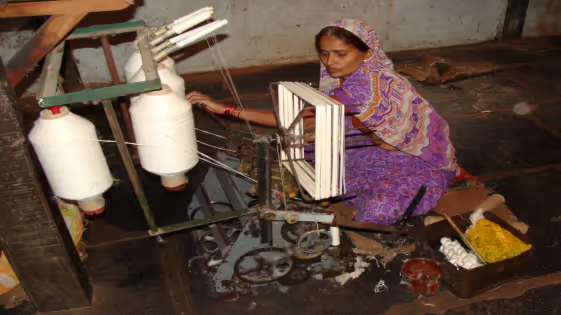
Urbanisation, gender, and social change: Do working women enjoy more agency?
Women’s limited work participation in India is not only of economic significance, but also has ramifications for their well-being and societal status. Based on a household survey in four north Indian urban clusters, this article finds a strong association between women’s work status and household decision-making agency, adding another dimension to our understanding of the link between women and work in India. However, the strength of this linkage is uneven and contingent on location, work categories, decision domains, and decision types.



India’s emerging crisis of representation
Article 81 of the Indian Constitution requires that each state receive Lok Sabha seats in proportion to its population and allocate those seats to constituencies of roughly equal size. However, the chronic unwillingness of the political class to reallocate seats in light of the country’s changing demographics has led to severe and entrenched malapportionment. In this piece, Vaishnav and Hintson explore this issue, and put forth potential solutions.

What do we know about corruption in India?
Despite ample media coverage of corruption, there remains a gap between headline-making scandals, policy options under discussion, and the actual evidence base drawn from empirical research on corruption. Based on an extensive review of the literature on corruption in India, this column highlights the underlying factors driving corruption, establishes a classification of corrupt activities, and distills five general principles that should guide future reform efforts.