
.svg)
.svg)
%201.svg)
%201.svg)
.svg)

.svg)
.svg)
Mushfiq Mobarak

Mushfiq Mobarak is an Associate Professor of Economics at Yale University, New Haven, USA. He is a development economist with interests in public finance (environmental and political economy) issues. He joined the Yale School of Management faculty in 2007 with previous work experience at the World Bank, the University of Colorado at Boulder, and at the International Monetary Fund. He has several ongoing field research projects in Bangladesh, India, Malawi and Brazil.
His current research interests include projects on water management and hydropower in Brazil, and field experiments exploring ways to induce people in developing countries to adopt technologies or behaviors that are likely to be welfare improving. He is also the Lead Academic for the Bangladesh Research Program of the DFID/LSE/Oxford ‘International Growth Centre (IGC)’, and a co-Chair of the Urban Services Initiative at the Jameel Poverty Action Lab (J-PAL) at MIT.
He advises several Ph.D. economics candidates working on development issues, and he won the 2006 Most Outstanding Faculty Advisor Award at the University of Colorado. He teaches MBA courses focused on the challenges to doing for-profit or non-profit business in developing countries, and on marketing products and behaviors to poor consumers. He also leads Yale MBA ‘international experience’ trips to developing countries.
.svg)

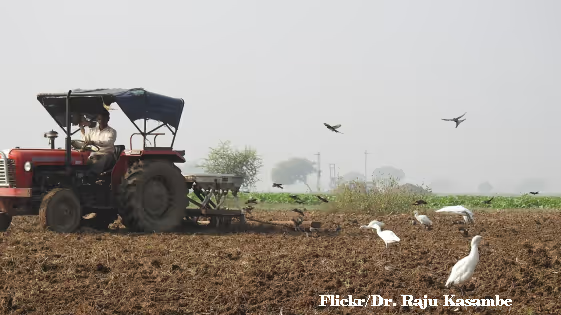
Internal migration and spatial reorganisation of agriculture
While migrants and their urban destinations are extensively studied, less is known about how their departure transforms the rural economies they leave behind. Analysing Indian data, this article shows that migrant-sending households near cities reduce farm size and investment rather than replacing workers with capital. On the other hand, non-migrant, remote households expand production in response to falling land prices and rising crop prices



Increasing tax compliance through social recognition
To enhance government revenues, it is important to tackle the menace of tax evasion. This column discusses an experiment that tests whether sharing a firm’s tax compliance status with neighbouring firms and/ or providing social recognition for compliance helps increase compliance. It finds that these interventions do bring about a positive behavioural change, but only for non-compliant firms in areas where some firms were already complying.
Encouraging household investment in sanitation
While the detrimental effects of poor sanitation are widely known, there is disagreement about the key barriers to expanding improved sanitation coverage. This column presents results from a field experiment in Bangladesh that designs, implements and tests a range of sanitation marketing strategies. It finds that cost is the primary barrier to adoption, and that investment decisions are interlinked across neighbours.
How to keep more girls in school? Lessons from Bangladesh
For years developing countries have been trying to increase parents’ incentives to send their children, particularly girls, to school and keep them there. This column looks at the success of Bangladesh, where the number of girls in school now exceeds the number of boys. It argues that money talks – but it’s the money that educated children will earn once they leave school that talks loudest.
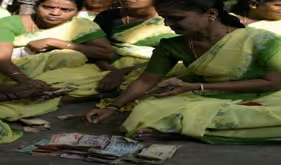
Can the microcredit model be improved?
Microcredit is frequently touted as an effective policy tool to fight global poverty. However, studies suggest that the long-term impact on recipients’ lives is limited. In this post, Mushfiq Mobarak of Yale University, and Vikas Dimble of Tata Centre for Development, argue that new research reveals microcredit can help more people by modifying and extending its model.

Formally insuring the informally insured
Rainfall is critical for the livelihoods of millions of Indians – yet many have no formal insurance if the rains fail. This column looks at what happens when a new formal insurance policy based on the weather is offered at random to farmers and farm workers across several states in India.