
.svg)
.svg)
%201.svg)
%201.svg)
.svg)

.svg)
.svg)
Namrata Kala

Namrata Kala is the W. Maurice Young (1961) Career Development Professor of Management and an Assistant Professor in Applied Economics at the MIT Sloan School of Management.
She is an economist with research interests in environmental and development economics. Her current research projects include studying how firms and households learn about and adapt to environmental change and regulation, the returns to environmental technologies, and the returns to worker training and incentives.
From fall 2015 to 2017, Namrata was a Prize Fellow in Economics, History, and Politics at Harvard University and a Postdoctoral Fellow in the Abdul Latif Jameel Poverty Action Lab at the Massachusetts Institute of Technology. She received her Ph.D. in environmental economics from the School of Forestry and Environmental Studies at Yale. She also holds a Bachelors (Honors) in Economics from Delhi University, and a Masters in International and Development Economics from Yale University.
.svg)


Easing contracting frictions with machines: Evidence from Karnataka
Productivity-enhancing technology adoption in agriculture, which makes workers available for other economic sectors, has long been considered essential for economic development. Based on a field experiment among 7,000 farmers in Karnataka, this article shows that mechanisation lowers supervision needs for hired workers in stages of production other than the one being mechanised, and family workers freed from those tasks engage in non-agricultural activities.



The economic and political consequences of India's demonetisation
The ruling party at the centre won the Uttar Pradesh state election despite its demonetisation policy having some negative economic impacts on the Indian economy. By combining primary data from surveys of wholesale and retail traders, with secondary data on wholesale markets, this column seeks to analyse why this was so.

भारत में पराली जलना कम करने के लिए स्थानांतरण भुगतान डिज़ाइन करना
पराली जलाने से होने वाले वायु प्रदूषण का स्वास्थ्य पर गंभीर प्रभाव पड़ता है, ख़ासकर उत्तर भारत में। पर्यावरण के अनुकूल प्रथाओं को अपनाने के लिए सशर्त नकद हस्तांतरण कार्यक्रम की शुरुआत के बावजूद, किसानों में इस प्रक्रिया में तरलता और विश्वास की कमी है। यह लेख पंजाब में किए गए एक अध्ययन का वर्णन करता है और बताता है कि यद्यपि कार्यक्रम के अनुपालन में चुनौतियों का सामना हो सकता है, आंशिक अग्रिम भुगतान वाले अनुबन्ध पराली जलने को कम करने और पराली जैसे फसल अवशेषों के कुशल प्रबंधन में उपकरणों व तकनीक के उपयोग को बढ़ाने में मदद कर सकते हैं।
Designing transfer payments to reduce crop burning in India
Air pollution caused due to crop burning has severe health impacts, particularly in north India. Despite the introduction of a conditional cash transfer programme to adopt environmentally friendly practices, farmers lack liquidity and trust in the process. This article describes a study undertaken in Punjab, and reveals that although the programme may face challenges with compliance, contracts that include partial upfront payments can help reduce crop burning and increase the use of equipment to manage crop residue.
Environmental relocation and firm outcomes
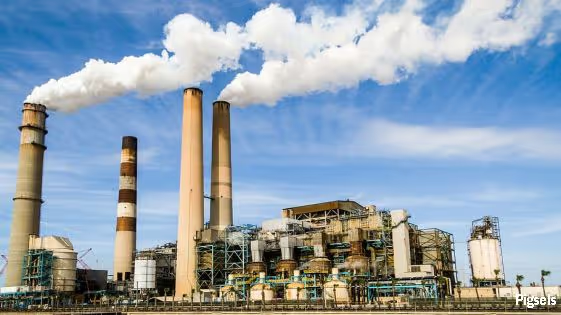
Industrial relocation policies have become increasingly popular as a policy tool to combat pollution in the developing world. Using Economic Census data from 2005 and 2013, this article examines the impact of an industrial relocation policy in Delhi, and shows that relocation caused a long-term change in the location and concentration of firms. The data also indicate distributional consequences – with firms that were relocated across larger distances being less likely to remain open in the long run

The hidden productivity benefits of energy-saving technology: Evidence from LEDs in Indian factories
Energy-efficient technologies are an increasingly relevant policy priority, given growing consensus on the need to tackle climate change. This column examines the productivity benefits of adopting one such technology – LED lighting – for manufacturing firms in India. It finds that improved productivity resulting from LED lighting’s lower heat emissions makes adopting such technology far less costly than previous anticipated, particularly for labour-intensive firms in hot climates.
The Impact of Climate and Pollution on Worker Productivity: Evidence from a Garment Factory in India
This project aims to answer the following research questions: i) What is the impact of air pollution on worker productivity and other labour outcomes (attendance, tardiness, and attrition)? ii) What is the impact of climate conditions (temperature and humidity) on worker productivity and other labour outcomes?