
.svg)
.svg)
%201.svg)
%201.svg)
.svg)

.svg)
.svg)
Navroz K. Dubash

Navroz K Dubash is a Professor at the Centre for Policy Research, a New Delhi-based think tank and an Adjunct Senior Research Fellow at the Lee Kuan Yew School of Public Policy, NUS. He has been actively engaged in global and national debates on climate change, air quality, energy and water as a researcher, policy advisor, and activist for over 25 years.
Navroz is a Coordinating Lead Author for the chapter on policies and institutions for the Sixth Assessment Report of the Intergovernmental Panel on Climate Change, serves on the UNEP GAP Report Steering Committee, and has been a member of the Scientific Advisory Group for the UN Climate Action Summit in 2019. He has worked to inform and advise Indian government policymaking on climate change, energy, and air and water policy over the last decade, including serving on the committee on a Long Term Strategy for Low Carbon Development for India. In the early 1990s, he helped establish the global Climate Action Network as its first international coordinator.
He has written widely on climate change, energy, and the environment, most recently, editing India in a Warming World: Integrating Climate Change and Development with Oxford University Press. In 2015 he was conferred the TN Khoshoo Memorial Award for his work on Indian climate change policy and the international discourse on global climate governance, and in 2018 his co-authored paper on interpreting model scenarios was awarded the Emerging Nations Award by Environmental Research Letters.
.svg)

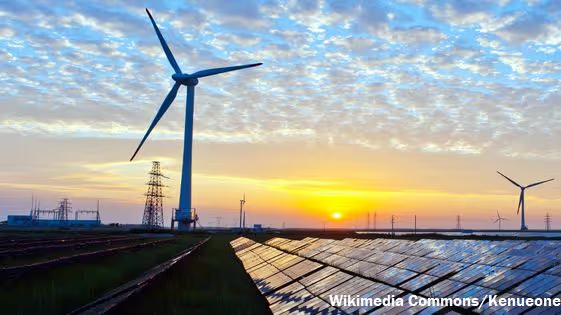
Keeping development at the forefront of India’s long-term climate strategy
India’s Long Term Low Emissions Development Strategy (LT-LEDS) sets out multiple low-carbon transitions, highlighting that climate action will be intimately tied to developmental processes. In this article, Chandra et al. identify some of the challenges and opportunities embedded within these transitions, and reflect on how these will impact developmental priorities such as employment and energy security. To operationalise the LT-LEDS effectively, they argue that India will benefit from planning now to minimise the trade-offs between low-carbon futures and development.


भारतीय कानून जलवायु-संबंधी नियमन किस प्रकार से कर सकता है?
बढ़ती हुई जलवायु परिवर्तन चिंता का समाधान केवल नीति के माध्यम से शायद पर्याप्त नहीं है। इस लेख में, दुबाश और श्रीधर कहते हैं कि जलवायु-संबंधित कानून से अर्थव्यवस्था के व्यापक परिणामों को सुनिश्चित किया जा सकता है, और जलवायु कानून को लागू करने की उम्मीद करने वाले देशों के समक्ष ऐसे नौ विचार प्रस्तुत करते हैं जिनको जलवायु परिवर्तन से प्रभावी ढंग से निपटने के लिए अपनाया जाना चाहिए। वे व्यापक राजनीतिक संदर्भ को ध्यान में रखते हुए, यह सुनिश्चित करते हुए कि पर्यावरण और विकास दोनों उद्देश्यों को पूरा किया जा सके; इन कानूनों को डिजाइन करने के संभावित तरीकों पर चर्चा करते हैं।
How could Indian law tackle climate governance?
As climate change becomes an increasing concern, addressing the problem only through policy may not be enough. In this piece, Dubash and Sridhar suggest that legislation around climate can ensure economy-wide outcomes, and put forth nine considerations that countries hoping to implement climate law should satisfy to effectively tackle climate change. They discuss possible approaches to design these laws – taking into account the broader political context – to make sure that both environmental and development objectives are met.
जलवायु संकट में भारत की संघीय प्रणाली की पुनर्कल्पना
सभी देशों की तरह भारत के लिए भी, जलवायु परिवर्तन एक अत्यंत तेजी से बढती समस्या बन गई है। इस लेख के जरिये पिल्लई एवं अन्य तर्क देते हैं कि इस समस्या के समाधान के लिए भारत की संघीय प्रणाली की पुनर्कल्पना करने की आवश्यकता है, क्योंकि भारत के संविधान में जलवायु संबंधी कई क्षेत्रों में राज्यों के महत्वपूर्ण कर्त्तव्य निर्धारित किये गए हैं। वे जलवायु नीति में संस्थागत सुधार हेतु एक नए दृष्टिकोण का सुझाव देते हैं, जो राष्ट्रीय लक्ष्यों के लिए अपने कार्यों का समन्वय करते हुए राज्यों को पर्याप्त लचीलापन देगा।
Reimagining Indian federalism in the climate crisis
Climate change is an increasingly urgent problem for India, as for all countries. In this post, Pillai et al. contend that addressing the issue requires reimagining Indian federalism, as the Indian Constitution gives states a crucial role in several arenas of climate action. They propose a new approach to institutional reform in climate policy, one that gives states adequate flexibility while coordinating their actions for national goals.

Understanding India’s energy and emissions future
India is an important player in global climate change mitigation, and it is crucial to understand its energy and emissions future. Projections for India’s 2030 CO2 emissions from energy range from 9% to 169% above 2012 levels – a small increase to well over a doubling in 18 years. Based on an interpretive review of seven studies, this article concludes that a doubling of CO2 emissions is a likely upper bound and that this trajectory is consistent with India’s Paris pledge