
.svg)
.svg)
%201.svg)
%201.svg)
.svg)

.svg)
.svg)
Nazar Khalid
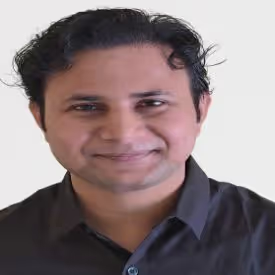
Nazar Khalid is a Ph.D. student in demography and population studies at the University of Pennsylvania, and a research fellow at the research institute for compassionate economics (r.i.c.e). His research interests include social stratification and mobility, poverty, health, and education. With r.i.c.e., Nazar has managed a phone survey project designed to measure attitudes towards marginalised groups, including women, lower castes, and Muslims, and to measure opinions about public policies in India. He has also conducted a household-level panel survey about sanitation behaviour in rural north India which examined why households in rural India find it difficult to switch to clean fuel use despite benefits for health.
.svg)


Using phone surveys to measure mental health
The public health and humanitarian crises caused by Covid-19 have led to greater recognition of the issue of poor mental health. Although mental health can affect work and quality of life much like physical health, it remains under-researched. In this article, Coffey et al. show that mobile phone surveys can be a valuable medium for incorporating mental health measurement into population-level health surveys.



Aadhaar, biometrics, and the PDS in Jharkhand
Aadhaar-based biometric authentication was made mandatory for obtaining rations under the Public Distribution System in Ranchi district in Jharkhand in August 2016. In this article, Nazar Khalid demonstrates that even a year later, a significant fraction of cardholders is still unable to buy their foodgrain rations.
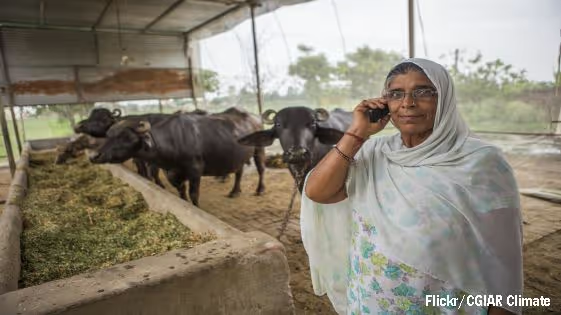
भारत में सामाजिक और आर्थिक अनुसंधान के लिए फोन सर्वेक्षण पद्धति
कोविड-19 के प्रसार को रोकने हेतु लगाई गई पाबंदियों और सामाजिक दूरी के दिशानिर्देशों के मद्देनजर फेस-टू-फेस सर्वेक्षणों के माध्यम से डेटा संग्रह करने में बड़ी बाधाओं का सामना करना पड़ा है। इस पोस्ट में कॉफ़ी एवं अन्य ने उनके द्वारा सामाजिक नज़रिया, भेदभाव, और सार्वजनिक राय पर वर्ष 2016 के बाद भारत के सात राज्यों एवं शहरों में किए गए मोबाइल फोन सर्वेक्षण करने के अपने अनुभव को साझा किया है।
Phone survey methodology for social and economic research in India
Data collection using face-to-face surveys has faced a roadblock in the wake of restricted mobility and social distancing guidelines to contain the spread of Covid-19. In this post, Coffey et al. describe their experience of conducting a mobile phone survey about social attitudes, discrimination, and public opinion, which has been carried out in seven states and cities in India since 2016.