
.svg)
.svg)
%201.svg)
%201.svg)
.svg)

.svg)
.svg)
Nicholas Haas

Nicholas Haas recently received his Ph.D. from the Politics Department at New York University. In Fall 2020, he will join the Department of Political Science at Aarhus University as an Assistant Professor. His research is broadly concerned with three questions: how can states with limited institutional capacity better address the demands of vulnerable populations; how do people seeking services decide between State and non-State alternatives; how does social polarisation affect political behaviour, and how can inter-group polarisation be lessened and conflict reduced? His scholarly work has been published or is forthcoming in the American Political Science Review, American Journal of Political Science, Public Choice, and Electoral Studies. His research has also appeared in The Monkey Cage at The Washington Post. You can hear him discuss some of his work here.
.svg)

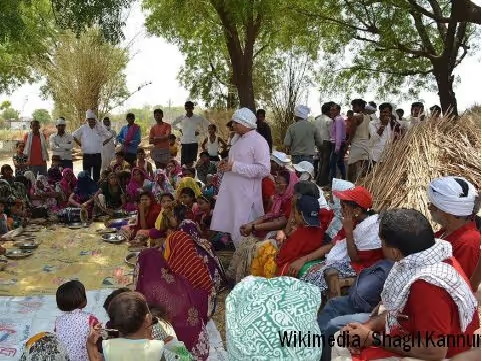
क्या राजनीतिक आरक्षण कारगर है? यदि हाँ तो किसके लिए?
क्या राजनीतिक आरक्षण विकास को कमजोर करता है या उसे बढ़ावा देता है, तो किसके लिए? यह लेख भारत के 'अनुसूचित क्षेत्रों' का विश्लेषण प्रस्तुत करता है, जहाँ ऐतिहासिक रूप से वंचित अनुसूचित जनजातियों के लिए राजनीतिक पद आरक्षित हैं। मनरेगा पर पड़ने वाले प्रभावों पर ध्यान देने से ज्ञात होता है कि आरक्षण का समग्र रूप से कोई बुरा परिणाम नहीं निकलता है। लक्षित अल्पसंख्यकों के लिए इसके कई लाभ हैं, जो अन्य अल्पसंख्यकों के बजाय अपेक्षाकृत विशेषाधिकार प्राप्त लोगों की कीमत पर आते हैं।


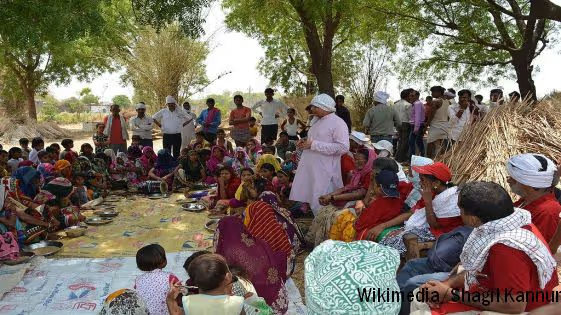
Does political reservation work, and for whom?
Does political reservation undermine or promote development, and for whom? This article presents an analysis of India’s Scheduled Areas, which reserve political office for the historically disadvantaged Scheduled Tribes. Focusing on the effects on MNREGA, it shows that reservation delivers no worse outcomes overall. There are large gains for targeted minorities, which come at the cost of the relatively privileged rather than other minorities.