
.svg)
.svg)
%201.svg)
%201.svg)
.svg)

.svg)
.svg)
Nidhiya Menon

Nidhya Menon is Associate Professor of Economics at Brandeis University, an affiliate of the Heller School for Social Policy and Management at Brandeis, and a Research Fellow at IZA. Her research interests are development economics, health, and labour. Current projects include short and long-term evaluations of the health consequences of water pollution in India, implications of the creation of a land market in Vietnam on household outcomes and child health, and programme evaluation in Indonesia in the absence of longitudinal data. She has been a researcher at the Grameen Bank, and a consultant with the World Bank and the United Nations Foundation in the past.
.svg)


The unintended child health consequences of the Green Revolution in India
While the Green Revolution in India greatly enhanced agricultural production, the enhanced use of fertilisers led to the contamination of surface and ground water. This column analyses the impact of fertiliser agrichemicals in water on infant and child health. It is found that exposure of mothers to these contaminants in the month after conception increases the chances of infant death within a month of birth, and also has long-lasting negative effects on child health.


कोयला आधारित बिजली इकाइयों से प्रदूषण और बच्चों एवं महिलाओं की एनीमिक स्थिति
स्वास्थ्य पर वायु प्रदूषण के प्रभाव को व्यापक रूप से शोध-साहित्य में जगह मिली है। जहां अन्य अध्ययनों में मुख्य रूप से सामान्य रुग्णता और मृत्यु दर जैसे परिणामों पर ध्यान केंद्रित किया गया है, यह लेख भारत में छोटे बच्चों और प्रौढ़ उम्र की महिलाओं की एनीमिक स्थिति पर कोयला आधारित बिजली इकाइयों द्वारा पड़ने वाले प्रदूषण के प्रभाव का मूल्यांकन प्रस्तुत करता है। इन अतिरिक्त लागतों के जुड़ जाने से नवीकरणीय ऊर्जा की ओर प्रगतिशील बदलाव और कोयले पर निर्भरता कम करने का मामला मजबूत होता है।
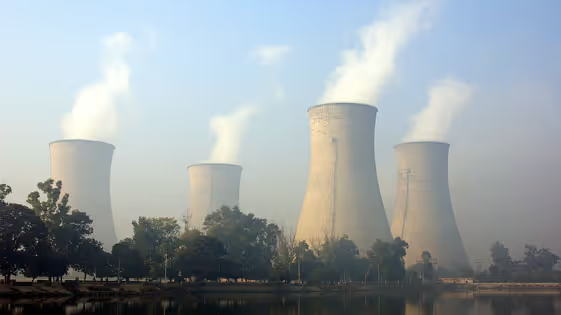
Pollution from coal-based power units and anaemic status of children and women
An extensive literature has considered the impact of air pollution on health. While studies have mainly focussed on outcomes such as general morbidity and mortality, this article evaluates the impact of pollution caused by coal-based power units on the anaemic status of young children and prime-age women in India. Factoring in these additional costs strengthens the case for a progressive shift to renewable energy and reduced reliance on coal.
Health policy and economic growth in India
A new synthesis paper (Menon 2017) produced by the International Growth Centre brings together evidence from various health-related IGC studies on India undertaken over the past seven years, to draw implications for health policy. At a workshop organised by IGC in collaboration with Ideas for India and Indian Statistical Institute, Srinath Reddy (Public Health Foundation of India), Alok Kumar (NITI Aayog), and Karthik Muralidharan (University of California, San Diego) discussed key policy lessons emerging from research, and areas where further work is required.

The growing problem of excess weight in India
The Indian population is increasingly becoming overweight or obese, and this phenomenon is likely to impose a considerable health burden in the future. Analysing data from the Indian Human Development Survey, this column finds that obesity is more evident among affluent, well-educated, urban groups, especially adult women. Increasing incomes and sedentary lifestyles are key contributing factors.

Seasonal Effects of Water Quality on Maternal and Infant Health in India
This project examines the impact of fertiliser agrichemicals in water on infant and child health using data on water quality combined with data on the health outcomes of infants and children from the Demographic and Health Surveys of India. Because fertilisers are applied at specific times in the growing season, the concentrations of agrichemicals in water vary seasonally and by agricultural region, as some Indian states plant predominantly summer crops while others plant winter crops.