
.svg)
.svg)
%201.svg)
%201.svg)
.svg)

.svg)
.svg)
Nirvikar Singh

Nirvikar Singh is Distinguished Professor of Economics at the University of California, Santa Cruz (UCSC), where he co-directs UCSC’s Center for Analytical Finance. He held the Sarbjit Singh Aurora Chair of Sikh and Punjabi Studies from 2010 to 2020, and also previously led its South Asian Studies Initiative. He has been a member of the Advisory Group to the Finance Minister of India on G-20 matters, and currently is a member of the Punjab Chief Minister's expert group on revitalizing the state economy. He previously served as Director of the Santa Cruz Center for International Economics, Co-Director of the Center for Global, International and Regional Studies, Special Advisor to the Chancellor (all at UCSC), and Consultant to the Chief Economic Adviser, Ministry of Finance, Government of India. He organised one of the first major US conferences on Indian economic reform.
He received his Ph.D. from the University of California, Berkeley, and his B.Sc. and M.Sc. from the London School of Economics, where he was awarded the Allyn Young Prize, Gonner Prize and Ely Devons Prize.
Professor Singh’s current research topics include entrepreneurship, information technology and development, electronic commerce, business strategy, political economy, federalism, economic growth and the Indian economy. He has authored over 100 research papers and co-authored/edited six books: The Other One Percent: Indians in America; Economic Transformation of a Developing Economy:The Experience of Punjab, India; Joint Ventures, International Investment and Technology Transfer; The Political Economy of Federalism in India; Waiting to Connect: India IT Revolution Bypasses the Domestic Industry; and The Oxford Handbook of the Economics of the Pacific Rim. He has also served as an advisor for several startups and knowledge services firms in Silicon Valley and in India.
.svg)

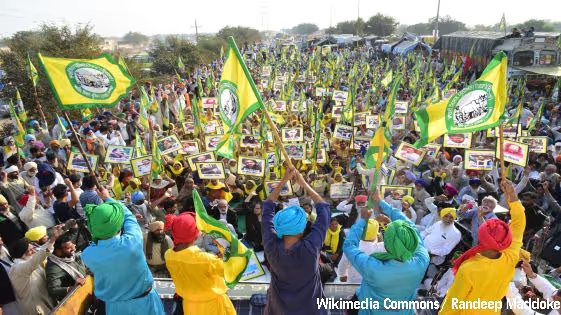
Farm laws: Reform needed but not at expense of small farmers
Commenting on the controversial farm laws, Kaushik Basu and Nirvikar Singh contend that the government should withdraw these laws, return to the drafting table, engage with farmers and states, and incorporate safeguards for the well-being of small farmers.



पंजाब का आर्थिक विकास : सम्भावनाएँ और नीतियाँ
वर्ष 2000 तक उत्तर भारतीय राज्य पंजाब देश में प्रति-व्यक्ति आय रैंकिंग में शीर्ष पर था, उसके बाद से इसकी स्थिति लगातार गिरती गई है। इस लेख में लखविंदर सिंह, निर्विकार सिंह और प्रकाश सिंह ने पंजाब की अर्थव्यवस्था- कृषि, विनिर्माण व सेवाओं, नौकरियों व शिक्षा और सार्वजनिक वित्त व शासन की वर्तमान स्थिति के सन्दर्भ में तथा राज्य के सामने आने वाली चुनौतियों के कारणों पर चर्चा की है। इसके अलावा विकास और सक्षम नीतियों की सम्भावनाओं पर भी विचार किया गया है। यह आइडियाज़@आईपीएफ2024 श्रृंखला का चौथा और अंतिम लेख है।
Economic development of Punjab: Prospects and policies
While the north Indian state of Punjab topped per-capita income rankings within the country until year 2000, its position fell consistently thereafter. This article discusses the current state of Punjab’s economy – in terms of agriculture, manufacturing and services; jobs and education; and public finance and governance – and the reasons for the challenges faced by the state. Further, they consider prospects for growth and enabling policies.

The Indian economy and policymaking: Towards ‘openness’
Providing his perspective on the recent policy paper by Subramanian and Felman, Nirvikar Singh contends that more emphasis is needed on financial reforms and innovation, addressing India’s export slowdown, and enhancing digital connectivity. In his view, greater transparency and openness to criticism will lead to better policymaking.

केंद्रीय बजट 2020 और भारत का आर्थिक भविष्य
इस पोस्ट में, निर्विकार सिंह ने यह चर्चा की है कि हम हाल ही में प्रस्तुत केंद्रीय बजट से भारत की अर्थव्यवस्था की संभावित दिशा के बारे में क्या जान सकते हैं। वे कहते हैं कि, हालांकि भारत की अर्थव्यवस्था पर संभावित प्रभावों के संदर्भ में यह बजट सकारात्मक है, हाल के वर्षों की तुलना में अंतर इतना है कि इसमें ध्यान दिए जाने और क्रियान्वयन के संबंध में तत्परता की आवश्यकता महसूस की गई है जो पिछले कुछ समय से आवश्यक नहीं समझी गई है।

Union Budget 2020 and India’s economic future
In this post, Nirvikar Singh discusses what we can learn from the recently presented Union Budget about the possible direction of India’s economy. He contends that, though the Budget is positive in terms of its potential impacts on India’s economy, the difference from recent years is a need for focus and implementation with an urgency that has not been needed for some time.
Union Budget 2016: Will it support India's economic transformation?
In this year’s Budget speech, the Finance Minister articulated the government’s agenda to ‘Transform India’ through a set of economic reforms framed in terms of ‘nine pillars’ - agriculture, rural development, health, education and skilling, infrastructure, financial sector, governance, fiscal discipline, and tax reform. In this article, Nirvikar Singh, Professor of Economics at the University of California Santa Cruz, summarises the highlights of the nine pillars and discusses whether or to what extent this Budget will support India’s economic transformation.
The 2015-16 Union budget and India's growth
The 2015-16 Union budget – the first full-year budget of the new government – was presented last week. In this article, Nirvikar Singh, Professor of Economics at the University of California Santa Cruz, contends that the budget is a welcome return to transparency and sanity, and has a host of small changes that add up to a promising reform agenda.
'Cry, the Beloved Country': Mending Punjab's economy
The growth rate of Punjab, which once ranked among India’s most affluent states, is slowing. In this article, Nirvikar Singh, who holds the Sarbjit Singh Aurora Chair of Sikh and Punjabi Studies at University of California Santa Cruz, diagnoses key issues with the Punjab economy and provides his perspective on what it would take to mend it.
The Goods and Services Tax: Light at the end of the tunnel?
As the Goods and Services Tax is inching towards implementation, a major overhaul of the Indian tax system has also been in progress. This article discusses three key strengths of the ongoing process, and highlights the merits of introducing GST as early as possible.
Can India grow faster again?
India’s growth prospects seem gloomy. This article argues that India can grow fast again even in the current global economic climate as it is different from other emerging economies in a number of important aspects. It recommends creating new businesses and jobs, developing internal supply chain networks, and domestic production of affordable consumer goods for reviving the growth rate.
Foreign investors under stress: Evidence at the firm level
Emerging market policymakers have been concerned about the financial stability implications of financial globalisation. These concerns are focussed particularly on behaviour under stressed conditions.
Understanding India's monetary policy
From the outside looking in, it may seem that India’s central bank is making up its own rules, making it difficult to predict the next movements in the interest rate. This column argues that the central bank is in fact following a rule, you just have to look hard enough.
Measuring India's Capital Control Regime
India’s policies on international capital flows are extremely complex, in part due to the absence of a consensus on the value of capital account controls. This column argues that the tools for measuring the implementation of the policy need to be revisited, and presents new evidence to suggest that India’s capital account has been liberalised – without leading to economic disaster.
Does Foreign Institutional Investment in India Increase Financial Vulnerability? An Empirical Investigation Using an Event Study Approach
Emerging market policymakers are concerned about the effects of foreign portfolio flows on financial stability. Do tail events in the home country trigger off extreme responses by foreign investors and is there any asymmetry between the responses of foreign investors to very good versus very bad days

How can Indians be happier?
The recently released World Happiness Report 2013 seeks to go beyond Gross Domestic Product and the Human Development Index to understand what really matters to people for their well-being. It is found that perceived social support and the effectiveness and honesty of the government are strongly associated with citizens’ life evaluations in India.
Introduction to e-Symposium: The good jobs challenge in India
One of the primary concerns for India is the question of jobs – specifically good quality jobs. Why has India lagged in creating opportunities for its working age population, and how different sectors can be leveraged to create good jobs? In this e-Symposium, anchored by Kunal Sen and Nirvikar Singh, six experts will weigh in on the different facets of the job-creation conundrum, from the perspective of the manufacturing sector, cities, trade, clusters, financing small firms, and the tradeable service sector.

The future of work from home
With the outset of the Covid-19 pandemic, work from home became the norm in 2020. However, even though mobility restrictions have been lifted, many workplaces all over the world continue to follow a model of remote or hybrid working. This has raised questions about worker productivity, work-life balance, and the future of commuting and cities. In this edition of I4I Conversations, Prof. Nirvikar Singh (University of California, Santa Cruz) and Prof. Nicholas Bloom (Stanford University) talk about the future of work. They delve into Prof Bloom's seminal work on management practices and work from home prior to the pandemic. They discuss the effects of flexibility on productivity, happiness and building managerial capital. They go on to speak about trends in remote work over the last few years, and how that has differed across countries. This leads to further discussion about the impact on cities and the environment, as more people move to suburbs and commute to work. They also touch ..
The future of work from home
With the outset of the Covid-19 pandemic, work from home became the norm in 2020. However, even though mobility restrictions have been lifted, many workplaces all over the world continue to follow a model of remote or hybrid working. This has raised questions about worker productivity, work-life balance, and the future of commuting and cities. In this edition of I4I Conversations, Prof. Nirvikar Singh (University of California, Santa Cruz) and Prof. Nicholas Bloom (Stanford University) talk about the future of work. They delve into Prof Bloom's seminal work on management practices and work from home prior to the pandemic. They discuss the effects of flexibility on productivity, happiness and building managerial capital. They go on to speak about trends in remote work over the last few years, and how that has differed across countries. This leads to further discussion about the impact on cities and the environment, as more people move to suburbs and commute to work. They also touch ..
Management and India’s economic growth
India has produced a well-recognised elite of managers, some of whom have demonstrated their capabilities in premier firms outside the country. In this post, Nirvikar Singh discusses existing empirical evidence from India that demonstrates the importance of managerial skills for economic growth, and recommends policy measures that can promote good management.

Manufacturing, management and mysteries
The private sector is crucial to India’s development. This column asks how it can be more effective. Looking at a large sample of Indian manufacturers it suggests that what many firms may be missing is good management.
Financial inclusion: Concepts, issues, and policies for India
The International Growth Centre recently brought out a synthesis paper (Singh 2017) that lays out the basic concepts surrounding financial inclusion, and reviews a wide range of IGC and other studies on financial inclusion. At a workshop organised by the IGC in collaboration with Ideas for India and Indian Statistical Institute, Rohini Pande (Harvard Kennedy School), S. Krishnan (State government of Tamil Nadu), Ashok Bhattacharya (Business Standard), and R Gopalan (ex-Ministry of Finance) discussed the key lessons emerging from research, implications for policy, and areas where further work is needed.
Foreign currency borrowing by Indian firms: What do we know?
As foreign currency borrowing by Indian firms has been increasing, concerns have surfaced about rising associated risks. Hence, recent policy changes seeking to make the regulatory regime simpler and more transparent are timely. This column addresses several important questions regarding foreign currency borrowing of Indian firms, the answers to which can provide a firmer basis for ongoing policy formulation.
Foreign borrowing by Indian firms: Implications for growth and macroeconomic stability
This project analyses the pattern of external borrowing by Indian firms, an exercise that has as yet not been carried out. It identifies possible drivers of such borrowing.
Challenges and priorities for financial sector reform in India
I4I Editor Nirvikar Singh (Professor, University of California, Santa Cruz) interviews K.P. Krishnan (Former Additional Secretary, Department of Economic Affairs, Ministry of Finance) on the central government’s plans and priorities for financial sector reform, and associated challenges. Dr Krishnan provides his perspective on issues including the regulatory architecture, financial inclusion initiatives, strengthening the banking system, and infrastructure financing.
Foreign investors under stress: Evidence from India
Emerging market policymakers are concerned about the effects of foreign portfolio flows on financial stability. This column focuses on the behaviour of investors in extreme events, allowing for the possibility that what happens under stressed market conditions may differ from day-to-day outcomes. The findings for India suggest that while on good days, foreign investors exacerbate the boom by bringing in additional capital, no significant effects are found on very bad days in the local economy.