
.svg)
.svg)
%201.svg)
%201.svg)
.svg)

.svg)
.svg)
Oriana Bandiera

Oriana Bandiera is Professor of Economics and Director of STICERD at the London School of Economics and Political Science. Oriana is fellow of CEPR, BREAD and IZA, co-director of the research programme in State Capabilities within the International Growth Centre at the LSE, and on the board of editors of the Journal of Economic Literature, Economic Journal and Journal of Development Economics. Her research focuses on the study of contracts and incentives in a broad range of organizations and countries. Her work has been published in leading academic journals such as the American Economic Review, Econometrica and the Quarterly Journal of Economics. She is the 2011 recipient of Carlo Alberto medal, awarded bi-annually to an Italian economist under the age of 40 for “outstanding research contributions to the field of economics.”
.svg)


What do Indian CEOs do?
While the Indian manufacturing sector has experienced rapid growth since the early 1990s, it is characterised by large productivity differences across firms and presence of several low productivity firms that use poor managerial practices. This column examines differences in CEOs’ management style via their time use to provide new insights on the observed diversity across firms.


What do Indian CEOs do? Time Use of Indian Top Executives: Determinants and Implications for Growth
This project presents evidence on the labour supply of CEOs, and on whether family and professional CEOs differ on this dimension. It does so through a new survey instrument that allows it to codify CEOs’ diaries in a detailed and comparable fashion, and to build a bottom-up measure of CEO labour supply.
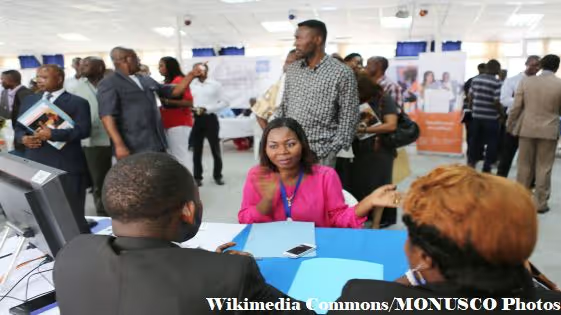
Aiding the search for good jobs: Evidence from Uganda
To design policies that lead young labour-market entrants to good jobs, it is important to understand job search processes and what affects the ability to find gainful employment. Based on an experiment in Uganda involving two interventions – vocational training and matching workers with firms – this article shows that while training enhances optimism about employment prospects, matching causes discouragement and poorer labour market outcomes in the long run.

Creating entrepreneurs: A big new idea in development
Can the world’s poorest people become entrepreneurs? This column outlines results from an evaluation of the Ultra Poor programme in Bangladesh, a scheme that the NGO behind it claims is a staggering success.