
.svg)
.svg)
%201.svg)
%201.svg)
.svg)

.svg)
.svg)
Parikrama Chowdhry

Parikrama Chowdhry is a Senior Policy Manager in the Scale-ups team at J-PAL South Asia. Before joining J-PAL, she worked with Syngenta Foundation, India, where she led the Partnerships vertical. She also led the scale-up of an Agri-Entrepreneurship model (with a focus on gender and climate smart agriculture) in collaboration with various State Governments (State Rural Livelihood Missions) and international organisations.
Before moving to the development sector she worked in ecommerce, developing partnerships and strategic initiatives. Parikrama also gained experience in Analytics, working with Mckinsey Knowledge center and in Government Advisory with Ernst and Young Pvt. Limited.
She holds a Master’s in Business Administration from Indian Institute of Management, Indore, and a BA (Hons) in Economics from Shri Ram College of Commerce, Delhi University.
.svg)

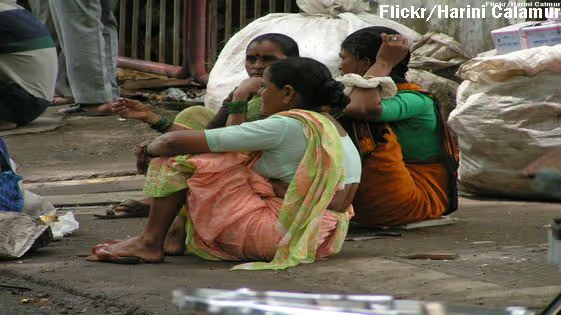
अज्ञात गरीबों की खोज: अत्यधिक गरीबी में रहने वाले लोगों की पहचान और लक्ष्यीकरण
गरीबी के बारे में अलग-अलग अनुमानों के परिणामस्वरूप कुछ वंचित समुदाय अक्सर सरकारी कल्याण योजनाओं से बाहर रह जाते हैं। सबरवाल और चौधरी बिहार में लागू ‘सतत जीविकोपार्जन योजना’ का अध्ययन करते हैं, जिसमें अत्यधिक गरीबी में रहने वाले लोगों की पहचान करने और यह सुनिश्चित करने के लिए कि उन्हें सामाजिक सुरक्षा योजनाओं तक पहुंच प्राप्त हो, बीआरएसी द्वारा अपनाए गए ‘ग्रेजुएशन अप्रोच’ कार्यप्रणाली के ज़रिए सामुदायिक ज्ञान का उपयोग किया जाता है। वे इस बात की चर्चा करते हैं कि यह लक्ष्यीकरण दृष्टिकोण किस तरह से गैर-मौद्रिक अभाव को ध्यान में रखता है और महिलाओं व अन्य हाशिए पर रहने वाले समूहों का समावेश सुनिश्चित करता है।


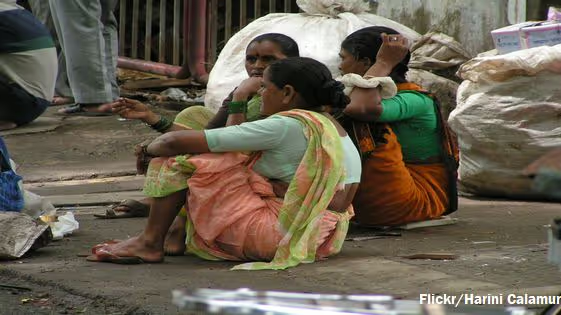
Finding the indiscernible poor: Community knowledge as a targeting approach
Varying estimates of poverty have often resulted in some deprived communities being excluded from government welfare schemes. Sabarwal and Chowdhry look at the case of Satat Jeevikoparjan Yojana in Bihar, which uses the mechanisms recommended by BRAC’s Graduation Approach and harnesses community knowledge to identify those living in extreme poverty and ensure that they receive access to social protection schemes. They discuss how this targeting approach takes into account non-monetary deprivation, and ensures the inclusion of women and marginalised groups.