
.svg)
.svg)
%201.svg)
%201.svg)
.svg)

.svg)
.svg)
Parikshit Ghosh

Parikshit Ghosh is the Editor-in-Chief of Ideas for India. Parikshit Ghosh is a Professor at the Delhi School of Economics. He received his Ph.D. in economics from Boston University, and has taught at Texas A&M University, University of British Columbia and the Indian Statistical Institute. Ghosh’s research focuses on game theory and information economics. He has written about contemporary policy issues in various Indian newspapers, including Hindustan Times, Economic Times and Anandabazar Patrika.
.svg)

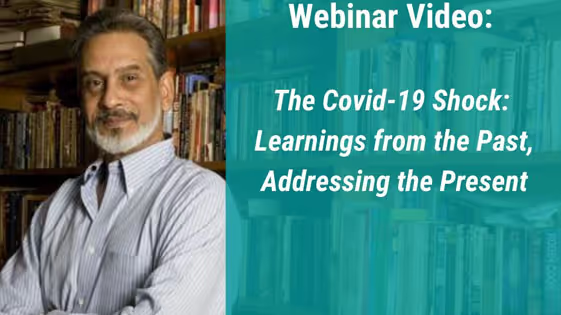
Webinar video: The Covid-19 shock
The Covid-19 pandemic and the containment measures adopted to check the spread of the disease, have caused an unprecedented economic crisis in India as well as the rest of the world. Further, India is experiencing a massive humanitarian crisis, exemplified by the scale of reverse migration that is in progress. There is an urgent need for the government to implement policies designed to mitigate the economic damage, and alleviate the suffering of the most vulnerable. In this webinar (12 June 2020) – moderated by Prof. Parikshit Ghosh, Member of the I4I Editorial Board – Dr Pronab Sen reviews the current status, and deliberates on what needs to be done, and where we are likely to be in the future. The webinar is based on Dr Sen’s recent five-part series on I4I.



हमें कोविड-19 से लड़ने के लिए एक मार्शल प्लान की आवश्यकता है
कोविड -19 महामारी के खिलाफ लड़ाई में अभी भी बहुत कुछ अज्ञात है, लेकिन दो कड़े सबक स्पष्ट रूप से दिखाई देते हैं: हमें अपनी स्वास्थ्य देखभाल क्षमता को सुदृढ़ करने तथा सामाजिक-सुरक्षा जाल को मजबूत बनाने के लिए सभी स्तरों पर आक्रामक रूप से प्रयत्न करने आवश्यकता है। इस पोस्ट में, परीक्षित घोष तर्क देते हैं कि अगर वायरस के खिलाफ लड़ाई को युद्ध के रूप में माना जाए, तो हमें यह युद्ध को लड़ते वक्त मार्शल प्लान की आवश्यकता होगी ना कि युद्ध के बाद।
We need a Marshall Plan to fight Covid-19
There are still a lot of unknowns in the fight against the Covid-19 pandemic, but two robust lessons are clear: we need to pull out all stops to strengthen our healthcare capacity and reinforce social-safety nets on a massive scale. In this post, Parikshit Ghosh argues that if the fight against the virus is given the metaphor of war, we need a Marshall Plan while we fight that war, not after it is over.

Introduction to e-Symposium: The GDP conundrum
Ever since India’s Central Statistical Organisation came out with the new GDP series with 2011-12 as the base year, controversy has surrounded it. The CSO claims that the new series is calculated based on a number of methodological changes that bring India closer to international practice. However, the resulting high growth figures do not seem to quite agree with several other indices that usually reflect the strength of the economy.
A conversation on development - I
Parikshit Ghosh (Member of the I4I Editorial Board & Associate Professor of Economics, Delhi School of Economics) speaks with Kaushik Basu (Chief Economist and Senior Vice President, World Bank and former Chief Economic Adviser, Government of India) on issues ranging from the change in World Bank’s mission and its engagement with the world, rising inequality in the developed world, managing the negative side effects of growth, to the role of behavioural economics and paternalism in development, and the exclusionary nature of the ongoing digital revolution.
Land acquisition Act: Addressing both justice and prosperity
The Modi government’s land acquisition ordinance did away with the consent and social impact assessment requirements for private projects in certain sectors under UPA’s 2013 land Act. In this article, Ghatak and Ghosh contend that in seeking to eliminate these hurdles, the ordinance puts more weight on prosperity and less on justice. In their view, justice and prosperity need not be irreconcilable objectives.
Land acquisition debate: The price is not right
The central government’s move to amend the 2013 land acquisition Act has come under criticism for being ‘anti-farmer’. In this article, Maitreesh Ghatak and Parikshit Ghosh argue that while the amendments would streamline the land acquisition process, the law will still be fatally flawed unless a more rational method of determining compensation for land owners is put in place.
The Land Acquisition Act is deeply flawed
In the second part of the Land Acquisition Act debate, Ghatak and Ghosh argue that the legislation is ill-conceived and falls short on several counts. They contend that the formula for compensation is arbitrary, and recommend holding large-scale land auctions to discover the true value of land. They contradict Pande’s point that the Act strikes a fine balance between industrialists and farmers.
The Land Acquisition Bill
Will the new Land Acquisition Bill make protests like those in Singur and Bhatta-Parsaul a thing of the past? Will it make land acquisition so expensive and difficult that the pace of industrialisation will suffer? Will it achieve justice? Development? Neither? Experts from academia and industry examine a piece of legislation that is likely to have far reaching consequences for the future of the country.
The Land Acquisition Bill
Will the new Land Acquisition Bill make protests like those in Singur and Bhatta-Parsaul a thing of the past? Will it make land acquisition so expensive and difficult that the pace of industrialisation will suffer? Will it achieve justice? Development? Neither? Experts from academia and industry examine a piece of legislation that is likely to have far reaching consequences for the future of the country.
Land acquisition: Is there a way out?
India is hungry for space to grow into a developed economy. Yet this hunger is increasingly raiding farmland and threatening traditional livelihoods. For some, this is a necessary evil, for others it is unjustified exploitation. This column argues that the debate need not be so stark and that politicians, policymakers and the public need to see that another way is possible.

Introduction to e-Symposium: The architecture of affirmative action
The Supreme Court of India recently upheld an amendment that excluded Scheduled Castes, Scheduled Tribes and Other Backwards Classes from the Economically Weaker Section (EWS) quota, restricting it only to general category applicants. However, the specifics of how this reservation policy is executed can have important social and political implications. Across this week, from 12-16 December, this I4I e-Symposium brings together articles that provide a theoretical basis – using principles of market design, and search and matching theory – for more efficient implementation of reservation policies. Anchored by I4I’s Editor-in-Chief Parikshit Ghosh, the e-Symposium aims to open a discussion on the architecture of affirmative action, from the mechanisms of vertical and horizontal reservations, to ensuring efficiency in meeting diversity targets.
Parikshit Ghosh speaks with Karl Ove Moene
There is a view that upsurge in inequality due to globalisation is leading to rising appeal of political platforms that promote inward-looking policies. In this podcast, Parikshit Ghosh (Member of the I4I Editorial Board & Associate Professor, Delhi School of Economics) speaks with Karl Ove Moene (Professor, Centre for the Study of Equality, Social Organization, and Performance, Department of Economics, University of Oslo) on the benefits of the Scandinavian model of social protection rather than protectionism, and the challenges associated with financing a welfare State.
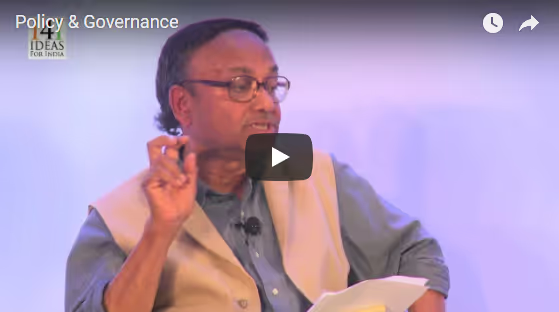
I4I Panel Discussion: Two years of Modi government
In a panel discussion organised to mark the 4th anniversary of Ideas for India, Parikshit Ghosh (Member of the I4I Editorial Board & Associate Professor, Delhi School of Economics) moderates a discussion on ‘Two years of Modi government’ among Pranab Bardhan (University of California, Berkeley), Mihir Sharma (Bloomberg View) and Pratap Bhanu Mehta (Centre for Policy Research), encompassing issues related to policy and governance; corruption; manufacturing; social sector; and social and cultural issues.

W(h)ither the State? 25 years of economic liberalisation
24 July 2016 marked 25 years of liberalisation of the Indian economy. In this article, Parikshit Ghosh, Associate Professor of Economics at Delhi School of Economics, contends that liberalisation did not mean the State should wither away and let markets rule the roost; it redefined complementary roles for the State and markets, making each more important than before.
Missing the target: NDA's not-so-rosy report card on social policy
In this article, Parikshit Ghosh, Associate Professor of Economics, Delhi School of Economics, assesses the performance of the social sector under the NDA government at the end of two years in office.
Debate: The Aadhaar Bill
In a debate on the Aadhaar Bill, commentators from academia and civil society will weigh in on issues around potential benefits and privacy concerns.
A conversation on development - II
Parikshit Ghosh (Member of the I4I Editorial Board & Associate Professor of Economics, Delhi School of Economics) speaks with Kaushik Basu (Chief Economist and Senior Vice President, World Bank and former Chief Economic Adviser, Government of India) on issues ranging from the use of economic knowledge in policy decisions, role of values in public service delivery, to the need for pluralism and tolerance for economic growth, and the importance of communicating good ideas effectively to policymakers and the general public. This part of the interview focuses on India-specific issues. This is the fourth in the series of I4I Conversations.
India's illiberal speech climate
India’s cultural watchdogs and hate speech laws are increasingly seeking to restrict free expression in the country. This article contends that the right to take offence is fundamentally incompatible with the right to speak freely, and outlines three reasons for protecting free speech.

Introduction to e-Symposium: The idea of a universal basic income in the Indian context
The idea of an unconditional basic income given to all citizens by the State, has caught on in the developed world. Does it make sense for India? To examine the issue, Parikshit Ghosh (Member of the I4I Editorial Board) is hosting an e-Symposium on the idea of a universal basic income in the Indian context. Over the next week, economists Pranab Bardhan (University of California, Berkeley), Abhijit Banerjee (Massachusetts Institute of Technology), Maitreesh Ghatak (London School of Economics), Debraj Ray (New York University), Kalle Moene (University of Oslo), T.N. Srinivasan (Yale University) and Vijay Joshi (University of Oxford) will contribute to the e-Symposium.

The tariff tantrums
President Trump’s administration has imposed steep tariffs on countries across the world, ostensibly to promote fair trade and reduce US trade deficits. However, Parikshit Ghosh argues that these “reciprocal” tariffs lack clear economic logic and reflect a mercantilist worldview. He notes that India should be prepared for a global recession in the face of this policy, and should tap into the strength of its domestic markets
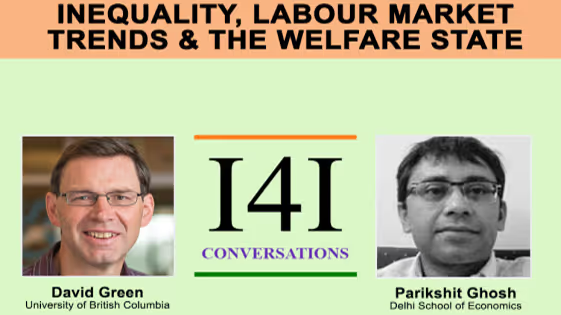
Inequality, labour market trends, and the welfare State
All around the world, rising levels of inequality – particularly in the last 3-4 decades – have been recognised as a major issue. In this context, David Green (University of British Columbia) and Parikshit Ghosh (I4I Editorial Board; Delhi School of Economics) discuss various factors including trade and globalisation; gradual ideological shift to the 'right'; the changing nature of work – role of technological advancements, hierarchies created by higher education, and 'rents' rather than returns to skill. They also examine social protection – going beyond income support to also provide public services and foster communities, identifying rents in the economy to generate tax revenue to fund welfare, shifting from redistribution as charity to redistribution as justice and how Covid-19 can jumpstart this attitudinal change. This is the second edition of I4I Conversations.

Parikshit Ghosh speaks with Debraj Ray
In this podcast, Parikshit Ghosh (Member of the I4I Editorial Board & Associate Professor, Delhi School of Economics) speaks with Debraj Ray (Julius Silver Professor, Faculty of Arts and Science, and Professor of Economics, New York University) on the rise of Trump and how it relates to the upsurge of inequality in the US and the ‘American dream’ narrative; implications of the process of automation for the relative shares of capital and labour as factors of production; the idea of committing a share of gross domestic product for the provision of a universal basic income; and the challenges involved in addressing inequality of wealth.

Introduction to e-Symposium: Tiger conservation in India
Despite a recent upward trend in tiger populations in India, the tiger remains on the endangered species list. Saving the tiger, therefore, is not a fait accompli but a continuous struggle that must be informed by scientific monitoring and analysis. Following Global Tiger Day on 29 July, Ideas for India will host a three-part series, anchored by Parikshit Ghosh, bringing together experts to discuss the challenges of tiger conservation, from human-animal conflict, to the unique ecosystem of various habits and climate-induced threats.
लाल में रहते हुए हरित होने के प्रयास
स्वीडन के स्टॉकहोम में 5 से 16 जून, 1972 को आयोजित पहली पर्यावरण संगोष्ठी के परिणामस्वरूप 1973 की 5 जून को 'मात्र एक पृथ्वी' के थीम से मनाए जाने वाले विश्व पर्यावरण दिवस ने एक लम्बी अवधि का सफर तय कर लिया है। परन्तु क्या पृथ्वी के समस्त देशों और भारत ने भी पर्यावरण को मानव कल्याण योग्य बनाए रखने की दिशा में उतना ही लम्बा सफर तय किया है? इस महत्वपूर्ण अवसर पर I4I के प्रधान संपादक परीक्षित घोष भारत की पर्यावरण नीति, सामाजिक सुरक्षा जाल और व्यापक आर्थिक प्रबंधन में सामंजस्य स्थापित करने वाले एक समग्र दृष्टिकोण की चर्चा करते हैं। जलवायु सम्बन्धी ज़रूरतें कब और कहाँ से उत्पन्न होंगी, इसके पूर्वानुमान में आ रही कठिनाई को देखते हुए, वे देश के लिए एक समेकित हरित निधि का विचार प्रस्तुत करते हैं।
Going green while being in the red
In the third post of a three-part blog series, I4I Editor-in-Chief Parikshit Ghosh advocates for a holistic approach that harmonises India’s environmental policy, social safety nets, and macroeconomic management. Given the difficulty of predicting where and when climate-related needs will arise, he puts forth the idea of a consolidated green fund for the country.
Delhi’s air: Parikshit Ghosh speaks with Mohan P George
Edited excerpts from an in-depth interview with Dr. Mohan P George (Senior Scientist, Delhi Pollution Control Committee), conducted by Parikshit Ghosh (Member of the I4I Editorial Board; Associate Professor, Delhi School of Economics) on the crucial public policy problem of air pollution in Delhi.
Improving Urban Air Quality in India: Lessons from the Kolkata Clean Air Regulations of 2009
This paper analyses the change in the economic returns of auto-rickshaw drivers in Kolkata (formerly Calcutta), roughly one year after they were required to shift to using liquefied petroleum gas (LPG) in 2009 as per the Kolkata clean air regulations.
On demonetisation
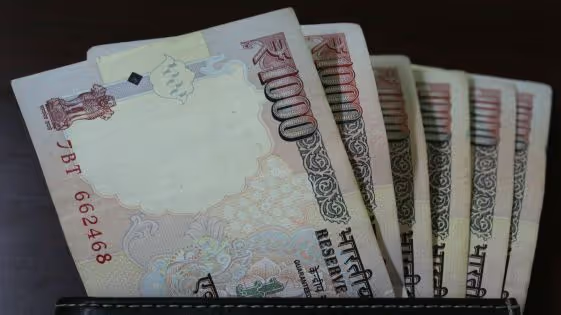
On the evening of 8 November, the Prime Minister announced on national television that Rs. 1,000 and 500 notes are no longer legal tender, and must be exchanged at the banks for newly issued currency. This major policy intervention has sparked a country-wide debate. Will it curb black money? Is it going to nudge us towards a cashless society? How much will be the collateral damage from the liquidity shock and is it a price worth paying?
Currency shock: Does the gain justify the strain?
On the evening of 8 November, PM Modi announced that 1,000 and 500 rupee notes will cease to be legal tender post-midnight. In this article, Parikshit Ghosh, Associate Professor of Economics at the Delhi School of Economics, contends that there are bigger, juicier and relatively low-hanging fruit the government is not reaching for, in the fight against black money.
रॉबर्ट सोलोव और 'राष्ट्रों की संपन्नता'
अर्थशास्त्र में नोबेल पुरस्कार विजेता रॉबर्ट सोलोव की हाल ही, दिसम्बर 2023 में मृत्यु हुई। उन्हें श्रद्धांजलि अर्पित करते हुए, I4I के प्रधान सम्पादक परीक्षित घोष इस दिवंगत के कुछ योगदानों को रेखांकित करते हैं और अर्थव्यवस्था के लिए उदाहरणों व रूपकों के माध्यम से इस बात पर प्रकाश ड़ालते हैं कि किस प्रकार से सोलोव मॉडल में गणितीय ढाँचे में विकास को मद्धम करने (टेपर करने) का विचार प्रस्तुत किया गया है। इस मॉडल के सन्दर्भ में वे भारत में कैच-अप विकास की जाँच करते हैं और जन-साधारण की समृद्धि के लिए, जो कई देशों के लिए एक सपना बन के रह गया है, सामान्य समझ से परे देखने की आवश्यकता पर ज़ोर देते हैं।
Robert Solow and the ‘Wealth of Nations’
In a tribute to Robert Solow, I4I’s Editor-in-Chief Parikshit Ghosh outlines some of the late Nobel Laureate’s contributions to macroeconomics, and uses examples and metaphors for the economy to explain how the Solow model presents the idea of tapering growth in a mathematical framework. He examines catch-up growth in India in the context of this model, and highlights the need to look beyond the usual suspects to find the path to mass prosperity that remains elusive to many nations.

The man who loved forests
On Ideas for India’s 10th anniversary, our Editor-in-Chief Parikshit Ghosh pens a tribute honouring the late Ashok Kotwal, whose vision and values percolated our portal’s character to make it a veritable ‘forest’ of ideas; a collaborative and self-sustaining ecosystem of engaged I4I contributors and readers has been possible only by building bridges across ideological and disciplinary chasms in the decade gone by.

Doing our bidding: Auctions and the greater common good
This year’s Nobel Prize in Economics has been awarded to Paul Milgrom and Robert Wilson for improvements to auction theory and inventions of new auction formats. In this post, Parikshit Ghosh discusses the evolution of auction theory and the significant contributions of the Laureates.