
.svg)
.svg)
%201.svg)
%201.svg)
.svg)

.svg)
.svg)
Partha Dasgupta
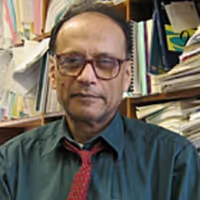
He is currently Frank Ramsey Emeritus Professor of Economics at the University of Cambridge, Fellow of St Johns College, Cambridge, and Professorial Research Fellow at the Sustainable Consumption Institute, University of Manchester. Since 1999 he has been a Founder Member of the Management and Advisory Committee of the South Asian Network for Development and Environmental Economics (SANDEE), Kathmandu. In 1996 he helped to establish the journal Environment and Development Economics, published by Cambridge University Press, whose purpose has been not only to publish original research at the interface of poverty and the environmental-resource base, but also to provide an opportunity to scholars in developing countries to publish their findings in an international journal.
Partha Dasgupta, was educated in Varanasi (Matriculation 1958 from Rajghat Besant School), Delhi (B.Sc. Hons, in Physics, 1962, University of Delhi), and Cambridge (B.A. Hons. in Mathematics, 1965, and Ph.D. in Economics, 1968) at the University of Cambridge). He is the son of the noted economist Amiya Dasgupta (1903-1992).
Professor Dasgupta research interests have covered welfare and development economics, the economics of technological change, population, environmental and resource economics, the theory of games, the economics of undernutrition, and the economics of social capital.
Professor Dasgupta is a Fellow of both the British Academy and the Royal Society (the first and so far only economist to be elected into the Royal Society since Malthus). He is also a Foreign Associate of the US National Academy of Sciences.
He was named Knight Bachelor by Her Majesty Queen Elizabeth II in her Birthday Honours List in 2002 for "services to economics"; was co-winner (with Karl-Goran Maler of the Beijer International Institute of Ecological Economics, Stockholm) of the 2002 Volvo Environment Prize and of the 2004 Kenneth E. Boulding Memorial Award of the International Society for Ecological Economics; and was the recipient of the John Kenneth Galbraith Award, 2007, of the American Agricultural Economics Association
.svg)


Getting India wrong
In this article, Partha Dasgupta argues that deliberations on economic development, as in the recently published books by Bhagwati-Panagariya and Dreze-Sen respectively, are of little instrumental use if they ignore the role that high population growth and environmental destruction play in the persistence of poverty.


Economics and the environment
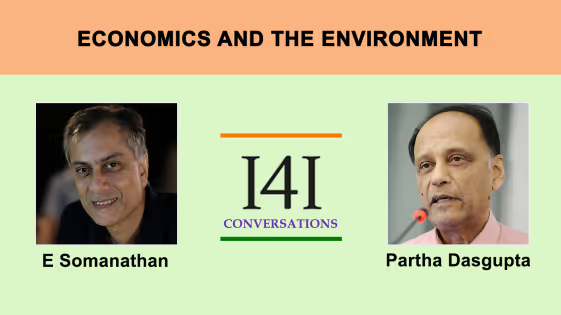
Published in February 2021 by the UK government, the ‘Dasgupta Review’ calls for changes in how we think, act and measure economic success to protect and enhance our prosperity and the natural world. Against the backdrop of the Review, in the fourth edition of I4I Conversations, E. Somanathan speaks with Partha Dasgupta, tracing the origins of his interest in environmental economics – a consistent theme of his academic work that spans several fields of economics – and how his thinking on the issue has evolved over the years. They foray into economic theorising of the ecology’s imprint on collective behaviours; fusing micro and macro perspectives on the embeddedness of the economy in nature; the complexities of accounting for natural wealth in economic terms and enhancing this wealth via small institutional changes; how average yields of primary producers such as algae are much higher than of virtually any other investment; how the millions of small errors we are making are adding up t
Economics and the environment
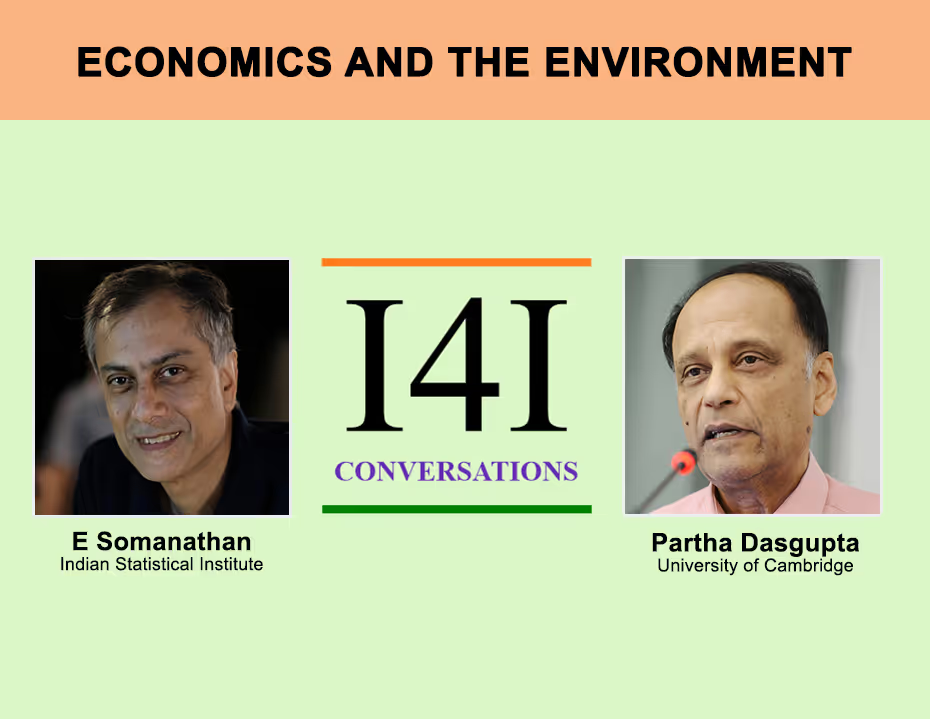
Published in February 2021 by the UK government, the ‘Dasgupta Review’ calls for changes in how we think, act and measure economic success to protect and enhance our prosperity and the natural world. Against the backdrop of the Review, in the fourth edition of I4I Conversations, E. Somanathan speaks with Partha Dasgupta, tracing the origins of his interest in environmental economics – a consistent theme of his academic work that spans several fields of economics – and how his thinking on the issue has evolved over the years. They foray into economic theorising of the ecology’s imprint on collective behaviours; fusing micro and macro perspectives on the embeddedness of the economy in nature; the complexities of accounting for natural wealth in economic terms and enhancing this wealth via small institutional changes; how average yields of primary producers such as algae are much higher than of virtually any other investment; how the millions of small errors we are making are adding up