
.svg)
.svg)
%201.svg)
%201.svg)
.svg)

.svg)
.svg)
Pascual Restrepo

Pascual Restrepo is Assistant Professor of Economics at Boston University. His research interests span labour and macroeconomics. His current research examines the impact of technology, and in particular of automation, on labour markets, employment, wages, inequality, the distribution of income, and growth. Recent empirical projects include a study of the impact of industrial robots on US labour markets, a study of how the decline of routine jobs interacted with the Great Recession, and a study on how aging and shortages of labour induce firms to automate their production process. His theoretical work centres on developing micro-founded models of technology choice to think about the short and long-run implications of different technologies and whether the resulting growth process is balanced.
.svg)


Does democracy cause growth?
Many analysts view democracy as a neutral or negative factor for growth. This column discusses new evidence showing that democracy has a robust and sizeable pro-growth effect. It finds that a country that switches from non-democracy to democracy achieves about 20% higher GDP per capita over the subsequent three decades.


Automation and inequality
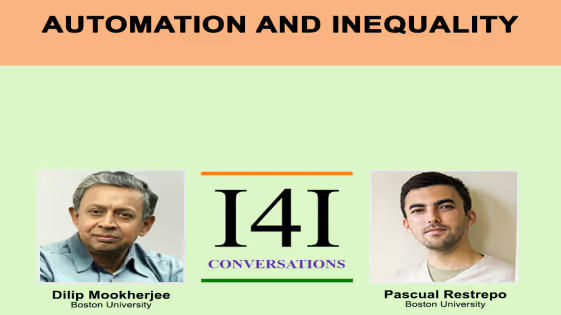
Public discourse around automation has seen some take a fairly alarmist view – with concerns around its impact on employment, wages, the labour share of national income, and inequality. Others take a more optimistic view – that short-run turbulence and long-run increases in welfare are the typical outcomes of any technological change. In this context, Dilip Mookherjee (Boston University) speaks with Pascual Restrepo (Boston University) to discuss the evidence around the developed and developing country experience with automation, and whether the optimistic or alarmist view is bearing out in reality. Prof Restrepo outlines the definition of automation technology – differentiating it from ‘augmenting’ technologies – and contends, that like most things in economics, the answer lies somewhere in the middle of the alarmist and optimist views. They foray into discussing evidence on automation and technological change for developed countries: decline in the labour share of national income,,,

Automation and inequality
Public discourse around automation has seen some take a fairly alarmist view – with concerns around its impact on employment, wages, the labour share of national income, and inequality. Others take a more optimistic view – that short-run turbulence and long-run increases in welfare are the typical outcomes of any technological change. In this context, Dilip Mookherjee (Boston University) speaks with Pascual Restrepo (Boston University) to discuss the evidence around the developed and developing country experience with automation, and whether the optimistic or alarmist view is bearing out in reality. Prof Restrepo outlines the definition of automation technology – differentiating it from ‘augmenting’ technologies – and contends, that like most things in economics, the answer lies somewhere in the middle of the alarmist and optimist views. They foray into discussing evidence on automation and technological change for developed countries: decline in the labour share of national ...