
.svg)
.svg)
%201.svg)
%201.svg)
.svg)

.svg)
.svg)
Paul Novosad

Paul is an assistant professor of economics at Dartmouth College. He works on economic development, political economy and economic geography, mainly in India. His research explores how political and bureaucratic factors affect regional patterns of development. He also works on understanding patterns of rapid urbanisation, one of the central phenomenona in developing countries today.
.svg)

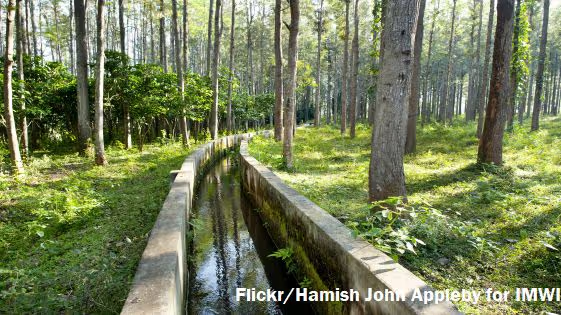
The long-run effects of agricultural productivity gains: Evidence from irrigation canals in India
Evidence from canals in India shows that labour mobility is a key channel to agricultural growth. This article shows that villages with access to canal water have persistently higher agricultural yields and higher population density for decades after canals are built. While the non-farm share of the economy is no different in canal and non-canal villages, nearby towns grew more quickly after canals were built. Structural transformation has taken place primarily through the migration of people to towns.



How do rural roads affect development? Evidence from India
Despite broad consensus that high transportation costs are a large barrier to economic development, many of the world’s poor live in rural communities without paved roads, impeding their access to outside markets and public services.
Rapid Response Project on Indian Firm Data
In March 2015, IGC organised a Workshop on Industry Data, held in Delhi. The workshop provided an opportunity for academics, policy makers and government agencies to discuss difficulties they face with using or collecting datasets on Indian firms, and define the steps for a way forward to improve the quality of the data available in these areas.
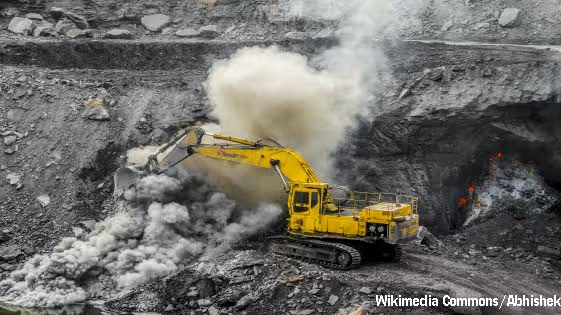
Digging for dirt: Rent-seeking among elected politicians in India’s mineral belt
The Indian mining industry is no stranger to corruption scandals and every year dozens of environmental activists are murdered for exposing illegal mining activities. This article discusses the impact of mining on political behaviour and finds that mineral rent booms increase the likelihood of criminally charged politicians entering office (adverse selection) and result in increased assets of politicians already in office (moral hazard).

Do ruling coalition-affiliated MLAs bring more development to their constituencies?
Despite the dismantling of the License Raj in the 1990s, interaction with government officials remains an important impediment to doing business in India. This column analyses the role of politics in determining which regions succeed and fail, and finds that MLAs from ruling parties make it easier for firms to do business in their constituencies. They do so not by providing public goods, but by helping firms clear bureaucratic hurdles that would otherwise hinder their operations.

Rapid urbanisation, rural-to-urban migration, and rural development: Evidence from 8,000 Indian towns
Rapid urbanisation and declining rural poverty are central features of many developing countries today, but there is little research on their relationship, especially on the impacts of rapid urbanisation on peri-urban and rural areas close to cities. Rural areas are expected to benefit from urban growth, but it is unclear whether these benefits take place via labour markets, goods markets, or rural-to-urban migration. There are many channels through which cities and their hinterlands are connected, but there is little research on the impact of urban growth on the rural hinterland; most of the current research focuses on structural transformation and the effects of agricultural productivity growth on cities rather than the reverse channel.
The SHRUG: A new high-resolution data platform for research on India
The Socioeconomic High-resolution Rural-Urban Geographic Dataset on India (SHRUG) is a new data source that describes socioeconomic development in India. In this post, Asher, Lunt, and Novosad describe its construction and particular advantages over existing datasets for research on economic development.