
.svg)
.svg)
%201.svg)
%201.svg)
.svg)

.svg)
.svg)
Pranab Bardhan

Pranab Bardhan is Professor of Graduate School at the Department of Economics at the University of California, Berkeley.
He was educated at Presidency College, Kolkata and Cambridge University, England. He had been at the faculty of MIT, Indian Statistical Institute and Delhi School of Economics before joining Berkeley. He has been Visiting Professor/Fellow at Trinity College, Cambridge, St. Catherine's College, Oxford, and London School of Economics. He held the Distinguished Fulbright Siena Chair at the University of Siena, Italy in 2008-9. He is the BP Centennial Professor at London School of Economics for 2010 and 2011.
For an autobiographical essay on his professional life brought out in the online Dictionary of Eminent Social Scientists of Foundation Mattei Dogan in Paris, you may go to the link http://eml.berkeley.edu/~webfac/bardhan/papers/autobioessay.pdf.
He has done theoretical and field studies research on rural institutions in poor countries, on political economy of development policies, and on international trade. A part of his work is in the interdisciplinary area of economics, political science, and social anthropology. He was Chief Editor of the Journal of Development Economics for 1985-2003. He was the co-chair of the MacArthur Foundation-funded Network on the Effects of Inequality on Economic Performance for 1996-2007.
He is the author of 12 books and editor of 12 other books, and of more than 120 journal articles including in leading Economics journals (like American Economic Review, Quarterly Journal of Economics, Econometrica, Journal of Political Economy, Review of Economic Studies, Economic Journal, American Economic Journal, Journal of Development Economics, Journal of Public Economics, Economic Development and Cultural Change, Oxford Economic Papers, etc.). He has also contributed essays to popular outlets like Scientific American, Financial Times, Project Syndicate, Yale Global Online, Business Standard, Hindustan Times, Economic and Political Weekly, Ananda Bazar Patrika (in Bengali), etc.
His latest book, Awakening Giants, Feet of Clay: Assessing the Economic Rise of China and Indiais published by Princeton University Press; their website for the book is at http://press.princeton.edu/titles/9153.html. He has given public lectures on the theme of the book at different institutions in the world: London School of Economics, Paris School of Economics, Oxford University, University of Warwick, National University of Singapore, University of Manchester, Tsinghua University (Beijing), Hong Kong University, Centre for Policy Research (Delhi), University of Copenhagen, University of Sydney, University of Melbourne, Victoria University (New Zealand), IESE Business School at Barcelona, Royal Institute of Internationa Affairs in London, and Indian Statistical Institute, apart from in the US at Berkeley, Harvard, Columbia, Brown, New York University, World Bank, Emory University, University of Illinois at Carbondale, Asia Society at Houston, Montery Institute of International Studies, Portland State University, Camden Conference in Maine, etc.
For a substantial interview on the book recorded at the London School of Economics, listen to http://www.voxeu.org/index.php?q=node/5109. For a longer interview on the book as well as looking back at his professional life, watch the video on YouTube: http://www.youtube.com/watch?v=g3QAqlqg1Do
Two collections of his selected essays came out in 2003; one is International Trade, Growth and Development published by Blackwell; and the other, Poverty, Agrarian Structure, and Political Economy in India published by Oxford University Press.
His book, Scarcity, Conflicts and Cooperation: Essays in Political and Institutional Economics of Development , was published by MIT Press in 2005.
A co-edited volume, Globalization and Egalitarian Redistribution was published by Princeton University Press in 2006, followed by another co-edited volume, Inequality,Cooperation, and Environmental Sustainability, also published by Princeton University Press in 2006. A co-edited volume, Decentralization and Local Governance in Developing Countries: A Comparative Perspective was published by MIT Press in 2006.A co-edited volume, The Contested Commons: Conversations between Economists and Anthropologists was published in 2008 by Blackwell.
A graduate-level textbook by Pranab Bardhan and Christopher Udry, Development Microconomics, Oxford University Press, was published in 1999. More information on the book may be found in the publisher's website: http://www.oup.co.uk/isbn/0-19-877371-4 In 2000 MIT Press published a two-volume Readings in Development Economics, edited by Bardhan and Udry. More information on the book may be found in the publisher's website: http://mitpress.mit.edu/book-home.tcl?isbn=0262024845
His other notable public lectures and keynote addresses include:
- Radhakrishnan Memorial Lectures at All Souls College, Oxford, 1983
- V.K. Ramaswami Memorial Lecture at Delhi School of Economics, 1997
- ILO Nobel Peace Prize Lecture at Capetown, South Africa, 2000
- Inaugural Max Corden Lecture at the University of Melbourne, Australia, 2003
- The first Luca d'Agliano Lecture in Development Economics in Turin, Italy, 2003
- K.R. Narayanan Oration at the Australian National University, Canberra, 2003
- K.C. Basu Endowed Lecture at the National University of Juridical Sciences in Kolkata, India, 2004
- Keynote Lecture at the CEPR/BREAD development conference at Istanbul, 2005
- Kalinga Lectures at the N.C. Centre for Development Studies in Bhubaneswar, India, 2005
- Opening Lecture at the CESIFO/BREAD development conference at San Servolo, Italy, 2006
- Silver Jubilee Lecture at the Centre for Economic and Social Studies, Hyderabad, 2006
- Keynote Lecture at the India Development Foundation conference in New Delhi, 2006
- Brookings/NCAER India Policy Forum Public Lecture in New Delhi, 2006
- Keynote Lecture at development conference at University of Quebec, Montreal, 2007
- DEC Lecture at the World Bank, Washington, DC, 2007
- Plenary lecture at the 2007 Annual meeting of the Latin American and Caribbean Economic Association at Bogota, Colombia
- TDPE Annual Distinguished Lecture at Syracuse University, 2007
- Fred J. Hansen Distinguished Lecture at San Diego State University, 2007
- Dipak Banerjee Memorial Lecture at Presidency College, Kolkata, India, 2007
- Valedictory address at an international conference on Poverty at A.N.Sinha Institute at Patna, India, 2007
- Public lecture at the Brooks World Poverty Institute at the University of Manchester, 2008
- State of the Arts lecture at 2008 Annual meeting of the Canadian Economic Association at Vancouver
- Sukhamoy Chakrabarty Memorial Lecture at Delhi School of Economics, 2009
- Opening lecture at a CEPAL conference on Decentralization at Santiago, Chile, 2009
- Distinguished Lecture at Singapore Economic Review Conference, 2009
- Keynote Lecture at conference on Decentralization at IFPRI, Washington DC, 2010
- Keynote Lecture at IGC Workshop on Trade and Development at Columbia University, 2010
- Bernard Fain Lecture at Brown University, 2010
- Keynote Lecture at Six Decades of Indian Democracy conference at Brown University, 2010
- Keynote lecture at the mid-West Development conference at Madison, Wisconsin, 2011
- B.G. Kumar Memorial Lecture at Centre for Development Studies, Trivandrujm, India, 2011
- Keynote Lecture at Copenhagen Business School, 2011
- Keynote Lecture at Norwegian University of Science and Technology, Trondheim, 2011
- Keynote Lecture at Indian Statistical Institute, Calcutta, 2012
- Keynote Lecture at Indian Council of Social Science Research, New Delhi, 2012
- Halle Speaker Series Lecture at Emory University, 2012
- S.C. Fang Memorial Lecture at Hong Kong University, 2012
- Distinguished Speaker Series Lecture at Hong Kong University of Science and Technology, 2012
.svg)


In lieu of the Planning Commission: Part I
The Indian government plans to replace the Planning Commission with a more contemporary think tank. Over the next few weeks, we will present views of experts from various stakeholder groups – private sector, civil society, academia, media and the government – on what should be the character and functions of the new body.


The labour reform myth
A few Indian states have taken steps to relax the labour law pertaining to worker retrenchment. This article argues that while this is a step in the right direction, it may be unrealistic to expect big improvements in output and job creation simply as a result of such reform as there is no evidence to show that this law is the only, or even the main, constraint on growth

भारत में रोज़गार की विशाल समस्या और इसके कुछ समाधान
भारत के केन्द्रीय बजट 2024-25 की घोषणा में रोज़गार सृजन की आवश्यकता पर महत्वपूर्ण ज़ोर दिया गया है। प्रणब बर्धन इस लेख के ज़रिए लम्बे समय में अच्छी नौकरियों के स्थाई सृजन हेतु एक चार-आयामी रणनीति- बड़े पैमाने पर व्यावसायिक शिक्षा व प्रशिक्षुता, पूंजी सब्सिडी को सशर्त मज़दूरी सब्सिडी से बदलना, गैर-कृषि घरेलू उद्यमों को विस्तार सेवाएँ प्रदान करना और कमज़ोर समूहों के लिए बुनियादी आय अनुपूरक के माध्यम से मांग को बढ़ावा देना प्रस्तुत करते हैं।
India’s massive employment problem and some ways out
In the recent announcement of India’s Union Budget 2024-25, significant emphasis was placed on the need for job creation. In this post, Pranab Bardhan presents a four-pronged strategy for the sustainable generation of good jobs in the long run: mass-scale vocational education and apprenticeship; replacing capital subsidies with conditional, wage subsidies; providing extension services to non-farm household enterprises; and boosting demand via a basic income supplement for vulnerable groups.

Second Ashok Kotwal Memorial Lecture: Inequality, Labour and Social Democracy
The Ashok Kotwal Memorial Lecture was instituted in 2022, in memory of our founding Editor-in-Chief, as an annual lecture on key issues of development. For its second edition, I4I hosted Professor Pranab K. Bardhan on 30 November 2023 in New Delhi on 'Inequality, Labour and Social Democracy’. A video recording of the lecture has been made available here.

Deconstructing the global wave of right-wing populism
At present, there seems to be palpable reaction against ideas of tolerance, minority rights, freedom of expression, and respect for individual autonomy and dignity, in many parts of the world. In this article, Pranab Bardhan contends that global traits of the populist right suggest how liberals can take it on.
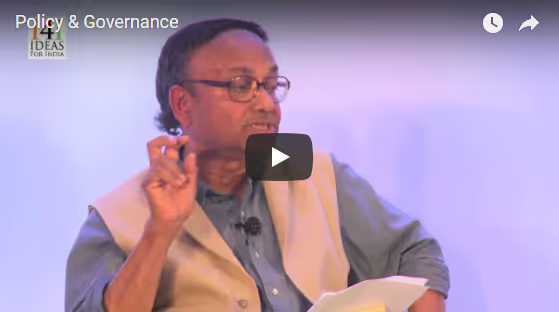
I4I Panel Discussion: Two years of Modi government
In a panel discussion organised to mark the 4th anniversary of Ideas for India, Parikshit Ghosh (Member of the I4I Editorial Board & Associate Professor, Delhi School of Economics) moderates a discussion on ‘Two years of Modi government’ among Pranab Bardhan (University of California, Berkeley), Mihir Sharma (Bloomberg View) and Pratap Bhanu Mehta (Centre for Policy Research), encompassing issues related to policy and governance; corruption; manufacturing; social sector; and social and cultural issues.
The first two years of Modi government
In this article, Pranab Bardhan, Professor of Graduate School at the Department of Economics, University of California, Berkeley, provides his perspective on the performance of the Modi government in its first two years in office.
An economist's view on the new government's initiatives
In this article, Pranab Bardhan, Professor of Economics, University of California, Berkeley, provides his perspective on some of the initiatives of the new Indian government at the centre in their first six months in office – Swachh Bharat Abhiyan, Jan Dhan Yojana, ‘Make in India’ campaign, and the proposed changes to MNREGA. In his view, inefficient subsidies must give way to a basic monthly income for all citizens.
Response to the Bhagwati-Panagariya rejoinder on MNREGA
In a recent article, Abreu et al. refuted the Bhagwati-Panagariya argument for phasing out MNREGA in favour of cash transfers. In this article, Abreu et al. respond to claims in a rejoinder by Bhagwati-Panagariya, regarding net benefits of MNREGA employment, the self-selection feature of the programme, and rural asset creation.
Political Clientelism and Government Accountability in West Bengal: Theory and Evidence
This project provide a theory of political clientelism, which explains sources and determinants of political clientelism, the relationship between clientelism and elite capture, and their respective consequences for allocation of public services, welfare and empirical measurement of government accountability in service delivery.
A plague on all houses
Which is better, India´s liberal capitalism modelled on the US or China´s authoritarian state-controlled capitalism? This column argues that dysfunctional governments in both systems are leading to dangerous levels of inequality and triggering populism.

DUET: Employment programme in public works in small towns
Given the severe problems of unemployment and under-employment in urban India, particularly among the country’s burgeoning youth population, Pranab Bardhan emphasises the need for an employment programme in urban public works. In his view, such a programme should be inclusive, local government-driven, and prioritise projects that serve environmental and health goals in small towns.

‘न्याय’ विचार-गोष्ठी: यूनिवर्सल बेसिक इनकम के एक अनुपूरक का पक्ष
कैलिफोर्निया विश्वविद्यालय, बर्कली में अर्थशास्त्र के प्रोफेसर प्रनब बर्धन ने एक आय अनुपूरक के पक्ष में तर्क दिए हैं, लेकिन वह जो सबको उपलब्ध हो।
NYAY e-Symposium: The case for a universal basic income supplement
Pranab Bardhan (Professor of Economics, University of California, Berkeley) argues in favour of an income supplement, albeit one that is universal.
Basic income in a poor country
Pranab Bardhan, Professor of Economics, University of California, Berkeley argues that even though universal basic income is being considered unaffordable in some developed countries, it may well be feasible and desirable in a poor to medium-income country partly on account of low poverty thresholds and existing social safety nets that are threadbare and costly to administer.
A symposium on Piketty - II: Capitalist dynamics and the plutocrats
In the last part of the series on Piketty, Pranab Bardhan, Professor of Economics, University of California, Berkeley, discusses the implications for further study that Piketty’s book has for developing countries such as India. He emphasises the need for collecting more serious information on wealth ownership in India.
(Mis)Leading attack on MNREGA
Bhagwati and Panagariya have argued for phasing out MNREGA in favour of cash transfers. In this article, Abreu et al. contend that the argument is based on inflating the costs of the programme and deflating the benefits. While they do not claim that all is well with MNREGA, they believe it needs better governance, not slow suffocation.
A tribute to Prof. Ashok Kotwal by Prof. Pranab Bardhan
Prof. Pranab Bardhan pens a heartfelt tribute to our founder Editor-in-Chief Prof. Ashok Kotwal.
Left and right: Examining the evolution of political ideologies
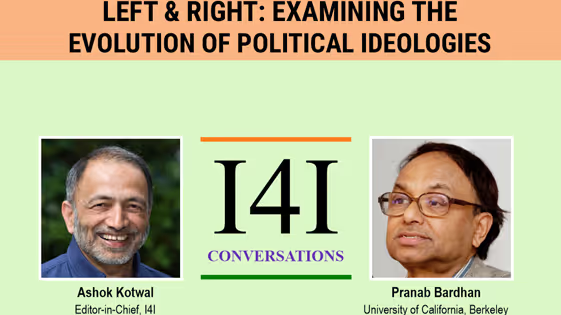
With the advent of globalisation, the struggle between the ‘left’ and ‘right’ – as defined in Marxian terms – rapidly evolved from one between economic ideologies, to cultural wars. In this context, I4I Editor-in-Chief Ashok Kotwal engages in a deep-dive with Prof. Pranab Bardhan (University of California, Berkeley) on issues ranging from growing resentment towards educated elite, shifts in the form of capital and employment patterns, role of communities, to emergence of illiberal political movements, and the different types of nationalism and populism. This is the first edition of I4I’s new feature “Conversations”, which would present in-depth discussions with experts on ‘big picture’ or futuristic topics.
Left and right: Examining the evolution of political ideologies
With the advent of globalisation, the struggle between the ‘left’ and ‘right’ – as defined in Marxian terms – rapidly evolved from one between economic ideologies, to cultural wars. In this context, I4I Editor-in-Chief Ashok Kotwal engages in a deep-dive with Prof. Pranab Bardhan (University of California, Berkeley) on issues ranging from growing resentment towards educated elite, shifts in the form of capital and employment patterns, role of communities, to emergence of illiberal political movements, and the different types of nationalism and populism. This is the first edition of I4I’s new feature “Conversations”, which would present in-depth discussions with experts on ‘big picture’ or futuristic topics.