
.svg)
.svg)
%201.svg)
%201.svg)
.svg)

.svg)
.svg)
Prashant Bharadwaj

Prashant Bharadwaj is a Professor in the Department of Economics at the University of California, San Diego. He received his B.A. in Economics from the University of Chicago in 2004 and his Ph.D. in Economics from Yale University in 2009. He has been at UC San Diego since 2009.
He is a Faculty Research Fellow at the National Bureau of Economic Research (NBER), an affiliate of the Bureau for Research and Economic Analysis of Development (BREAD), Center for Economic Research in Pakistan (CERP), and of the Center for Evaluation of Global Action (CEGA). He is currently (for 2013-2014) a visiting Assistant Professor at the Stanford Institute for Economic Policy Research (SIEPR).
.svg)

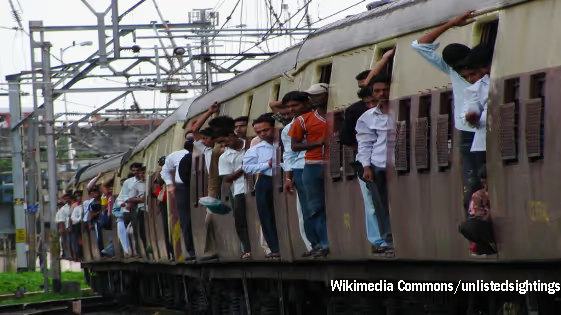
The impact of displacement on women’s marriage outcomes: Evidence from the partition of India
Women and children are made particularly vulnerable by displacement – the high incidence of gender-based violence and vulnerability to child marriage is well-documented in literature. Using data from Pakistan’s 1973 Housing, Economic, Demographic Characteristics survey, this article examines the impact of displacement during the partition of India (1947-1949) on the outcomes of young women, and finds that adolescent displaced women were more likely to get married at the time of partition, and experienced higher child marriage and fertility rates.


भारत के बाल श्रम प्रतिबंध के अनपेक्षित परिणाम
हर जून में दो महत्वपूर्ण दिन आते हैं, एक पर्यावरण से संबंधित और दूसरा बाल श्रम से संबंधित। "आइए अपनी प्रतिबद्धताओं पर कार्य करें, बाल श्रम को समाप्त करें!" 12 जून को मनाए जाने वाले बाल श्रम विरोधी दिवस की थीम के परिपेक्ष्य में यह चिंतन करने का समय है कि बाल श्रम की समस्या से निपटने के लिए क्या आवश्यक है। विकासशील दुनिया में बाल श्रम के विरुद्ध प्रतिबंध और विनियमन, इस समस्या को हल करने के सबसे लोकप्रिय नीतिगत उपायों में से हैं। लेकिन ये व्यवहार में कितने कारगर हैं? कई वर्ष पूर्व का यह शोध आलेख आज भी प्रासंगिक है। आलेख में बाल श्रम के विरुद्ध भारत के प्रमुख कानून,1986 के बाल श्रम अधिनियम की प्रभावशीलता का विश्लेषण किया गया और यह पाया गया कि इस प्रतिबंध के कुछ वर्षों बाद, 14 वर्ष की कानूनी रोज़गार आयु की तुलना में कानूनी आयु से कम आयु के बच्चों के रोज़गार स्तर में वृद्धि हुई।

Drawing the line: The short- and long-term consequences of partitioning India
Colonial rule in India culminated in the birth of two nations, forcing the displacement of millions. This column analyses the economic and political consequences of the Partition in 1947. It finds that differences in the distribution of education and organisational skills across communities and the extent to which communities and regions traded with each other, played a key role in shaping the bloody nature of the upheaval during the Partition itself, and its long-term consequences.
Unintended consequences of India's child labour ban
Bans and regulations against child labour are among the most popular policy tools used to address the problem throughout the developing world. But how well do they work in practice? This column analyses the effectiveness of India’s flagship legislation against child labour, the Child Labour Act of 1986. It finds that a few years after the ban, employment levels of children under the legal working age of 14 rose relative to those of legal age.