
.svg)
.svg)
%201.svg)
%201.svg)
.svg)

.svg)
.svg)
Pronab Sen
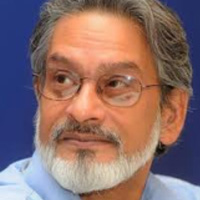
Pronab Sen is the former Country Director for the India Programme of the International Growth Centre (IGC). Pronab received his Ph.D. in Economics from the Johns Hopkins University specialising in open-economy macroeconomic systems, international economics and public finance.
Most recently the Chairman of the National Statistical Commission, he has also had positions as Principal Economic Adviser at Government of India's Planning Commission, the first Chief Statistician of India, acting as the functional and technical Head of the national statistical system in India, as well as Secretary, Ministry of Statistics & Programme Implementation, Government of India (2007-2010). As a representative of the Planning Commission he was principal author and coordinator of (a) the Mid-term Appraisal of the Eighth Five Year Plan, (b) the Ninth Five Year Plan, (c) the Mid-term Appraisal of the Ninth Five Year Plan, (d) the Tenth Five Year Plan, and the Mid-term Appraisal of the Tenth Five Year Plan.
.svg)


क्या कृषि ऋण की माफी इतनी बुरी है?
विभिन्न राज्य सरकारों द्वारा विभिन्न हदों तक कृषि ऋणों की माफी के आशय की घोषणाओं की मीडिया और अन्य टिप्पणीकारों द्वारा सख्त आलोचना की गई है। इस आलेख में डॉ. प्रनब सेन ने उन दावों की वैधता की जांच की है जिन पर यह विरोध आधारित है।


Are farm loan waivers really so bad?
Recent announcements by various state governments of their intent to waive farm loans to varying extents have been strongly criticised by the media and other commentators. In this article, Dr Pronab Sen examines the validity of the claims on which this opposition is based.
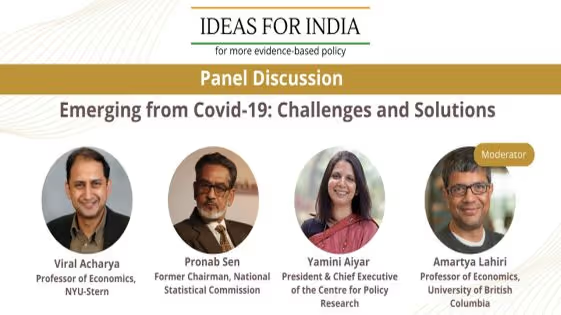
I4I@10 | Emerging from Covid-19: Challenges and solutions
As India emerges from the Covid-19 pandemic, economists will have to rethink how they understand the Indian economy in context of global volatilities. In this panel, moderated by Amartya Lahiri, Viral Acharya, Yamini Aiyar and Pronab Sen discuss both the macroeconomic implications of growth, infrastructure and public policy, and the microeconomic concerns of whether we are creating enough good jobs, ensuring welfare, and reducing income inequality.
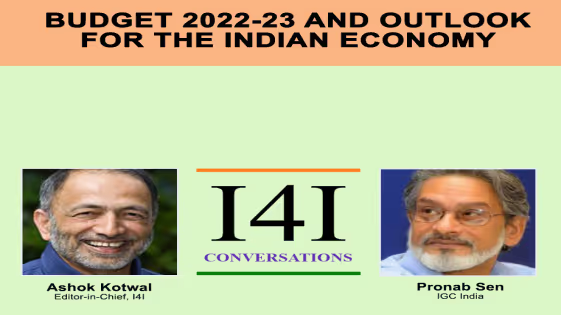
Budget 2022-23 and outlook for the Indian economy
Several commentators have lauded the recently presented Budget 2022-23 as a ‘growth budget’, on account of the large allocations made for capital expenditure on public infrastructure. On the other hand, concerns have been expressed about the Budget’s potential to create jobs for the masses, allay inflation worries, and strengthen social sectors such as health and education. Should we be optimistic or cautious? In this edition of I4I Conversations, Ashok Kotwal (Editor-in-Chief, Ideas for India) speaks with Pronab Sen (IGC India) to dissect the various policies and proposals in the Budget, and deliberate on the outlook for the Indian Economy. Dr Sen explains that the rhetoric around the Budget is mixing up accounting and economic classifications in the context of the announcement of 35% increase in public capex, why we cannot think of infrastructure as a homogenous activity in terms of the intensity of employment generation, how the support for MSMEs may be cherry-picking the units...
Budget 2022-23 and outlook for the Indian economy
Several commentators have lauded the recently presented Budget 2022-23 as a ‘growth budget’, on account of the large allocations made for capital expenditure on public infrastructure. On the other hand, concerns have been expressed about the Budget’s potential to create jobs for the masses, allay inflation worries, and strengthen social sectors such as health and education. Should we be optimistic or cautious? In this edition of I4I Conversations, Ashok Kotwal (Editor-in-Chief, Ideas for India) speaks with Pronab Sen (IGC India) to dissect the various policies and proposals in the Budget, and deliberate on the outlook for the Indian Economy. Dr Sen explains that the rhetoric around the Budget is mixing up accounting and economic classifications in the context of the announcement of 35% increase in public capex, why we cannot think of infrastructure as a homogenous activity in terms of the intensity of employment generation, how the support for MSMEs may be cherry-picking the units ...
Webinar video: The Covid-19 shock
The Covid-19 pandemic and the containment measures adopted to check the spread of the disease, have caused an unprecedented economic crisis in India as well as the rest of the world. Further, India is experiencing a massive humanitarian crisis, exemplified by the scale of reverse migration that is in progress. There is an urgent need for the government to implement policies designed to mitigate the economic damage, and alleviate the suffering of the most vulnerable. In this webinar (12 June 2020) – moderated by Prof. Parikshit Ghosh, Member of the I4I Editorial Board – Dr Pronab Sen reviews the current status, and deliberates on what needs to be done, and where we are likely to be in the future. The webinar is based on Dr Sen’s recent five-part series on I4I.
कोविड-19 झटका: अतीत के सीख से वर्तमान का सामना करना – पांचवां भाग
इस श्रृंखला के पिछले दो भागों में, डॉ. प्रणव सेन ने कोविड-19 झटके से उबरने के लिए तीन अलग-अलग चरणों (उत्तरजीविता, पुनर्निर्माण और सुधार) के माध्यम से सुधार के मार्ग प्रस्तुत किए हैं। श्रृंखला के अंतिम भाग में, उन्होंने सरकार की राजकोषीय स्थिति के बिगड़ने के बारे में चिंताओं पर विचार करते हुए, सुधार के निधिकरण पर और बड़े प्रोत्साहन पैकेज के निधिकरण के लिए संसाधनों को कैसे जुटाया जा सकता है, इन मुद्दों पर चर्चा की है।
कोविड-19 झटका: अतीत के सीख से वर्तमान का सामना करना – चौथा भाग
इस श्रृंखला के पिछले भाग में डॉ. प्रणव सेन ने सुधार के लिए एक मार्ग प्रस्तुत किया था, जिसमें उन्होने 'उत्तबरजीविता' के चरण, यानि लॉकडाउन की तीन महीने की अवधि पर ध्यान केन्द्रित किया था। इस भाग में उन्होंने पुनर्निर्माण चरण यानि लॉकडाउन हटाए जाने के बाद के चार महीने की अवधि जिसमें सामान्य आर्थिक गतिविधियों को जून 2020 से फिर से शुरू करने की अनुमति दी जाएगी और उसके बाद के सुधार चरण पर चर्चा की है।

कोविड-19 झटका: अतीत के सीख से वर्तमान का सामना करना – तीसरा भाग
श्रृंखला के पिछले भाग में, डॉ. प्रणव सेन ने वर्तमान में जारी संकट के कारण हुई आर्थिक क्षति, और अगले तीन वर्षों में अर्थव्यवस्था के अपेक्षित प्रक्षेपवक्र के अनुमान प्रदान किए थे। इस भाग में, उन्होंने उत्तरजीविता के चरण पर ध्यान केंद्रित करते हुए सुधार का मार्ग प्रस्तुत किया है। तात्कालिक संदर्भ में जब लॉकडाउन लागू है, दो प्रमुख अनिवार्यताएं होनी चाहिए – पहली, अपनी आजीविका खो चुके लोगों की उत्तरजीविता, और दूसरी, गैर-अनिवार्य क्षेत्रों में उत्पादन क्षमता। इस तीन महीने की अवधि के दौरान आवश्यक अतिरिक्त राजकोषीय समर्थन का अनुमानित आकलन रु.2,00,000 करोड़ है।

कोविड-19 झटका: अतीत के सीख से वर्तमान का सामना करना – दूसरा भाग
आलेखों की इस श्रृंखला के पहले भाग में डॉ. प्रणब सेन ने पिछले दो बड़े आर्थिक झटकों – 2008 में वैश्विक वित्तीय संकट और 2016-17 में नोटबंदी एवं जीएसटी के दौरान भारतीय अर्थव्यवस्था के प्रदर्शन पर चर्चा की, और उनसे वर्तमान संकट के लिए सबक प्रस्तुत किए। इस भाग में उन्होंने सरकार द्वारा अब तक घोषित राजकोषीय प्रोत्साहन को ध्यान में रखते हुए, लॉकडाउन और निर्यात मंदी के कारण अर्थव्यवस्था को हुए नुकसान का अनुमान लगाया है। अगले तीन वर्षों में अर्थव्यवस्था के अपेक्षित प्रक्षेपवक्र को प्रस्तुत करते हुए वे कहते हैं कि संभावित सुधार पथ V नहीं है, बल्कि दीर्घ U है या L के करीब भी जा सकता है।
The Covid-19 shock: Learnings from the past, addressing the present - V
In the previous two parts of the series, Dr Pronab Sen presented a pathway to recovery from the Covid-19 shock in three distinct phases – survival, revival, and recovery. In the final part of the series, he discusses the financing of the recovery, addressing concerns around deterioration of the government’s fiscal position, and how resources can be raised for financing a larger stimulus package.
The Covid-19 shock: Learnings from the past, addressing the present - IV
In the previous part of the series, Dr Pronab Sen presented a pathway to recovery, focusing on the ‘survival’ phase, that is, the three-month period of lockdown. In this part he discusses the revival phase – four-month period after the lockdown is lifted and normal economic activity is allowed to resume from June 2020, and the recovery phase thereafter.
The Covid-19 shock: Learnings from the past, addressing the present - III
In the previous part of the series, Dr Pronab Sen provided estimates of the economic damage on account of the ongoing crisis, and the expected trajectory of the economy over the next three years. In this part, he presents a pathway to recovery, focusing on the survival phase. In the immediate context while the lockdown is in place, the two principal imperatives should be survival of those who have lost livelihoods, and of production capacities in non-essentials sectors. An approximate estimate of the additional fiscal support required during this three-month period is Rs. 2 trillion.

The Covid-19 shock: Learnings from the past, addressing the present - II
In the first part of the series, Dr Pronab Sen discussed the performance of the Indian economy during the last two major economic shocks – Global Financial crisis in 2008, and demonetisation-cum-GST in 2016-17 – and drew lessons for the current crisis. In this part, he estimates the damage to the economy due to the lockdown and export slowdown, taking into account the fiscal stimulus announced by the government so far. Presenting the expected trajectory of the economy over the next three years, he contends that the likely recovery path is not a V, but an elongated U, maybe even closer to an L.

कोविड-19 का राज्य वित्त पर प्रभाव
स्वास्थ्य का विषय राज्य सरकारें देखती हैं, इस लिए जब से भारत में कोविड-19 महामारी की शुरुआत हुई, तब से अलग-अलग राज्यों ने वे सारी प्रतिक्रियाएं अपनाईं हैं जो वे अपने राज्य-स्तरीय विधानों के तहत अपना सकते थे। हालांकि, 24 मार्च को देशव्यापी लॉकडाउन की घोषणा के बाद सभी आर्थिक गतिविधियों में से 60% से अधिक को बंद कर दिया गया था, इसके परिणामस्वरूप जब राज्यों के खर्चों में वृद्धि हुई, उसी समय उनके अपने करों में अचानक और तेज गिरावट आ गई। इस पोस्ट में, प्रणव सेन उन सभी अलग-अलग प्रकारों के बारे में बताते हैं जिनसे राज्य वित्त को एक विनाशकारी झटका लगा है।

Covid-19: Consequences for state finances
When Covid-19 pandemic started in India, given that health is a state subject, individual states reacted as best they could under state-level legislations. However, as more than 60% of all economic activity was shut down with the announcement of a nation-wide lockdown on 24 March, the result was a sudden and sharp drop in states’ own taxes at the time when their expenses shot up. In this post, Pronab Sen discusses how state finances have been dealt a devastating blow.
Covid-19: Ashok Kotwal speaks with Pronab Sen
In conversation with Ashok Kotwal on the ongoing economic crisis caused by lockdown to mitigate Covid-19 spread, Pronab Sen breaks down the problem into survival of individuals and livelihoods, and the survival of enterprises and the productive capacity of the economy. He contends that if enough is not done for the latter, the former will become very difficult to manage – once the pandemic begins to recede.
What should we do about the Indian economy? A wide-angled perspective - III
In the previous part of this series, Ashok Kotwal and Pronab Sen presented an export-led development strategy employed by successful Asian countries and why India failed on this front. In this part, they trace the genesis of the present economic slowdown.
What should we do about the Indian economy? A wide-angled perspective - IV
In the previous part of this series, Ashok Kotwal and Pronab Sen traced the genesis of the present economic slowdown. In this part, they discuss the way forward to arrest the slowdown. They suggest a rural-led growth strategy, which would deliver slower overall growth but will have a bigger positive impact under the present circumstances. They argue that a rural-led strategy may also circumvent some of the obstacles that are presently preventing India from implementing the template followed by successful Asian countries.
What should we do about the Indian economy? A wide-angled perspective - II
In the previous part of this series, Ashok Kotwal and Pronab Sen described the generic process of development in a dual economy. In this part, they present the strategies employed by successful Asian countries that led to a total structural transformation of their economies. They further explain the unique problems that make India’s progress on this front difficult.
डॉ. प्रणव सेन का पी.टी.आई. भाषा के साथ देश की आर्थिक सुस्ती पर साक्षात्कार
भारत के वर्तमान वित्तीय वर्ष की पहले तिमाही के रिपोर्ट आने से यह ज्ञात हो रहा है कि कई कारणों से देश आर्थिक सुस्ती से गुज़र रहा है। इस बढ़ती हुई आर्थिक सुस्ती के ऊपर डॉ प्रणव सेन का कहना है कि देश की सरकार को मांग बढ़ाने की ज़रूरत है, जबकि सरकारी घोषणाओं का झुकाव आपूर्ति बढ़ाने पर ज्यादा है और इन घोषणाओं से लाभ मिलना मुश्किल है।

Why external sovereign debt should be avoided
The Finance Minister of India, in her 2019 Budget speech, announced the government’s intent to finance a part of the fiscal deficit by issuing sovereign bonds in the international financial markets. This is a major departure from a 72-year history of Indian economic management when external commercial debt was consciously avoided by the government. In this post, Dr Pronab Sen discusses the arguments made in favour of issuing foreign currency-denominated sovereign bonds, and contends that such debt should be avoided.
The lad(y) doth protest too much, methinks
Former Finance Minister Yashwant Sinha has trashed the present government’s track record on economic management. In a recent article, economist Surjit Bhalla refuted Mr. Sinha’s claims with a point-by-point take-down. In this article, Dr Pronab Sen responds to Dr. Bhalla’s critique.
How much public debt is too little?
Virtually the entire literature on public debt is focussed on determining how much is too much, beyond which it becomes a systemic threat to the economy. In this article, Pronab Sen outlines some of the considerations which should be taken into account while determining the minimum stock of public debt and its flow counterpart, the fiscal deficit.
When windmills tilt: The FRBM debate
In this article, Dr Pronab Sen presents his views on the ongoing debate on the Fiscal Responsibility and Budget Management Act.
Shock and oh damn
In this article, Pronab Sen, Country Director for the India Central Programme of the International Growth Centre, argues that India’s recent demonetisation has penalised virtually the entire informal sector, and perhaps damaged it permanently.
Monetary dimensions of the recent Indian inflationary experience
Inflation in India remained at or near double-digit levels between 2009-10 and 2014-15. In this article, Pronab Sen, Country Director, IGC India Central, argues that while the initiation of the inflationary process may have been rooted in structural factors, there is a monetary story to be told about its propagation across commodities and perpetuation over time. This understanding explains RBI’s helplessness and may help in designing appropriate policy interventions for similar inflationary episodes in the future.
Towards integrating sample surveys in India
Large-scale household surveys in India are mainly undertaken by the NSSO and the NCAER. In this article, Pronab Sen, Chairman of the National Statistical Commission, highlights the need for systematic convergence between the two organisations, as well as other smaller ones, in the conduct of surveys. He discusses the requirements and challenges of such an integration process, including issues of data sharing and dissemination.
In lieu of the Planning Commission: Part IV
In this post, Pronab Sen – former Principal Adviser, Planning Commission of India – provides his perspective on some of the issues involved in replacing the Planning Commission. In his view, none of the functions that were performed by the Planning Commission are entirely dispensable for any central government in a federal democratic system; the issue is the manner in which they are performed and who performs them.
The future of economic planning in India
Economic planning has been a central tenet of India’s development strategy since independence. In this article, Pronab Sen – former Principal Adviser to the Planning Commission of India – presents his views on the criticisms leveled against Indian planning from time to time, and reflects upon the continuing utility of planning in the future.
Can SMEs drive India's growth?
Investment, particularly by the corporate sector in India, drove high growth rates during 2003-2009. Given the expected slow and weak recovery of the global economy, Indian corporates are unlikely to be able to lead the process of growth revival. This column argues that under the right circumstances and with proper policies, the dynamism of the Small and Medium Enterprises sector can ensure growth rates of 7% and above.

उनसे ज्यादा अंधा कोई और नहीं जो देखना हीं नहीं चाहते
भारत सरकार के आंकड़ों के आधार पर, भारत के अर्थशास्त्रियों ने और सरकार ने अर्थव्यवस्था की स्थिति को लेकर दो विपरीत आख्यान स्थापित किए हैं। इस पोस्ट में, प्रणव सेन ने इस दो आख्यानों के बीच के अंतर पर प्रकाश डाला है। वह इस बात पर भी चिंता व्यक्त करते हैं कि मौजूदा आर्थिक मंदी का मुकाबला करने के लिए सरकार जिस तरह की प्रतिक्रिया दे रही है, वह पूरी तरह से अपने आख्यानों पर आधारित है और दूसरे की पूरी तरह से अनदेखा कर रही है।

There are none so blind as they who will not see
Based on Government of India’s own data, the government and the community of economists in India have come up with different narratives about the position of Indian economy. In this post, Pronab Sen highlights the differences between the two narratives. He also expresses concern over the kind of response government is taking to combat the current economic slowdown, which is fully consistent with its own narrative and completely ignores the other.

‘न्याय’ विचार-गोष्ठी: राष्ट्रीय सामाजिक सहायता कार्यक्रम के विस्तार को प्राथमकिता
आइजीसी इंडिया के कंट्री डायरेक्टर डॉ. प्रोनाब सेन का तर्क है कि यह देखते हुए कि अधिकांश गरीबी उच्च निर्भरता अनुपातों के कारण हैं – पहली प्राथमिकता वर्तमान सामाजिक सुरक्षा का विस्तार होना चाहिए जिसमे बुजुर्ग, विकलांग और विधवाएं शामिल हैं। सबसे महत्वपूर्ण बात है कि अभी न्याय के बारे में जैसी परिकल्पना की जा रही है, उसकी तुलना में यह काफ़ी कम भेदभाव वाला होगा।
NYAY e-Symposium: Prioritise expansion of National Social Assistance Programme
Dr Pronab Sen (Country Director, IGC India) argues that the first priority should be to expand existing social security, which covers the elderly, the handicapped, and widows – given the fact that much of poverty is due to high dependency ratios. More importantly, this would be much less divisive than how NYAY is currently being envisaged.
What explains the steep poverty decline in India from 2004 to 2011?
Ashok Kotwal, Editor-in-Chief, Ideas for India, interviews Pronab Sen on the recent poverty figures that show a steep decline in poverty in India between 2004 and 2011. According to him, the shift in terms of trade in favour of agriculture and higher rural wages accelerated the trickle down of the fast economic growth to the poor.

Should the rupee trade with Russia be revived?
The issue of revival of the bilateral rupee-denominated trade between India and Russia is back on the table after a break of over 20 years. This column contends that while there is justification for India’s hesitancy in reviving this trade, the prevailing conditions are such that it makes eminent sense for both sides - provided appropriate precautions are taken.
The puzzle of Indian urbanisation
The global experience has been that as countries develop, rural-to-urban migration accelerates, and decelerates only when the urbanisation level is very high – usually well over 50%. In contrast, migration in India began decelerating when urbanisation was below 25%. In the article, Pronab Sen deconstructs this puzzle.

What ails the Indian banking sector?
Non-performing assets (NPAs) of Indian banks have risen from under 3% to over 13% in the past couple of years, making the state of the banking sector one of the biggest challenges facing the country in accelerating investments and growth. In this post, Dr Pronab Sen diagnoses the causes of the current NPA problem, and proposes solutions.

Picking up the pieces
In an earlier article , Pronab Sen, Country Director, IGC India Central, examined some of the economic consequences of the recent demonetisation of Rs. 1,000 and 500 notes in India, and concluded that the potential damage could be substantial, both in terms of growth and equity.