
.svg)
.svg)
%201.svg)
%201.svg)
.svg)

.svg)
.svg)
Raavi Aggarwal

Raavi Aggarwal is an economist working on environment and development issues in emerging economies. She is a Visiting Assistant Professor at the Indian Statistical Institute, Delhi, and holds a Ph.D. from the Technische Universität Berlina PhD candidate at the Technical University of Berlin. She is a member of the Centre for research on the Economics of Climate, Food, Energy and Environment (CECFEE) at ISI Delhi.
.svg)


Are we prepared for the future of work?
Given the threat of jobs displacement on account of the rise of automation and artificial intelligence, it has become crucial to develop a high-quality labour force with advanced cognitive skills. In this context, Raavi Aggarwal examines the trends in government spending on the education sector, as well as learning outcomes. She contends that in order to sufficiently prepare for the Fourth Industrial Revolution, we need to make adequate investments in education, skills, and innovative capacity now.


Complementarity between labour and energy in Indian manufacturing
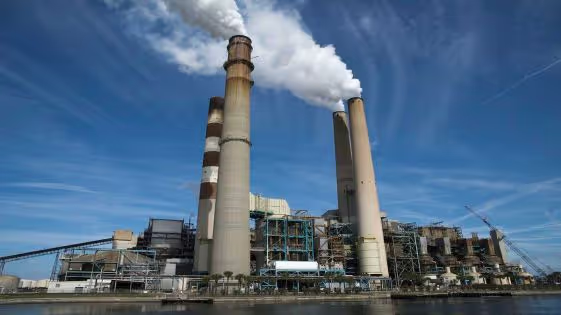
As India develops its carbon markets to mitigate climate change, it is important to consider the short-term costs for industry. Analysing data on formal manufacturing from 2009-10 to 2019-20, this article finds that energy and labour are complementary inputs in production – if an intervention such as a carbon tax raises the cost of energy and reduces its use in manufacturing, employment will go down as well.
क्षेत्रीय असमानताओं पर जलवायु परिवर्तन के आघात का प्रभाव
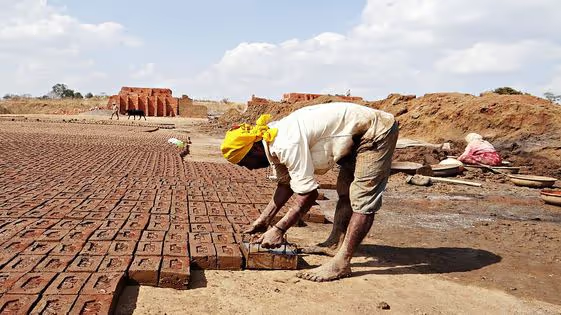
पिछले तीन दशकों में, तापमान में वृद्धि के कारण कृषि और औद्योगिक क्षेत्र के श्रमिकों को खपत में कमी का सामना करना पड़ा है, जबकि सेवा क्षेत्र में खपत की वृद्धि दर्ज हुई है। इस लेख में विभिन्न क्षेत्रों में जलवायु परिवर्तन के प्रभावों की व्यापकता पर चर्चा की गई है और तापमान परिवर्तनशीलता में बदलाव के कारण घरेलू उपभोग की असमानता में तेज़ वृद्धि की ओर विशेष रूप से ध्यान आकर्षित किया गया है। इसमें सामाजिक सुरक्षा योजनाओं के महत्त्व और नीतियों के अनुकूलन में सहायता के लिए, जलवायु परिवर्तन के आर्थिक प्रभावों के बारे में डेटा की आवश्यकता पर भी ज़ोर दिया गया है।
Effects of climate shocks on sectoral inequality
Over the last three decades, agricultural and industrial sector workers have suffered consumption losses due to temperature rise while those in the services sector saw consumption increases. This article discusses the broad range of impacts of climate change across sectors, and highlights the stark rise in inequality of household consumption due to increased temperature variability. It emphasises the need for social protection schemes, and data on the economic impacts of climate change to aid the design of adaptation policies.