
.svg)
.svg)
%201.svg)
%201.svg)
.svg)

.svg)
.svg)
Radhika Jain

Radhika Jain is an Assistant Professor of Health Economics at the Global Business School for Health, University College London, and an invited researcher at JPAL South Asia.
She was previously an Asia Health Policy Postdoctoral Research Fellow at Stanford University. She completed her doctorate in the Department of Global Health at Harvard University in May 2019. Her research focusses on the role of the private sector in the health system, frictions in healthcare markets, the extent to which public health policies serve the needs of target populations (women in particular), and health policy design in lower-income countries. Her doctoral dissertation examines the extent to which government subsidies for healthcare are captured by private hospitals, and whether accountability measures can help patients claim their entitlements in the context of a government-funded health insurance programme that aims to provide free care to 46 million people in Rajasthan, India.
Her research has been supported by grants from Harvard University, the Weiss Family Fund, and JPAL. She has held a doctoral fellowship at the Center for Global Development. Previously, she worked on impact evaluations of health programmes in India, and on the implementation of HIV programmes across several countries in sub-Saharan Africa.
.svg)

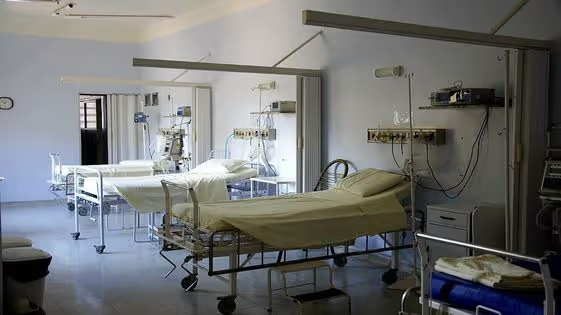
अस्पताल की जवाबदेही में सुधार हेतु मरीज़ों को जानकारी देकर सशक्त बनाना
समूचे भारत में गरीबों के लिए मुफ्त स्वास्थ्य सेवा में विस्तार होने के बावजूद, कई अस्पतालों ने मरीज़ों की जेब से फीस लेना जारी रखा है। डुपास और जैन ने अपने अध्ययन में, इस बात की जांच की है कि क्या मरीज़ों को उनके लाभों के बारे में सूचित करने से अस्पतालों को जवाबदेह बनाने में मदद मिलती है। वे राजस्थान की एक सरकारी योजना के तहत, बीमा के हकदार डायलिसिस मरीज़ों का सर्वेक्षण करते हैं और पाते हैं कि निजी एवं सार्वजनिक अस्पतालों में जानकारी संबंधी हस्तक्षेप के प्रभाव अलग-अलग तरीके से उजागर होते हैं और केवल सार्वजनिक अस्पतालों में परीक्षण और दवाओं की कम कीमतों के कारण मरीज़ों के जेब से भुगतान में कमी आती है।


Empowering patients with information to improve hospital accountability
Despite the expansion of free healthcare for the poor throughout India, many hospitals continue to charge patients out-of-pocket fees. In this study, Dupas and Jain investigate whether informing patients of their benefits helps hold hospitals accountable. They survey dialysis patients in Rajasthan entitled to insurance under a government scheme and find the impact of the information intervention manifests differently in private and public hospitals, with a decrease in out-of-pocket payments
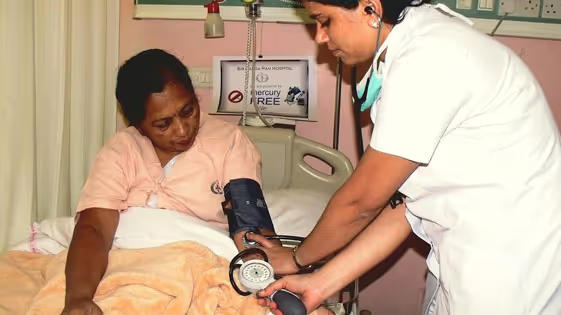
महिलाओं को पीछे छोड़ दिया: सरकारी स्वास्थ्य बीमा के उपयोग में लैंगिक असमानताएँ
भारत में स्वास्थ्य नीति का एक प्रमुख लक्ष्य स्वास्थ्य सेवा में समानता लाना है। राजस्थान के प्रशासनिक आंकड़ों का विश्लेषण करते हुए इस लेख में इस बात पर प्रकाश डाला गया है कि राज्य स्वास्थ्य बीमा कार्यक्रम के तहत सब्सिडी-प्राप्त अस्पताल देखभाल के उपयोग में बड़ी मात्रा में लैंगिक असमानता मौजूद है। कार्यक्रम का काफी विस्तार किए जाने के बावजूद ये असमानताएँ बनी हुई हैं, और ऐसा प्रतीत होता है कि ये असमानताएं परिवारों द्वारा स्वास्थ्य संसाधनों को पुरुषों की तुलना में महिलाओं को आवंटित करने की कम इच्छा के कारण हैं।
Women left behind: Gender disparities in utilisation of government health insurance
Equity in healthcare is a key goal of health policy in India. Analysing administrative data from Rajasthan, this article highlights substantial gender gaps in the utilisation of subsidised hospital care under the state health insurance programme. These disparities persist despite substantial programme expansion, and seem to be driven by households being less willing to allocate resources to female vis-à-vis male health.

बाधित महत्वपूर्ण देखभाल सुविधाएं: कोविड-19 लॉकडाउन और गैर-कोविड मृत्यु दर
कोविड के प्रसार को रोकने के लिए भारत में 10 हफ्तों तक चला राष्ट्रीय लॉकडाउन दुनिया के सबसे कड़े लॉकडाउनों में से एक था। यह लेख उन रोगियों के स्वास्थ्य की देखभाल तक पहुँच और स्वास्थ्य परिणामों पर लॉकडाउन प्रतिबंधों के प्रभावों की पड़ताल करता है जिन्हें दीर्घकालिक जीवन-रक्षक-देखभाल की आवश्यकता होती है। इसमें दर्शाया गया है कि इस दौरान स्वास्थ्य सेवाओं तक पहुंच बुरी तरह बाधित हो गई थी। मार्च और मई 2020 के बीच मृत्यु दर में 64% की वृद्धि हुई, और लॉकडाउन लागू होने के बाद के चार महीनों में अतिरिक्त मृत्यु दर कुल 25% थी।